AI Adoption in SME Manufacturing: Gaps and Next Steps

|
One-Minute Summary 💡 |
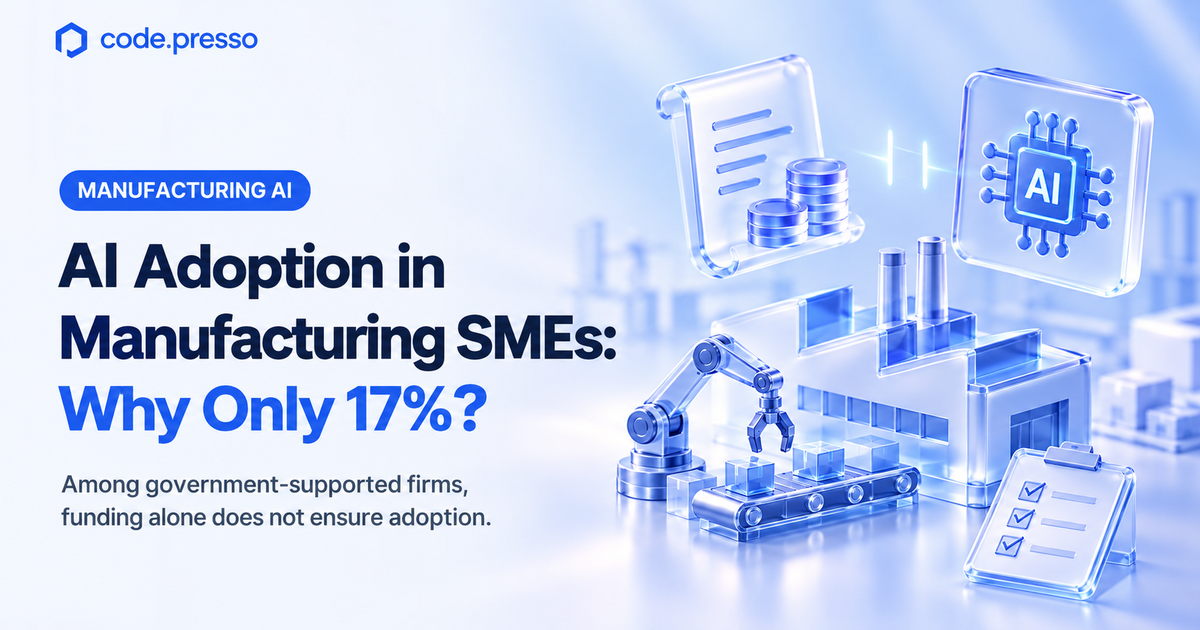
Among 3,015 companies participating in South Korea’s government initiative to accelerate AI transformation among small and midsize manufacturers, AI adoption was confirmed at 517 companies — 17.1% of the total.
3,015 participating companies
517 confirmed AI adopters
17.1% confirmed adoption
All 517 participated in three programs that required AI implementation. The remaining 2,498 companies participated in four programs that did not investigate whether AI had been adopted.
Important distinction
The 17.1% figure represents confirmed adoption,
not the actual AI adoption rate across all participating companies.
Introducing technology and preparing an organization to use it effectively are separate challenges.
AX Grow addresses this gap by assessing
organizational AI readiness before designing training and
practical exercises, helping organizations align AI
adoption with their actual capabilities and workflows.
|
South Korea’s Ministry of SMEs and Startups has been supporting AI transformation, or AX, among small and midsize manufacturers. Yet the available records confirmed AI adoption at only about 17% of supported companies.
The finding came from an analysis of ministry data obtained on October 4, 2026, by Democratic Party lawmaker Kwon Hyang-yeop, who represents the Suncheon, Gwangyang, Gokseong, Gurye B constituency.
From 2025 through August 2026, 3,015 companies received support through the initiative. AI adoption was confirmed at 517 companies, or 17.1%.
A more significant issue lies behind that figure. Of the seven related programs, three required AI implementation. The other four did not track whether participating companies had adopted AI at all.
Read this article alongside our guide to corporate AI training case studies by job function to explore the distinction between confirming technology adoption and developing employees’ ability to use it.
Why Was AI Adoption Confirmed at Only 17% of Supported Manufacturers?
The confirmed adoption rate reflects a gap in measurement. Only three of the seven programs required AI implementation, while the other four did not investigate adoption among participating companies.
Support was provided, but follow-up measurement was incomplete.
| Period | Companies Supported | Companies with Confirmed AI Adoption | Confirmed Adoption Rate |
|---|---|---|---|
| 2025 | 1,640 | 129 | 7.9% |
| January–August 2026 | 1,375 | 388 | 28.2% |
| Total | 3,015 | 517 | 17.1% |
All 517 confirmed adopters participated in three programs that required AI implementation: the Manufacturing AI Specialization program, the Collaborative AI Track, and the Autonomous Factory program.
The remaining 2,498 companies participated in four programs covering advanced smart factories, large-enterprise and SME smart factory collaboration, robotics-based manufacturing innovation, and process automation for manufacturing businesses.
Because AI adoption was not investigated in these four programs, the actual number of adopters could be higher.
Kwon criticized the ministry’s incomplete understanding of adoption among supported companies and called for progress in digital transformation (DX) and AI transformation (AX) to be reviewed at each stage of support.
The distinction matters: increasing participation in a program does not, by itself, establish whether the program changed how an organization works.
What Prevents SMEs from Turning AI Investment into Everyday Use?
Organizational conditions play an important role in whether employees use AI effectively.
Analysis by the Korea Chamber of Commerce and Industry’s economic research institute suggests that the AI usage gap between large enterprises and SMEs is closely associated with access to training, usage guidelines, and tools tailored to employees’ work.
The generative AI usage gap between employees at large enterprises and SMEs was 13.8 percentage points: 66.5% versus 52.7%.
Among organizations providing all three forms of support, training, guidelines, and tailored tools, the gap narrowed to 4 percentage points.
Access to that support also differed:
- Training: 34.7% of large-enterprise employees reported receiving it, compared with 24.9% of SME employees.
- Usage guidelines: 33.8% of large-enterprise employees reported receiving them, compared with 24.3% of SME employees.
These findings highlight the importance of preparing people alongside investing in technology. When support concentrates on tools and equipment, the processes for developing and assessing employee capability can receive less attention.
The manufacturing program data should also be interpreted carefully. The 17.1% figure is the share of participating companies whose AI adoption was confirmed in the available records. It does not establish the overall rate of adoption or workplace use. The 2,498 companies that were not assessed cannot all be classified as non-adopters.
The central problem is the absence of consistent criteria and follow-up data for understanding actual use.
Organizations can avoid a similar gap by comparing conditions before and after an initiative using the same measures. Alongside installation records, track:
- How frequently employees use AI in their work.
- How long recurring tasks take to complete.
- The practical outputs employees produce.
- Errors identified during review and approval.
Documenting both the starting point and subsequent results helps distinguish technology deployment from improvements in how work gets done.
How Do the Government Programs and AX Grow Assess AI Transformation Differently?
In the government programs discussed here, adoption was checked retrospectively in only some programs, particularly those requiring AI implementation.
AX Grow begins with an organization-level AX assessment before training is designed. This establishes a baseline and identifies where progress is being held back.
| Dimension | Government Programs Discussed Here | AX Grow |
|---|---|---|
| Assessment timing | Follow-up checks after support, conducted in only some programs | Baseline AX assessment before training design |
| What is measured | Whether AI has been adopted | The organization’s stage of AI transformation and barriers to progress |
| Shared criteria | Criteria vary by program; some have no adoption assessment | A consistent AX assessment applied across participating organizations |
| Outputs | Adoption statistics | AI competency assessment reports, builderthon projects, and an adoption roadmap |
AX Grow is operated by AXMOS, a manufacturing AI innovation consortium. Codepresso, an AI competency assessment and training specialist, participates in designing and delivering the AX assessment, practical training, and builderthon.
The program helps companies with internal IT teams build AI agents and automation tools around their own workflows. It runs for approximately three to four weeks, including onboarding, with around 16 business days of training and builderthon activities.
At an agreement-signing event with the Busan IT Industry Promotion Agency to expand AX adoption, Codepresso CEO Donghoon Lee described AI transformation as reorganizing how an organization works around AI, with individual employee capability as the starting point.
Codepresso’s approach begins by identifying where the organization is struggling. Training and practical exercises are then designed around those needs.
Where Should SMEs Begin with AI Transformation?
Start by identifying recurring tasks, assessing current readiness, and testing a focused use case.
Choosing equipment or a solution based primarily on an available funding opportunity can leave employee readiness unresolved. Assessing people and workflows early helps organizations plan how the investment will translate into practical use.
1. Identify Recurring Work
Shortlist tasks that occur frequently and have usable data.
Examples include preparing reports, responding to business partner inquiries, and checking inventory or demand.
2. Review the Support Program’s Requirements
Determine whether the program requires AI implementation and follow-up verification, or primarily supports equipment deployment.
Understanding these requirements helps clarify what the program will measure, and what your organization will need to measure itself.
3. Establish a Baseline with an AX Assessment
Identify the organization’s current capabilities and the barriers it faces before designing the training curriculum. This gives learning and implementation activities a clear starting point.
4. Test a Focused Use Case, Then Reassess
Begin with one department and one workflow. Review the results, reassess using the same criteria, and use that evidence to guide broader adoption.
Consistent criteria are essential to this final step.
AI Fluent provides a shared competency framework for comparing performance before and after training. It evaluates prompt histories, intermediate outputs, and final deliverables together.
Evidence of what improved, and how much, provides a stronger basis for the next funding application or budget decision.

Frequently Asked Questions
Why Was AI Adoption Confirmed at Only 17% of Supported SME Manufacturers?
AI adoption was confirmed in the three programs that required implementation. The other four programs did not investigate whether participating companies had adopted AI.
Of the 3,015 supported companies, 517 had confirmed adoption, representing 17.1% of the total.
The actual adoption rate remains uncertain because the remaining companies were not assessed.
Where Should an SME Start with AI Transformation?
Identify recurring workflows, review how any relevant support program verifies adoption, and assess your organization’s current capabilities.
Then test a focused use case and reassess using consistent criteria before expanding to other teams.
How Can We Find the Right AX Assessment and Training for Our Company?
Contact sales@codepresso.kr to discuss AX assessment, role-specific AI training, and pre- and post-training evaluation with AI Fluent.
Share your current working environment and the tasks you want to improve. Codepresso can help you design an assessment and training plan around those priorities.
Does the 17.1% Figure Mean the Remaining Companies Had Not Adopted AI?
No. AI adoption was not investigated at 2,498 companies, so they cannot be classified as non-adopters.
The 17.1% figure represents the share of all participating companies whose adoption was confirmed in the available records.
References
- Energy News: “AI Adoption at Just 17% Among Companies Supported by the Ministry’s SME Manufacturing AI Transformation Initiative” — October 4, 2026
- Global Economic: “KCCI: Organizational Support Narrows the AI Usage Gap Between Large Enterprises and SMEs from 13.8 to 4 Percentage Points” — June 10, 2026
- Codepresso: “AX Grow: Identify Skill Gaps Through Assessment and Help Your Team Close Them”
- Codepresso: “How Far Can Public Sector AI Training Go? BIPA’s AX Grow Case Study”
- Ministry of SMEs and Startups: “AI-Based Smart Manufacturing Innovation 3.0 Strategy Announced” — October 24, 2025
- Korea Chamber of Commerce and Industry Economic Research Institute: “The Generative AI Usage Gap Between Large Enterprises and SMEs: The Role of Capability and Organizational Conditions” — June 11, 2026