AI Skills Assessment _ AI Fluent: 7 Core AI Skills Assessment Track

You have probably seen it happen: two people on the same team use the same AI tool, yet the quality of their outputs is dramatically different.
One person writes a few prompts and produces a project proposal that is almost ready to use. Another spends days working with the same AI tool and still ends up with an output that requires significant revision.
Yet on their résumés, both may describe themselves in exactly the same way: “Proficient in using AI.”
The problem is that there has been no reliable way to prove the difference between them.
Course completion certificates, satisfaction surveys, and informal feedback such as “this person is good at AI” do not necessarily demonstrate actual AI competency. AI Fluent is an AI competency assessment service designed to answer this question with data.
| Summary 💡 | AI Fluent focuses on both the process and the outcomes of working with AI. Assessment covers the full range of artifacts created during AI-assisted problem-solving, including prompt history, product requirement documents (PRDs), skill configurations, source code, and final outputs. Assessment tasks vary by job function, including Marketing, HR, Business Management, Customer Service, and R&D, but the underlying competency model is standardized across the organization. This makes it possible to compare AI capabilities across different roles using a common framework. |
What Does Codepresso AI Fluent Do?
AI Fluent assesses how effectively employees use AI and translates the results into data that helps organizations understand their current level of AI transformation (AX).
Two ideas are central to the service: multidimensional assessment and objectivity.
For individuals, AI Fluent provides a way to understand AI competency through measurable results rather than intuition.
For organizations, it provides quantitative evidence to answer a much more important question: How effectively is our organization actually using AI?
Instead of relying on training satisfaction surveys alone, companies can use competency data to evaluate whether their investment in AI education has translated into real workplace capability. These insights can also inform the organization’s next AI transformation strategy.
A Better Way to Measure Real-World AI Skills
A course completion rate proves that someone completed the training. It does not prove that they can apply what they learned.
A satisfaction survey measures how participants felt about the learning experience. It does not show whether they can collaborate effectively with AI to solve real business problems and produce usable results.
The same applies to job descriptions and résumés that simply state that someone is “proficient in AI.”
This article explains how AI Fluent addresses that gap. We will look at its assessment methodology, the relationship between role-specific tasks and a shared competency model, its seven assessment tracks, its four proficiency levels, and how organizations can use the results to support AI transformation.
What Exactly Does AI Fluent Assess?
This is one of the fastest ways to understand how AI Fluent works.
AI Fluent assesses three areas:
| Assessment Area | What Is Evaluated |
|---|---|
| Prompt history | The instructions, requests, and conversations entered by the participant when working with AI |
| Intermediate outputs | PRDs, skill configurations, source code, and other artifacts created through collaboration with AI |
| Final output | The completed deliverable itself |
Even when two participants produce similar final outputs, they may receive different scores depending on how they instructed the AI, validated its responses, identified problems, and refined the work throughout the process.
In other words, AI Fluent does not simply ask whether someone reached the correct answer. It evaluates how effectively that person worked with AI to get there.
The assessment methodology has 4 key characteristics.
1. Assessment Is Based on Real-World Work Scenarios
AI Fluent does not rely on abstract quizzes alone.
Assessment tasks are based on situations and data that professionals are likely to encounter in actual work. The entire problem-solving process, from defining the problem to planning and implementing a solution, becomes part of the evaluation.
2. The Entire AI Collaboration Process Is Evaluated
AI Fluent looks at multiple dimensions of the work process.
Prompt history, intermediate outputs, and the final deliverable are assessed together rather than treating the final answer as the only indicator of competency.
3. Assessment Tasks Differ by Job Function
Marketing, HR, Business Management, Customer Service, and R&D teams operate in very different business contexts.
AI Fluent therefore provides assessment tasks tailored to the actual work requirements of each function.
4. Results Can Still Be Compared Across the Organization
Although the tasks vary by role, the assessment criteria and competency model are standardized across the organization.
This allows companies to evaluate employees from different functions using the same overall framework and compare AI competency across teams.
What Are the 7 AI Fluent Assessment Tracks?
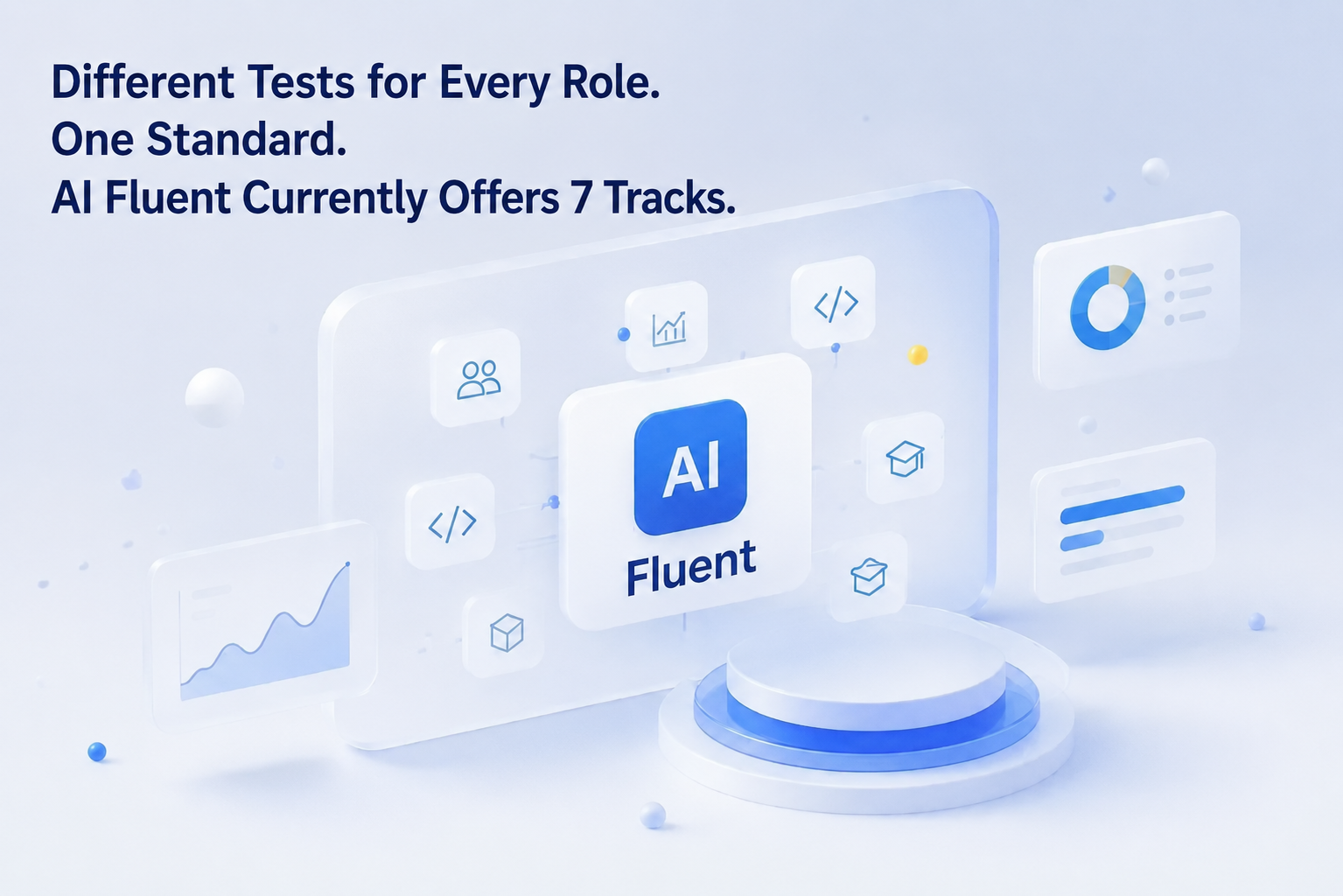
AI Fluent currently offers 7 assessment tracks.
They include:
- 2 core tracks for all job functions
- 1 track specifically for non-developers
- 4 tracks specifically for software developers
The two core tracks are available across job functions, with role distinctions reflected by proficiency level. The remaining five tracks are divided between non-development and software development roles.
Assessment Tracks
Currently available tracks · Organized by target role
All Roles 2
Workflow Optimization with AI Vibe Coding
The ability to collaborate with AI to build software by defining clear roles and instructions, executing and validating outputs, and refining them through iteration
Workflow Optimization with AI Agents
The ability to design, develop, and operate AI agent systems—from defining problems and designing architectures to configuring tools and skills
Non-Developer Roles 1
Prompt Engineering
The ability to precisely guide AI responses for specific business objectives without coding
Software Development Roles 4
Prompt Engineering for Developers
The ability to guide AI responses predictably in real-world software development workflows
LangChain
The ability to build production-ready LLM applications, including chatbots, RAG systems, workflow automation, AI agents, and LLM evaluation
LangGraph
The ability to design stateful, multi-step workflows, tool-integrated agents, and human-in-the-loop systems
Hugging Face
The ability to build and improve NLP models—from creating NLP pipelines and using pretrained models to fine-tuning
New assessment tracks are continuously being added. Contact us to discuss the right track configuration for your organization.
Ask About Track ConfigurationHow Does the AI Fluent Level System Work?
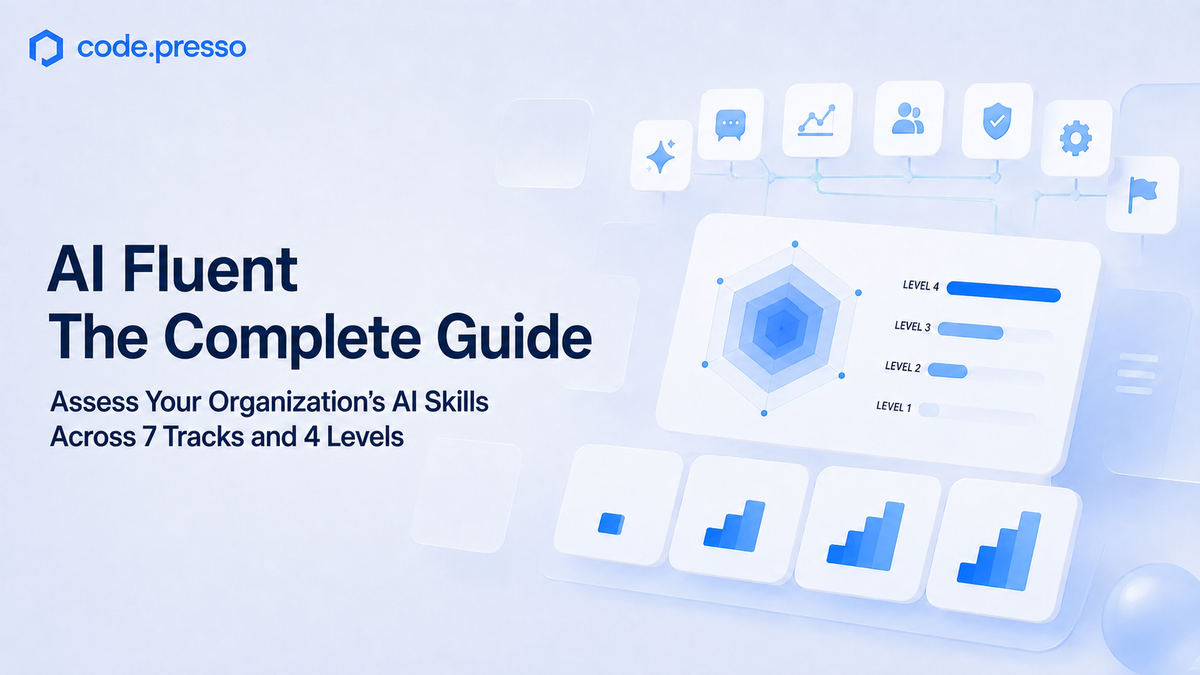
AI Fluent defines AI competency across four levels:
Entry, Beginner, Intermediate, and Professional.
The framework is designed to show the progression between simply knowing how to use AI and being capable of establishing AI standards across an organization.
AI FLUENT
Proficiency Levels
Entry · Beginner · Intermediate · Professional
Proficiency Levels
Four levels: Entry · Beginner · Intermediate · Professional
| Level | Workflow Optimization with AI Vibe Coding | Workflow Optimization with AI Agents |
|---|---|---|
| Entry | Generate individual code snippets and use basic AI interactions to identify and correct errors | Use AI safely as an assistive tool to complete simple, repetitive tasks |
| Beginner | Build a single-purpose work environment and independently complete small-scale features and automations | Build a simple, single-purpose agent to automate small-scale tasks within a team |
| Intermediate | Design complex workflows, optimize context and token usage, and implement production-ready service logic | Design multi-step workflows, integrate external APIs, and lead cost and performance optimization |
| Professional | Establish organizational standards and governance for AI use, design architecture and security, and lead organization-wide capability development | Design organization-wide agent standards and governance, and oversee operational stability, security, and production deployment |
The Entry level does not simply mean “someone who has just started using AI.” It is closer to someone who has begun using AI safely and effectively in practical work.
Likewise, Professional is not defined by an individual’s ability to use AI exceptionally well. It represents the capability to establish standards, governance, architecture, and practices that can be applied across an organization.
Most teams fall somewhere between these two points.
- Turn AI Competency Insights into Workforce Action
AI Fluent assessment data can support several aspects of enterprise AI transformation.
- Objectively and quantitatively measure AI competency. Organizations can move beyond intuition, reputation, and self-reported AI proficiency.
- Evaluate the ROI of AI training. By comparing competency levels before and after training, companies can determine whether AI education has translated into measurable skills.
- Generate insights for AI transformation strategy. Assessment data helps identify where AI capabilities are strong and where competency gaps remain across the organization.
- Build a continuous capability development cycle. Assessment, training, and personalized learning can be connected as part of an ongoing AI workforce development process.
- Build Targeted AI Training from Assessment Results
AI Fluent is not intended to end with a single assessment.
Instead, assessment results can help determine what employees should learn next. After completing targeted training, organizations can reassess participants to measure how much their competencies have improved.
This creates a continuous cycle connecting: Assessment → Training → Personalized Learning → Reassessment
Rather than providing a one-time snapshot, the model enables organizations to measure AI skills periodically and track how capabilities change over time.
For example, organizations can reassess employees each quarter to monitor progress and identify new development priorities.
Who Benefits Most from AI Skills Assessment?
AI Fluent may be particularly relevant for organizations in the following situations:
- Organizations with employees who want to automate repetitive tasks or build simple functions using AI
- Organizations with planners, operators, and other non-developers who need to create business outputs by collaborating with AI without traditional coding experience
- Software development teams that need to design AI agent architectures or build LLM-based systems
- Organizations planning to build internal document-based RAG systems or AI-powered workflow automation chatbots
- Organizations seeking to reduce dependence on external APIs and establish their own NLP model operations
- Organizations that have already invested in AI education but do not yet have a reliable way to demonstrate whether that training has led to measurable improvements in employee capability
Frequently Asked Questions (FAQ)
Is AI Fluent only for developers?
No.
The AI Vibe Coding and AI Agent tracks are available across job functions, while the Prompt Engineering track is specifically designed for non-developer roles.
The LangChain, LangGraph, and Hugging Face tracks are designed for software development roles.
If assessment tasks differ by job function, can results still be compared?
Yes.
Assessment tasks are customized to reflect the work context of each role, but the underlying competency model and assessment criteria are standardized across the organization .
This makes it possible to compare AI competency using a common framework, even across different job functions.
Are assessment results only available to individuals, or can organizations use them as well?
AI Fluent is designed for both purposes.
Individuals can use the results to understand their own AI competency, while organizations can use aggregated assessment data to generate insights into their overall AI transformation (AX) capabilities.
How are AI Fluent proficiency levels defined?
AI Fluent uses four proficiency levels:
Entry, Beginner, Intermediate, and Professional.
Each level is defined according to what a participant can practically accomplish in the workplace within a specific assessment track.