Assessing Employee AI Skills: Why the Verification Process Matters

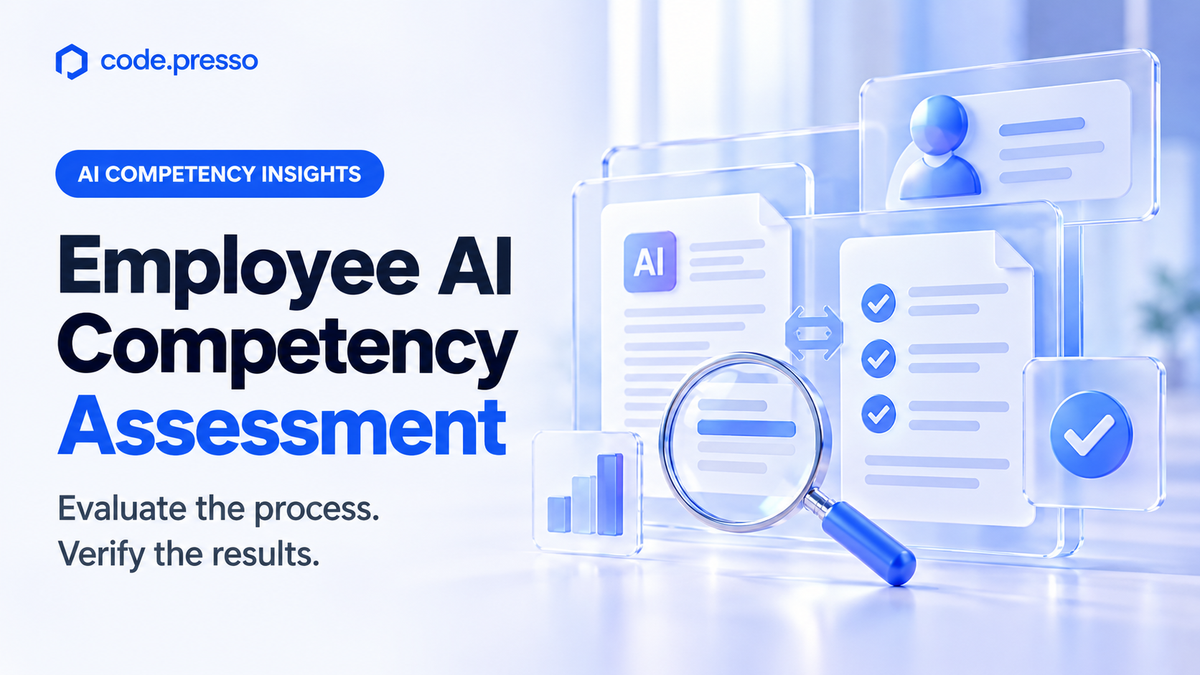
Drawing on OpenAI and Ironclad’s research on workplace task evaluation, Codepresso explores the process evidence and shared criteria organizations should review before incorporating AI proficiency into employee performance evaluations.
|
One-Minute Summary 💡 |
|
When incorporating AI skills into employee performance evaluations, start by defining what you are assessing. Using AI to rate employees and evaluating how effectively employees work with AI are two different activities. This article focuses on the latter.
At Codepresso, we believe the starting point should be clear: How did the employee decide what to delegate to AI, and how did they verify the results?
OpenAI’s research collaboration with Ironclad, published on October 6, 2026, offers a useful perspective. Instead of treating a task marked “complete” as proof of success, the researchers checked whether it met specific operational requirements.
The relevant lesson is how to define successful work in concrete, observable terms.
What Did the OpenAI - Ironclad Research Evaluate?
The research evaluated how well AI agents, AI systems that carry out sequences of actions, met the requirements of contract-related work. Ironclad employees and internal OpenAI users selected 11 tasks across legal, sales, and procurement functions, with 8–50 evaluation criteria for each task.
One example in the announcement involved configuring a software procurement workflow. Requests above a specified amount needed finance approval, relevant requests had to undergo security review, and nonstandard contract terms required legal review.
Creating the approval rules was only part of the task. The agent also needed to verify that requests above and below the threshold followed the correct approval paths.
| Research Finding | Consideration for Employee Assessment |
|---|---|
| The study covered 11 specialized workplace tasks. | Do not interpret them as a representative sample of all employee competencies. |
| Each task was scored against 8–50 criteria. | Do not assume employee assessments need the same number of criteria. |
| Approval rules were tested across multiple scenarios. | Define both standard scenarios and exceptions relevant to your own workflows. |
In the announcement, Ironclad Chief Technology Officer Sunita Verma explained that agents need to understand the full contracting lifecycle, including the connections between business workflows and the controls teams depend on.
The implication is straightforward: a completed contract document does not necessarily mean the work is finished. Required approvals and exception handling must also be in place.
The study’s average scores and task completion times also need to be understood within its research conditions. The reported times were simulated estimates based on assumptions such as model processing speed, rather than measured time savings at customer organizations.
The research does not establish that employee performance improved or that an employee evaluation method is valid.
How Can You Measure Employees’ AI Skills?
Employee AI proficiency can be assessed by reviewing three elements together: prompt histories, the revision process, and final deliverables.
Codepresso recommends starting with a practical shift in assessment design: move beyond asking “How often did the employee use AI?” to examine “What did they check, and what did they correct?”
Consider a marketing team preparing a campaign performance report. AI can summarize advertising results and suggest ideas for the next campaign. The employee still needs to check whether:
- The reporting periods are consistent.
- Canceled orders have been included.
- Advertising spend and revenue use comparable definitions and reporting bases.
- Every figure is supported by the source data.
If AI introduces a number that does not appear in the source material, the employee should consult the original data and correct it. If an item cannot be verified, the report should clearly state that limitation.
A final report alone rarely shows who identified an error or why a correction was made. An assessment can therefore ask employees to submit the original materials, their prompts, versions before and after revision, and explanations for their changes.
Assessment materials should stay within the organization’s approved data-use boundaries. Tasks should also be designed to avoid collecting actual customer information or sensitive HR data unnecessarily.
The table below compares assessment approaches, rather than ranking competing products. Usage records can help show whether a tool is being adopted, while final deliverables reveal the quality of the output. HR and learning teams need a broader evidence base when they also want to understand the skills demonstrated during the work.
| Assessment Approach | Evidence Reviewed | What It Assesses |
|---|---|---|
| Usage-based tracking | Tool access, prompt counts, and other activity records | Whether employees use the tool. Their verification process requires separate review. |
| Final deliverable review | Completed reports, proposals, and other outputs | The accuracy and quality of finished work. Reasons for revisions require additional evidence. |
| Codepresso AI Fluent | Role-specific tasks, prompt histories, and intermediate and final deliverables | Both process and results, using a shared scoring framework across the organization. |
Codepresso AI Fluent is an AI competency assessment service that evaluates how people work with AI and what they produce. It scores prompt histories, the instructions employees enter into AI tools, alongside intermediate outputs and final deliverables.
Its value lies in making verification and revision part of the assessment evidence, while applying shared criteria across job functions.
According to product information available on October 7, 2026, AI Fluent offers seven assessment tracks and four proficiency levels. Its AI agent, based workflow efficiency track applies across job functions.
For guidance on selecting an assessment that fits your organization, explore how to evaluate and choose an AI competency assessment tool.
How Can You Compare AI Skills Fairly Across Different Roles?
Use tasks that reflect each role, while aligning the scoring criteria for the competencies those tasks share.
Organizations should also account for differences in tool access, training opportunities, and data-use restrictions. These conditions affect how assessment results should be interpreted.
For example, a marketing employee might prepare a campaign report, while an HR employee analyzes training needs. Comparing the length of their deliverables would reveal little about their AI proficiency.
More useful shared criteria include whether each employee:
- Checked the definitions and reporting basis of the source data.
- Identified and removed unsupported content.
- Explained the reasons for revisions.
Where a task requires specialized professional knowledge, the relevant department should define the expected results.
AI Fluent uses a shared organization-wide scoring framework even when assessment tasks differ by role. However, a common framework alone does not guarantee fairness in every HR decision.
HR teams still need to review conditions that may influence performance, including permitted tools, task difficulty, and previous training experience.
A score difference should not immediately be treated as a difference in motivation or potential. First, examine the tasks and conditions behind the difference, and give employees an opportunity to explain how they approached the work.
For a closer look at the competencies involved, see AI literacy skills to assess beyond prompting.
How Should AI Competency Inform Employee Performance Reviews?
Start with a pilot focused on learning and development. Then decide whether to connect the assessment to formal HR processes, once people can review the criteria and supporting evidence.
Codepresso’s recommended approach does not involve automatically converting assessment scores into promotion or compensation ratings.
| Stage | Decisions to Make | Evidence to Retain |
|---|---|---|
| 1. Define the purpose | Clarify whether the assessment will support training plans or inform a review of HR practices. | Purpose, participant groups, and permitted uses of the results. |
| 2. Explain the conditions | Communicate the tasks, scoring criteria, permitted tools, and acceptable assistance. | Assessment instructions and scoring rubric. |
| 3. Run a pilot assessment | Have employees complete role-specific tasks and arrange human review of the results. | Prompt and revision histories, deliverables, and reviewer comments. |
| 4. Reassess after training | Address identified skill gaps and reassess under comparable conditions. | Training content and changes in competency before and after training. |
During the pilot, check whether different evaluators reach similar judgments when reviewing the same evidence.
For example, evaluators should agree on what qualifies as “verified the output.” Does the employee need to compare it with the original source? Must they also explain why they made a correction?
Without that agreement, differences in employee competency can become mixed with differences in evaluator interpretation.
Employees should know in advance what they must submit and who will be able to access it. Defining the records needed for a specific assessment task makes the purpose clearer than collecting every conversation from day-to-day work.
Any subsequent use of results in compensation or promotion decisions should be considered separately through the organization’s HR procedures and relevant legal review.
Connect Assessment Results to Targeted Training
Learning teams can turn assessment findings into practical training priorities.
If employees struggle to verify errors, for example, training can include exercises in checking outputs against source materials and documenting the reasons for corrections. A follow-up assessment using tasks of comparable difficulty can then help determine whether those skills have improved.
This approach also connects with the examples discussed in AI training that links practical tasks with reassessment.
At Codepresso, we believe training effectiveness should be measured separately from course completion.
AI Fluent’s assessment → training → reassessment approach helps organizations compare competency before and after training. Business performance should be evaluated through separate operational metrics.
An increase in competency scores alone should not be presented as proof of revenue growth or return on investment.
Frequently Asked Questions (FQAs)
How Can We Include AI Competency in Employee Performance Reviews?
First, distinguish assessments for learning and development from evaluations used for compensation and promotion.
Communicate the role-specific tasks, shared scoring criteria, and tool-use conditions. Run a pilot, then have people review both the results and the supporting evidence.
We do not recommend automatically assigning employee performance ratings based solely on AI competency assessment scores.
How Can We Compare AI Skills Fairly Across Different Roles?
Use tasks that reflect each role while applying consistent criteria to shared competencies, such as problem definition, source verification, and error correction.
AI Fluent combines role-specific tasks with a shared organization-wide scoring framework.
Before incorporating results into HR processes, also review differences in tool access, training opportunities, and workplace constraints.
Who Evaluates an AI Competency Assessment?
AI-based assessments used in recruitment and assessments of employees’ ability to work with AI have different purposes and methods.
AI Fluent is an AI competency assessment service that scores prompt histories, intermediate outputs, and final deliverables.
For the HR use discussed in this article, the responsible team should review the assessment evidence and give employees an opportunity to explain their work process.
Who Can We Contact About AI Competency Assessment and Training Effectiveness?
Contact Codepresso at sales@codepresso.kr .
Tell us which job functions you want to assess, which AI tools your employees currently use, and what you want the assessment to achieve.
We can discuss how to connect a pre-training assessment with post-training reassessment to measure changes in competency.

References
- OpenAI, “Advancing computer use with Ironclad”. Published October 6, 2026; accessed October 7, 2026. Referenced for the 11 research tasks, the 8–50 criteria per task, the scope of the research, the limitations of simulated task times, and Sunita Verma’s comments on contracting workflows and operational controls.
- Codepresso, “Why Results Differ Even with the Same AI: The Seven Tracks AI Fluent Assesses”. Public product information reviewed October 7, 2026. Referenced for assessment evidence, role-specific tasks, shared scoring criteria, and the connection between assessment and training.
Written by: Codepresso GGP Division