Codepresso × Ewha Womans University AI Agent Academy

Why 34 Future Teachers Started by Building an AI Teaching Assistant
Codepresso joined 34 pre-service teachers at Ewha Womans University’s College of Education for the first day of its AI Agent Academy. Here is how participants built AI teaching assistants using their own teaching materials and rules, and how the program will evaluate learning outcomes.
|
One-Minute Summary 💡 |
On October 2, 2026, Codepresso delivered the first session of the AI Agent Academy for Pre-Service Teachers to 34 participants from Ewha Womans University’s College of Education.
34 participants
15 in person
19 via Zoom
The first session focused on building an AI teaching assistant equipped with teaching materials and rules. Participants moved beyond asking AI individual questions to delegating tasks to an assistant configured around their own classroom resources and teaching principles.
The academy is the first program launched under the MOU
signed with Ewha’s College of Education on September 7.
Its effectiveness will be evaluated through changes in AI competency before and after training , rather than course completion alone. |
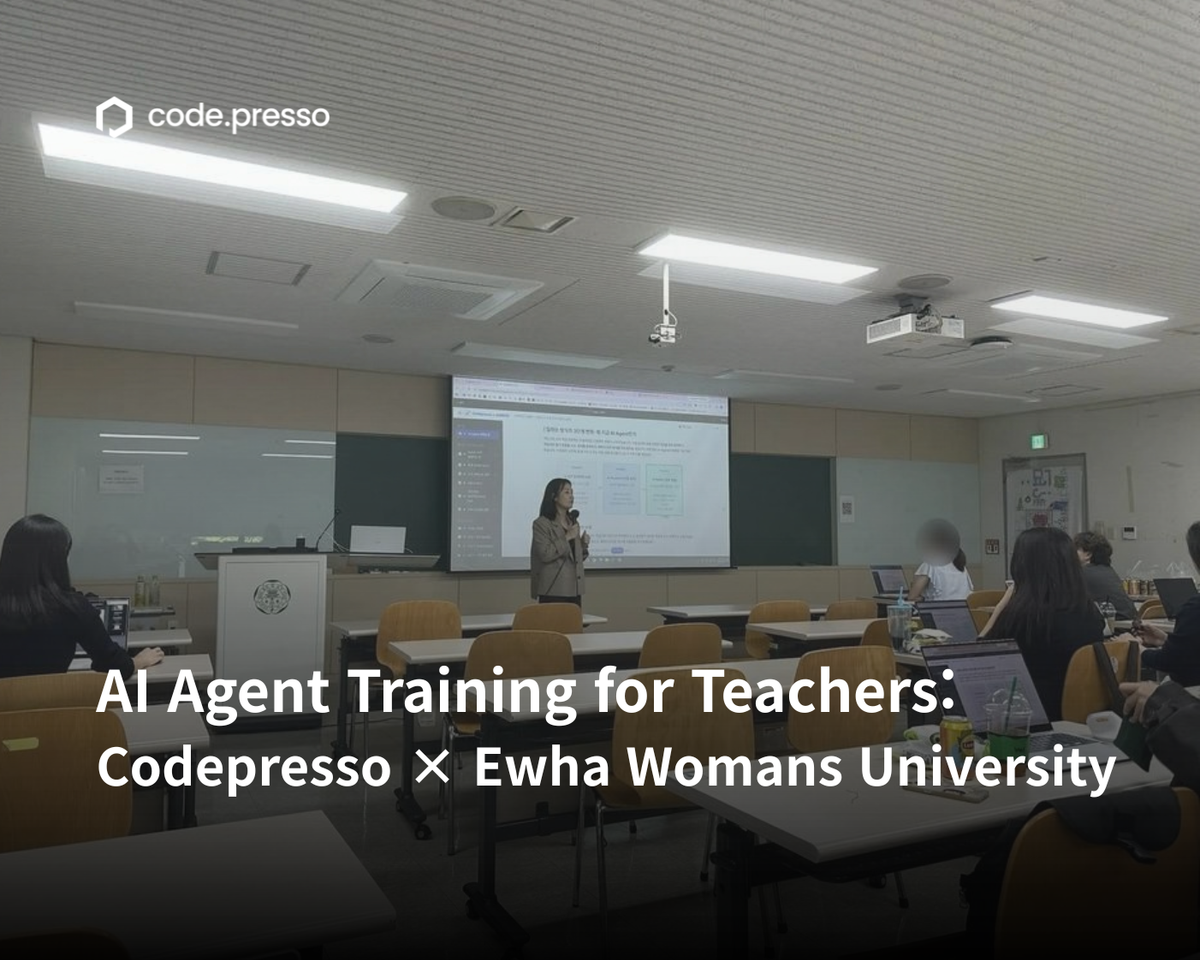
At 3:30 p.m. on October 2, pre-service teachers gathered with their laptops in Room 253 of Education Building B at Ewha Womans University. Including those joining via Zoom, 34 participants took part. Over the next four hours, they built AI teaching assistants equipped with their own teaching materials and rules.
The AI Agent Academy for Pre-Service Teachers is a hands-on program offered by Ewha Womans University’s College of Education as part of its 2026 Teacher Education Curriculum Development Project. Codepresso, an AI competency assessment and training company led by CEO Donghoon Lee, delivers the instruction.
Across two days and eight hours, the program develops foundational AI skills for school settings, covering lesson design, student counseling, teaching practicums, and learning support.
What Is the AI Agent Academy for Pre-Service Teachers at Ewha?
The academy is a two-day, hands-on AI agent program for pre-service teachers enrolled in Ewha’s College of Education.
The first session took place on Friday, October 2, from 3:30 to 7:30 p.m. The second is scheduled for Thursday, October 8, from 5:00 to 9:00 p.m. Codepresso Director Hyunjin Hwang and Principal Researcher Sera Shin lead the sessions, with the in-person classes streamed live via Zoom.
| Session | Date and Time (KST) | Location | Topic |
|---|---|---|---|
| Day 1 | Friday, October 2, 2026, 3:30–7:30 p.m. | Education Building B, Room 253 + Zoom | Building an AI teaching assistant with teaching materials and rules |
| Day 2 | Thursday, October 8, 2026, 5:00–9:00 p.m. | Education Building A, Room 313 + Zoom | Creating classroom resources by connecting AI to the web and external tools |
The curriculum follows three stages. Participants first explore “What Is an AI Agent?”, then build their own in “Getting Started with AI Agent Development,” and finally apply what they have learned in “Teaching with AI Agents.”
Thirty-four pre-service teachers attended the first session, with 15 in the classroom and 19 online.
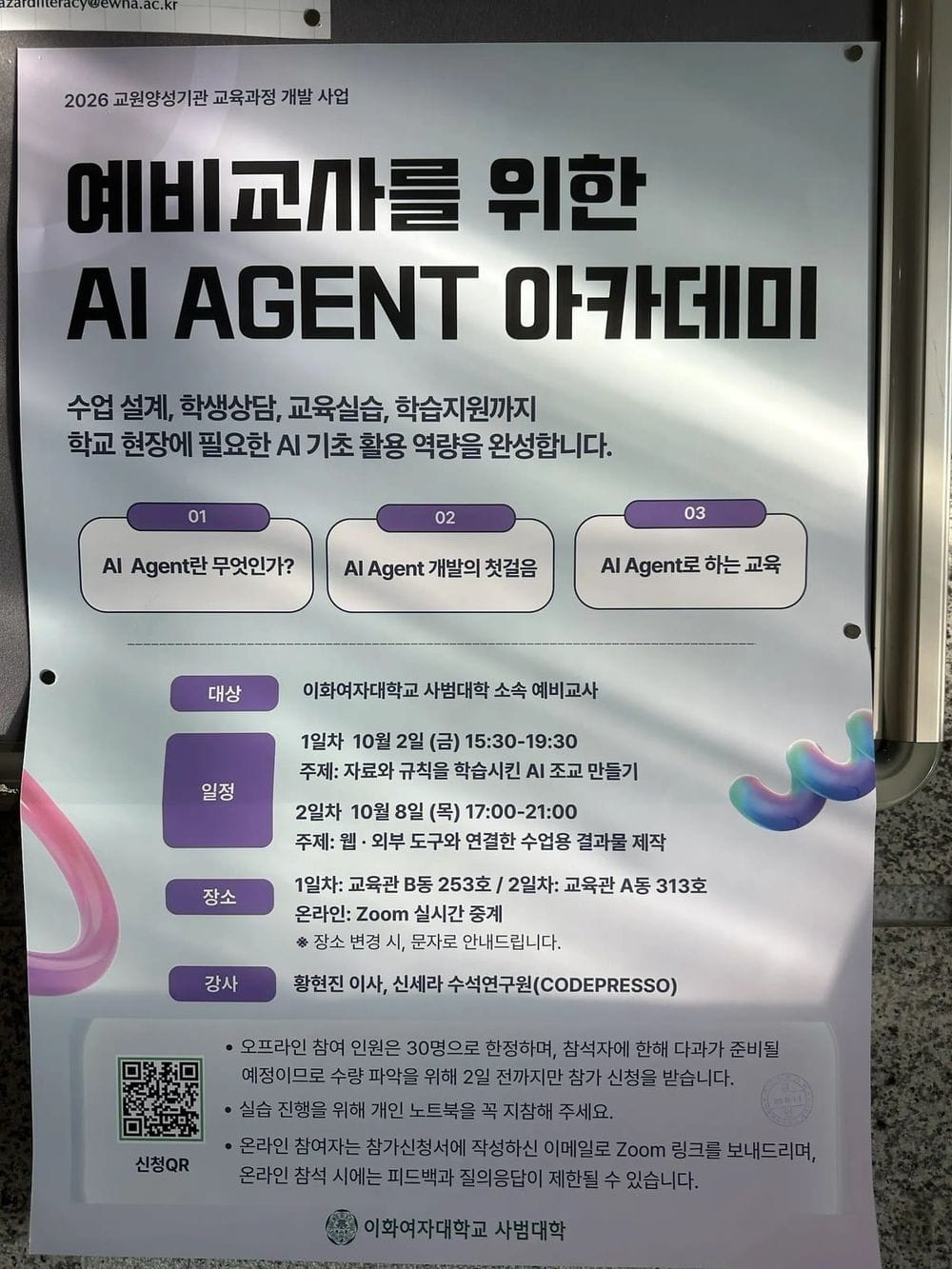
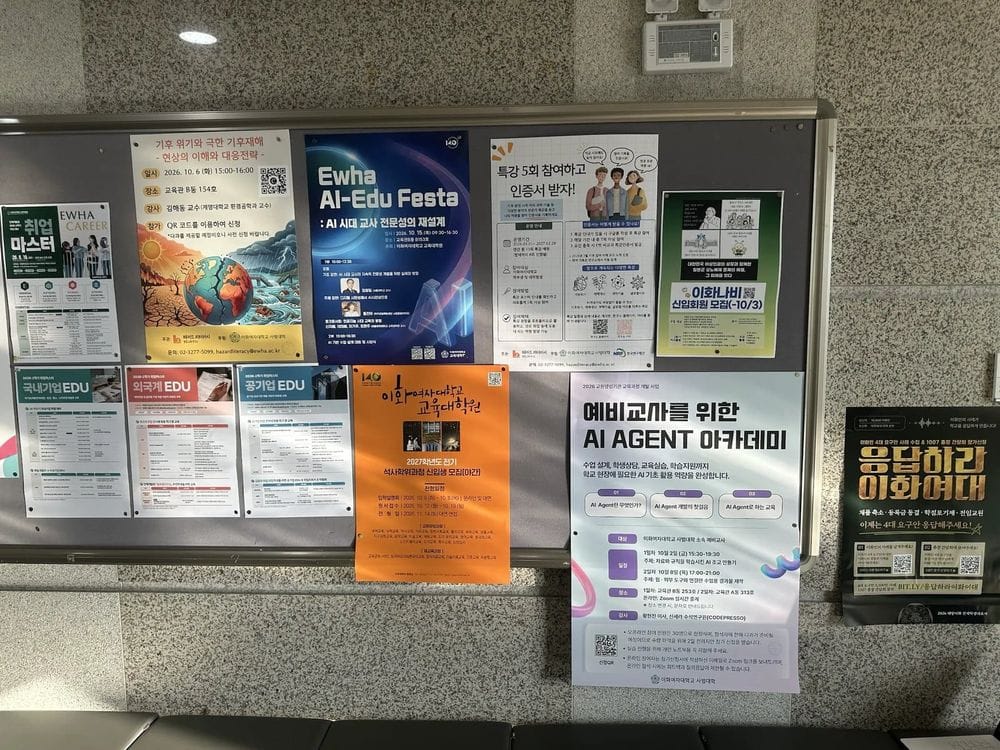
The AI Agent Academy for Pre-Service Teachers poster displayed in Ewha’s Education Building.
Why Should Pre-Service Teachers Learn to Use AI Agents?
Teachers’ use of AI is moving beyond individual questions and answers toward delegating clearly defined tasks.
The first session explored this shift through “Three Stages of Changing How We Work: Why AI Agents, and Why Now?” It described the progression from preparing lessons without AI, to an AI-assisted approach built around individual prompts, and then to an AI-native approach in which tasks are delegated to AI.
When teachers remain at the second stage, they often have to repeat the same context: where the class is in the curriculum, which assessment criteria apply, or why students should receive hints before being given an answer.
An agent configured with these materials and rules can work within that context, allowing teachers to spend more time reviewing outputs and exercising professional judgment. This is closely related to the AI delegation skills professionals need when assigning work to AI agents.
Ewha’s College of Education is taking a similar approach. Through this initiative, it plans to integrate four types of AI agents into teacher education:
- AI Instructional Design Coach: Supports lesson planning and design.
- AI School Violence Counseling Coach: Helps pre-service teachers practice counseling for school violence situations.
- AI Teaching Practicum Coach: Supports school-based teaching practice.
- AI Growth Support Coach: Helps manage individual professional development.
When the partnership was announced, Eunhye Park, Dean of Ewha’s College of Education, said:
“Teachers now need more than the ability to operate AI tools. They need the capacity to redesign subject teaching and assessment with AI and lead change in schools.”
— September 2026 MOU press release
What Kind of AI Teaching Assistant Did Participants Build on Day One?
The first day’s assignment was to build an AI teaching assistant equipped with teaching materials and rules.
Participants supplied materials from their own subject areas, wrote instructions defining how the assistant should behave, and then asked questions while role-playing as students to check whether it followed those instructions.
For example, they could set rules such as: “Offer hints before revealing the correct answer.”; “If the answer is not covered in the teaching materials, say that you do not know.”
Codepresso Principal Researcher Sera Shin explains “Why AI Agents, and Why Now?” on October 2 in Education Building B, Room 253.
The most important part of the exercise was deciding what to delegate and what the teacher should personally review.
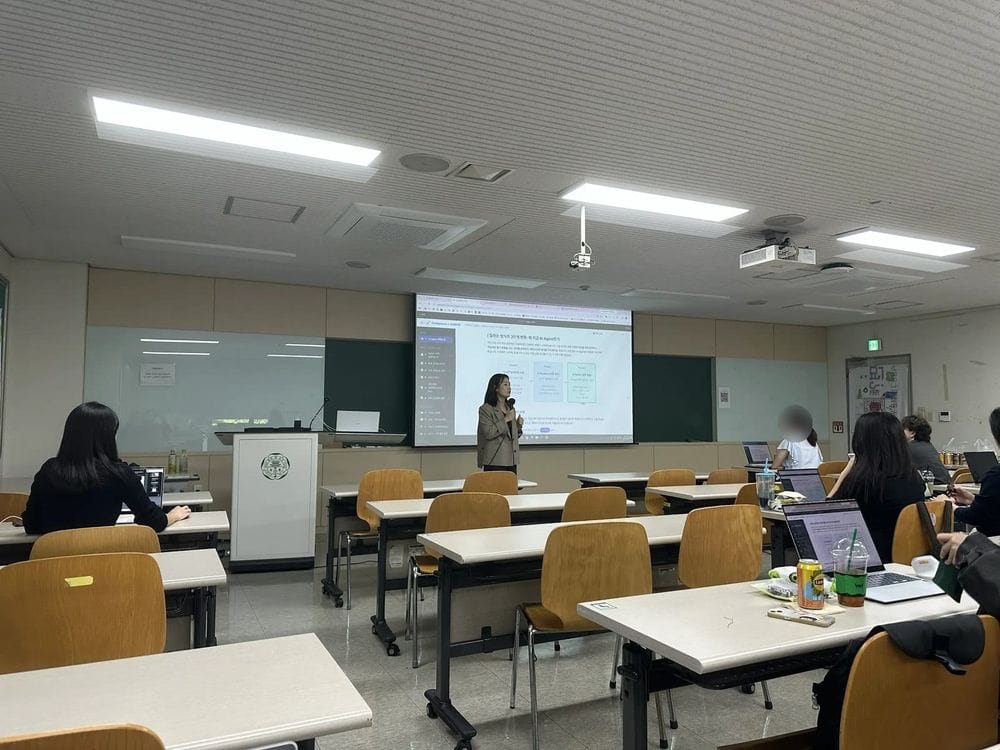
Changing even one line of instructions could change the assistant’s response. Participants could see firsthand how writing instructions for an AI assistant becomes part of designing the learning experience.
“Our goal for the first day was to help participants leave with an assistant that understood their teaching materials and principles, beyond simply learning tips for using AI. We wanted them to develop the habit of defining what to delegate and reviewing the results before they enter the classroom as teachers.”
— Sera Shin, Principal Researcher, Codepresso
“I changed one line in the rules, and the assistant started giving hints instead of the answer. I’d like to try using it to respond to students’ questions during my teaching practicum.”
— Day 1 participant
The first day’s hands-on session brought together 15 participants in the classroom and 19 via Zoom.
How Does Building AI Agents Differ from an Introductory AI Tools Workshop?
Even when all participants are non-developers, the right training format depends on the learning objective. The table below compares four common formats by duration, content, and assessment approach.
| Format | Duration | Content | Assessment Approach | Best Suited For |
|---|---|---|---|---|
| Introductory AI tools seminar | 1–2 hours | Generative AI concepts and demonstrations of major tools | Participant satisfaction survey | Introducing AI to groups with little or no prior experience |
| Hands-on prompting workshop | Half a day | Practicing prompts and responses using workplace examples | Review of practice outputs | Improving efficiency in individual tasks |
| Hands-on AI agent workshop, as used in this academy | 2 days, 8 hours total | Building an assistant with participants’ own materials and rules, then connecting it to external tools | Review of completed agents and classroom resources | Delegating clearly defined, recurring tasks |
| AI-integrated academic courses | One semester or longer | Redesigning course objectives, content, and assessment to incorporate AI | Competency assessments at the beginning and end of the semester | Transforming the broader teacher education curriculum |
Introductory seminars and prompting workshops can help large groups become familiar with AI in a short time. However, participants may remain focused on individual prompts and responses.
Building an AI agent takes more time, but it gives participants practice in breaking down their own work and deciding which tasks to delegate.
Ewha’s College of Education has chosen to combine a short academy with AI-integrated academic courses. Beginning in the fall semester of 2026, the college is updating nine courses, four teacher education courses and five subject-specific pedagogy courses, to incorporate AI.
Our case study on AI training for non-developers describes how business professionals worked through a project from planning to deployment without writing code. Although the audience differs, the learning design follows the same principle: participants build something themselves using materials from their own work.

How Will the Program Measure Its Impact on Future Teachers’ AI Competency?
The approach is to assess AI competency before and after training using the same criteria, rather than relying on the number of courses completed.
Ewha’s College of Education plans to assess students’ AI competency at the beginning and end of the semester to track changes. Codepresso is applying its assess - train - reassess approach, already used in corporate training, to the design of teacher education curricula.
Codepresso’s generative AI competency assessment service, AI Fluent, evaluates prompt histories, intermediate outputs, and final deliverables through realistic work scenarios. Results are reported across four competency levels, from Entry to Professional.
By examining how participants work with AI as well as what they produce, the assessment is well suited to training that teaches learners what to delegate and how to review the results.
For more information on selecting an assessment tool, see our guide to choosing an AI competency assessment service.
When the partnership was announced, Codepresso CEO Donghoon Lee said:
“Pre-service teachers’ AI competency should be demonstrated by how effectively they can rethink lesson design and assessment in their own subjects with AI, rather than by how many AI courses they have completed.”
— September 2026 MOU press release
What Comes Next in the Partnership Between Ewha and Codepresso?
The next session takes place on Thursday, October 8, in Room 313 of Education Building A. Participants will connect the assistants they built on Day 1 to the web and external tools, using them to create resources for actual classroom use.
“In corporate training, we often see people follow along successfully during a session but struggle to carry that learning into their work the following week. That is why we designed this program so that the assistant built on Day 1 leads directly to practical classroom resources on Day 2.”
— Hyunjin Hwang, Director, Codepresso
The academy also marks the first step in a three-year collaboration.
On September 7, 2026, Codepresso signed an MOU with Ewha’s College of Education, led by Dean Eunhye Park, to collaborate on research and curriculum development for teacher education. The partnership also includes DRIMAES, a member of the manufacturing AI innovation consortium AXMOS, and education platform company Jaranda.
The agreement covers four areas:
- Improving teacher education and subject-specific curricula.
- Strengthening AI skills among faculty and pre-service teachers.
- Developing, delivering, and advising on programs for pre-service teachers.
- Conducting joint research that connects education and industry.
The college plans to make the project’s resources available to other universities and practicing teachers through its online sharing platform, SHARE Campus, beginning in February 2027.
From 2028, it plans to expand the approach across the program requirements for five subject areas: Korean, English, mathematics, social studies, and science.
Codepresso will continue supporting courses in AI agents and vibe coding, alongside guest lectures from industry professionals.
Frequently Asked Questions
What Is AI Training for Non-Developers?
AI training for non-developers is corporate training designed to help employees outside traditional software development roles use generative AI, AI agents, and AI-assisted coding tools to automate and improve their work.
As of October 2026, programs from organizations such as SK AX, Convenzers, and Worksphere increasingly focus on vibe coding, department-specific AI projects, and no-code or low-code AI agent development.
Is Vibe Coding Training Enough to Build AI Competency?
Not by itself.
Vibe coding can improve employees’ ability to create outputs and automate work with AI, but companies should also develop capabilities such as defining the purpose of AI use, validating AI-generated results, deciding what should be delegated, and maintaining human accountability.
One practical approach is to add three questions to every AI exercise:
- What should not be delegated?
- How will the output be validated?
- Who owns the final decision?
How Should Companies Measure AI Skills Before and After Training?
Employees should complete realistic work scenarios in which both their AI interaction process and final output are evaluated.
Codepresso AI Fluent assesses prompt history, intermediate outputs, and final results, and reports competency across four levels: Entry, Beginner, Intermediate, and Professional.
Using the same competency framework before and after training makes it possible to measure improvement consistently.
How Can My Company Design AI Training and Competency Assessments?
If your organization is planning enterprise AI training and wants to measure employee capability before and after the program, contact Codepresso at sales@codepresso.kr.
References
- ZDNet Korea (PRNewswire), “Codepresso Signs Agreement with Ewha’s College of Education to Jointly Develop an AI-Integrated Teacher Education Curriculum,” September 11, 2026
- Yonhap News Agency (PRNewswire), “Codepresso Signs Agreement with Ewha Womans University to Jointly Develop an AI-Integrated Teacher Education Curriculum,” September 11, 2026
- Ewha Womans University College of Education, AI Agent Academy for Pre-Service Teachers program poster, October 2026.
Written by Codepresso’s GGP Division | Last updated October 2, 2026