Digital Healthcare Workflow Automation: AX Grow Case Study

Company R, a medical device manufacturer that develops precision diagnostic and treatment equipment for markets worldwide, is already experienced in applying AI technology to its products.
However, its internal operations presented a different picture. Many recurring tasks had yet to be automated, including the monthly cash flow documents prepared by the accounting team, component guides created by the quality team, and proposal drafts written by the sales team.
Even companies in highly regulated industries with strict quality standards, such as medical devices, can close this gap through AX Grow, an organizational AI transformation program. Company R chose a phased approach, delivering training to different departments in sequence.
This article explores how Company R structured the program and what employees in each department learned.
Demonstrations Built Around Real Departmental Work

The participants at Company R represented a wide range of roles. The program included employees from six departments, as well as engineers who participated in a separate training track.
Participants first completed approximately four hours of online training covering foundational concepts, including how AI works and how to delegate tasks to it. This was followed by a one-day, in-person session. During the in-person training, instructors demonstrated how to apply the concepts from the online course to each department’s actual work.
The examples used in these demonstrations varied by department. The accounting team’s training focused on creating cash flow documents, while the quality team’s training used component documentation as its primary example.
Employees were not expected to complete a finished deliverable during the session. Instead, they learned by observing how a real task could be assigned to AI and completed step by step.
The six departments participated across four sequential cohorts. Cohort 4, which included employees from the Product Development Division, remained part of the non-developer track but covered more advanced material because many participants already had experience using AI tools.
Training for engineers was delivered separately from all four cohorts.
Training Sequence and Representative Tasks by Cohort
| Cohort | Participating Departments | Representative Task |
|---|---|---|
| Cohort 1 | Support Division; People & Operations Division | Creating monthly reports that automatically consolidate performance data from multiple subsidiaries |
| Cohort 2 | Manufacturing Division; Quality Division | Matching component codes with images to create product or component guidance documents |
| Cohort 3 | Sales and Marketing Division | Saving and reusing workflows for multilingual content and webpage production |
| Cohort 4 | Product Development Division, advanced track | Connecting AI to specialized software used within the company so that the AI can operate it directly |
| Engineering training | Mechanical, hardware, and firmware engineers, separate track | Writing program code and tests for reading equipment logs, along with a concise one-page planning document |
Different Departments, One Framework for Delegating Work to AI
Company R’s non-developer track was divided into four cohorts. A defining feature of the program was that each division worked with topics drawn directly from its own operational needs.
- Cohort 1: Support Division and People & Operations Division:
The accounting team focused on standardizing account-mapping rules to automate cash flow statement preparation. The People team explored automating job description creation based on NCS and ARIS standards. The Corporate Support team learned how to consolidate performance data from all subsidiaries into an HTML dashboard, while the Treasury team practiced automating the consolidation of payment data. - Cohort 2: Manufacturing Division and Quality Division:
The manufacturing team focused on aggregating production and shipment data by option, model, and country. The purchasing team explored how to build an integrated purchasing and inventory dashboard. The Quality Assurance team worked on automating web and literature collection for PMS and PMCF documentation. The Quality Control team practiced extracting data from supplier Certificates of Analysis (CoA) in PDF format and standardizing evaluation rules. - Cohort 3: Sales and Marketing Division:
The Product Strategy team worked on a dashboard that automatically consolidates sales activity across subsidiaries. The Imaging Product Management team focused on standardizing multilingual localization rules for product and training content. The International Sales team practiced conducting preliminary reviews of potentially unfavorable clauses in letters of credit and researching countries and distributors. The Communications team worked on drafting social media content and integrating workflows with the company’s CRM. - Cohort 4: Non-developer employees in the Product Development Division:
This advanced cohort was designed for employees with prior experience using Claude Code. The Imaging Development team worked on a CS and SQA issue dashboard with natural-language search capabilities. The Mechanical Development team explored automating bill of materials change notifications using CAD exports. The Hardware Development team also practiced connecting open-source applications such as ImageJ and FreeCAD through a local MCP server.
All four cohorts shared one important feature: instructors demonstrated AI using the tasks that each team actually performs every month, rather than relying on generic textbook examples.
The program also addressed data security. Materials containing personal information were masked, while exercises requiring patient data used synthetic datasets.
AI Coding for Engineers Instead of Dashboards
One particularly notable topic in Cohort 4 was the Hardware Development team’s local MCP server integration.
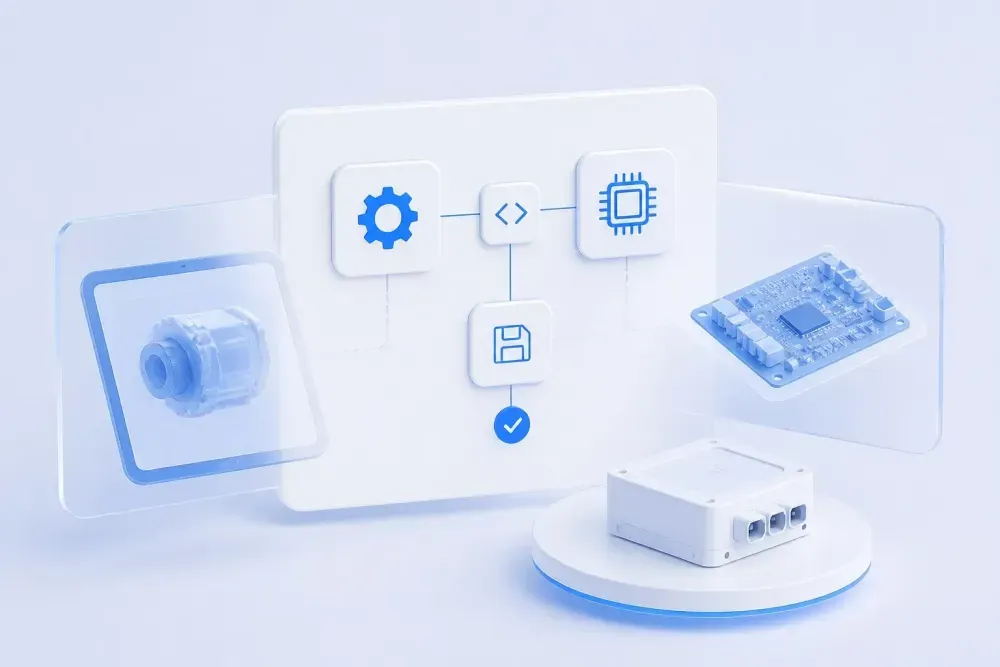
The objective was to connect AI with specialized software used by the company, including open-source tools for image analysis and design, so that the AI could operate those applications directly. MCP serves as the bridge that allows AI to launch and interact with other software.
Mechanical, hardware, and firmware engineers participated in a completely separate program from the four general employee cohorts. Instead of building dashboards, they worked with code.
Participants learned how to write Python functions for reading equipment logs, create test code, and summarize their work in a one-page planning document. They used anonymized sample data rather than actual product logs.
Even within the same AX Grow program, the learning experience differed by audience. Employees in general business functions learned how to delegate their work to AI, while engineers learned how to connect AI-assisted coding, testing, and documentation into a single workflow.
| Category | General Department Training: Four Cohorts | Engineering Training, Separate Track |
|---|---|---|
| Participants | Employees from six departments | Mechanical, hardware, and firmware engineers |
| Approach | Using natural-language instructions to direct AI without writing code, “Vibe Coding” | Adding AI to existing coding workflows |
| Deliverables | Dashboards, automatically generated documents, and reusable workflow rules | Program code, tests, and a one-page planning document |
| Learning focus | Understanding how to delegate work to AI | Connecting coding and documentation in one continuous workflow |
| Delivery format | Delivered sequentially across four cohorts | Operated as a separate program from the general department training |
When repetitive tasks differ by department, training must also be tailored to each department’s work to be practically useful. This is why Company R delivered the program in phases.
This approach made it possible to scale AI training across the organization without requiring all employees to participate at the same time. For the same reason, engineers who work with code were not trained in the same way as employees in non-technical roles.
AX Grow does not end with training. The next stage after practical instruction is an internal builderthon. Rather than relying on an external provider to build solutions on their behalf, employees create AI agents and automation tools tailored to their own work.
This approach can be applied even in the medical device industry, where regulatory requirements and quality standards are especially strict. Other manufacturing and technology companies facing similar challenges can also use Company R’s experience as a practical reference.

Frequently Asked Questions (FAQs)
Can employees without development experience participate in a program like AX Grow?
Yes. In Company R’s case, all four cohorts were designed as part of the non-developer track. Employees from accounting, People, manufacturing, quality, sales, and marketing participated regardless of their technical backgrounds.
The engineering track was operated separately for mechanical, hardware, and firmware engineers.
Is there a risk of exposing internal company data or personal information during training?
In Company R’s program, materials containing personal information were masked, and synthetic data was used for exercises requiring patient information.
The engineering track also used anonymized sample data instead of actual product logs, preventing the exposure of sensitive information.
How do the non-developer and engineering curricula differ?
The non-developer track focuses on methods for automating departmental documents, data consolidation, and other recurring business tasks.
The engineering track focuses on integrating AI into the development process itself, including writing log-parsing functions, completing test code, and preparing concise planning documents.
Company R operated the two tracks as completely separate programs.