FDE Jobs: 4 Preferred Qualifications for Nondevelopers

Preferred qualifications in FDE job postings describe experience that can help an application stand out. This guide explains how nondevelopers can build concrete evidence across four common areas.
|
💡 One-Minute Summary |
|
Nondevelopers preparing for FDE careers often hesitate when they reach the “preferred qualifications” section of a job posting. A list that includes Python, AI projects, industry experience, and English can make them feel unqualified before they begin.
Codepresso recommends treating this section as a list of experiences that can strengthen an application. For each relevant qualification, aim to provide something a reviewer can examine rather than simply stating that you have done it.
When choosing FDE training, also consider whether the program will help you produce that evidence.
Forward Deployed Engineers work directly with customers or business departments to define problems, build AI solutions, and integrate them into everyday operations. For an introduction, see Forward Fellowship: An FDE Training and Development Program.
This article explains how nondevelopers and job seekers can prepare evidence for preferred qualifications in FDE applications.
What Is the Difference Between Required and Preferred Qualifications?
Job postings typically distinguish between two categories.
Required qualifications establish the criteria candidates are expected to meet. Missing them may lead to rejection during application screening.
Preferred qualifications describe additional experience or capabilities that can make an application more competitive.
Read them in that order: establish whether you meet the requirements, then consider how your preferred qualifications distinguish you.
The expectations in both categories vary considerably between employers.
Palantir’s Forward Deployed Software Engineer posting lists at least one year of relevant experience after graduation, a strong technical background in fields such as computer science, mathematics, or data science, and proficiency in languages such as Python, Java, or TypeScript.
For a nondeveloper, preferred qualifications are unlikely to compensate for missing those core requirements.
However, the same posting’s “What We Value” section also emphasizes collaboration across technical and nontechnical teams and the ability to iterate with users as goals evolve. Even employers that require development experience assess the ability to work effectively with people in the field.
Forward Fellowship takes a different approach. Applicants can come from any academic or professional background, but must hold at least a bachelor’s degree, including those expecting to graduate in February 2027, and be able to participate in the full seven-week program.
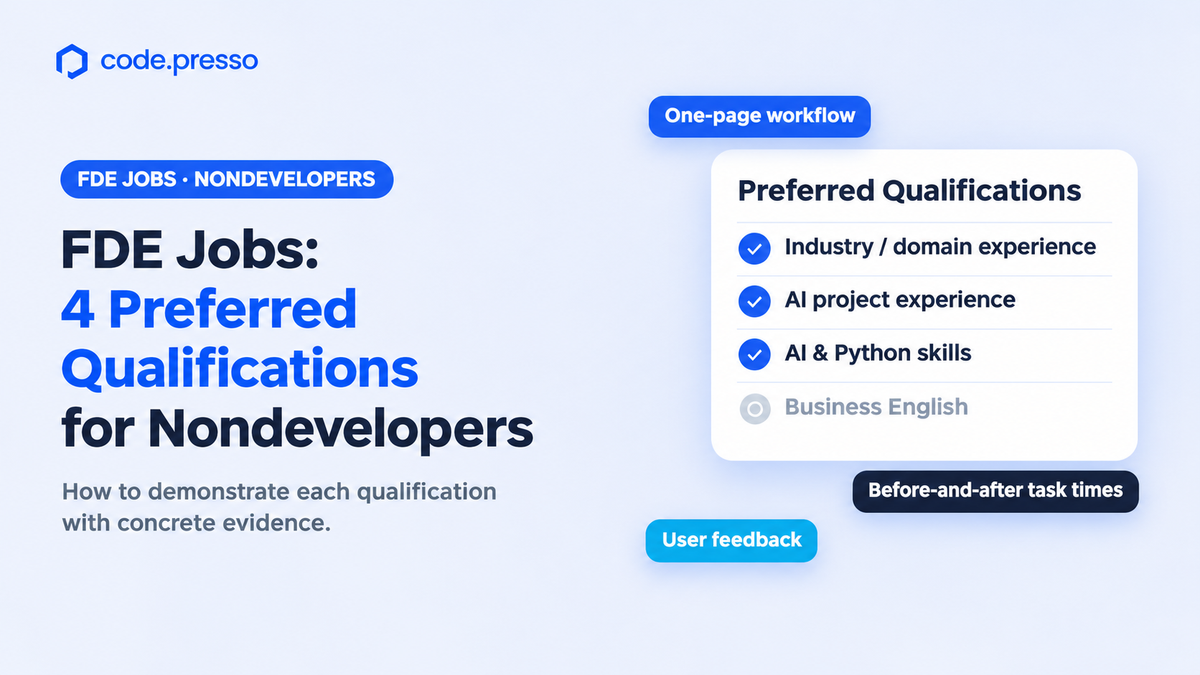
Its four preferred qualifications are:
- Recognized business English test scores.
- AI and Python skills.
- AI project experience.
- Industry or domain experience.
The official website states that AI and Python skills are preferred rather than required, that the online competency assessment is optional, and that assessment results are used only to award additional points.
Nondevelopers exploring an initial opportunity can start with roles or programs that do not require development experience, then use these four areas as a preparation checklist.
For related job titles to search, see How Nondevelopers Can Join an FDE Team.
What Evidence Can Nondevelopers Provide for Each Qualification?
The wording in a preferred qualifications section may be brief, but the underlying questions are concrete.
The table below uses Forward Fellowship’s four preferred qualifications as a starting point. The suggested preparation and evidence are Codepresso’s recommendations.
| Preferred Qualification | What It Helps Demonstrate | Evidence a Nondeveloper Can Provide | Weaker Evidence |
|---|---|---|---|
| Industry or domain experience | Understanding of how work progresses within an industry | A one-page workflow from a previous workplace, identifying the slowest step and the time it takes | A statement such as “I am very interested in this industry” |
| AI project experience | Ability to select a problem and work through it with AI | A deliverable built using real work materials, measured before-and-after completion times, and feedback from someone who used it | A project reproduced by following a course exercise exactly |
| AI and Python skills | Ability to work directly with AI tools and code | Competency assessment results, a record of reviewing and modifying AI-generated code, or a short script that reduces repetitive work | A list of tools you have tried |
| Business English | Ability to work with English-language materials and communicate with international customers | Recognized test scores and notes that summarize official English-language documentation in terms relevant to the business | An unsupported statement such as “Proficient in English” |
The distinction between the last two columns is the central principle.
Anyone can state an interest or list courses. Measurements, deliverables, and feedback from other people provide evidence of practical experience.
For guidance on organizing that evidence, see our FDE portfolio guide.
Do You Need to Demonstrate All Four Preferred Qualifications?
Not necessarily.
An efficient starting point for nondevelopers is to connect domain experience and AI project experience through a single task.
Choose a problem from work you already understand. Documenting the workflow demonstrates domain knowledge. Solving the problem with AI provides project evidence. If you also review and modify AI-generated code, you can begin documenting your AI and Python skills.
English proficiency generally requires sustained preparation, so it benefits from a separate development plan.
This approach reflects the nature of FDE work. FDEs connect problem definition, AI implementation, and workplace adoption. A record of following one problem through to completion can demonstrate that process more clearly than unrelated experiences collected solely to fill four application fields.
It can also show the ability to improve a solution with users, a quality highlighted in Palantir’s posting.
What Could This Look Like for a University Library Student Worker?
Suppose a final-year public administration student has worked at a university library for two years and wants to apply for an FDE-related opportunity.
Their initial application says: “Two years of library experience, completed an AI course, basic Python.”
These statements appear relevant to the preferred qualifications, but they offer little evidence a reviewer can examine.
The student can build stronger evidence through the following process.
| Step | What the Student Does | Preferred Qualification Demonstrated |
|---|---|---|
| 1. Document the workflow | Map the steps from receiving an email about returns or overdue loans to sending a reply. Track inquiry volume and handling time per inquiry for one week. | Industry or domain experience |
| 2. Select one problem | Identify inquiry types that can be answered using established rules, such as loan periods and overdue fees. | Industry or domain experience |
| 3. Build an AI-assisted solution | Create a workflow that drafts replies using library policies as reference material. Test it against past inquiries and count correct and incorrect answers. | AI project experience and, where tools or code are used directly, AI and Python skills |
| 4. Have someone use it | Ask a colleague to try the drafts and record their edits and feedback. | AI project experience supported by user review |
After these steps, the application can become more specific.
“Two years of library experience” becomes:
Mapped the workflow for return and overdue-loan inquiries and measured handling time per inquiry.
“Completed an AI course” becomes:
Built a workflow that drafts replies using library policies and tested its outputs against historical inquiries.
Any numerical claims should come from the student’s own measurements.
For guidance on making rules explicit, see FDE Training for Nondevelopers: What Should You Learn First?. For opportunities beyond campus, see Four Ways to Gain FDE Experience Before Your First Job.
Which Preferred Qualifications Can an FDE Training Program Help You Develop?
The hardest part of AI project experience to create independently is often the final stage: solving a real company’s problem with its employees and having them verify the results.
When evaluating FDE training, look first for access to that experience rather than focusing only on instructional hours.
Forward Fellowship is an FDE training and development program operated by Codepresso with AXMOS consortium partners.
According to the official website, selection involves application review, competency assessment, and interviews. After five weeks of online learning and assessment, selected Fellows participate in two weeks of in-person company projects.
The website features projects across six sectors. One finance project automated the collection and consolidation of business reports from 100 venture capital investment firms, reducing a task that previously took three to five days to approximately one hour.
Completing a project of this kind allows participants to describe the business problem, measured changes, and feedback from the people who used the solution together under AI project experience.
The first Forward Fellowship cohort began on October 17 and is approaching its demo day in late November. These details were checked against the official website on November 17, 2026.
Frequently Asked Questions (FAQs)
Can I Apply for an FDE Role If I Have None of the Preferred Qualifications?
If you meet the required qualifications, you can apply. Preferred qualifications strengthen an application; they are distinct from mandatory eligibility criteria.
Still, aim to provide evidence in at least one of the four areas. A useful starting point is a one-page description of a workflow you know, supported by measurements of how long it takes.
How Much Python Should a Nondeveloper Learn?
If programming proficiency is a required qualification, prepare to meet the expectations of a development role.
If Python appears only as a preferred qualification, begin by learning to read short AI-generated scripts, make changes, and explain how those changes affect the results.
For guidance on the technical concepts to understand, see RAG and LangGraph for Nondevelopers.
Is an FDE Training Certificate Enough to Demonstrate Preferred Qualifications?
A certificate shows that you completed training. It does not replace the experience the preferred qualifications are intended to identify.
During training, work on a real company problem and retain evidence of the output, measured changes in completion time, and user verification.
Those records give you something concrete to include in an application.
References
- Palantir, Forward Deployed Software Engineer job posting (accessed November 17, 2026).
- Forward Fellowship official program page (accessed November 17, 2026).
- Forward Fellowship: An FDE Training and Development Program.
For inquiries about Forward Fellowship, please contact axmos@codepresso.io.

Written by Codepresso’s Global GTM & Partnerships (GGP) Division | Last updated November 17, 2026