How Strong Are Your AI Skills? 8 Ways to Evaluate Your AI Proficiency


AI usage among Korean adults is reportedly 1.7 times the global average. However, the same study found that people who received proper prompt training reduced their working hours by one-third. This suggests that the growing AI skills gap is not simply about how often people use AI, but how effectively they use it.
This article explores eight ways to evaluate your AI proficiency and four stages of AI adoption, from occasional use to leading AI transformation across a team or organization.
When was the last time you evaluated your AI skills?
A recent study found that AI usage among Korean adults is 1.7 times the global average. The figure comes from a survey of 1,057 Korean adults conducted by London-based strategic consultancy Public First.
Prompt Training Can Reduce Working Hours by One-Third
The same study revealed another striking finding: people who received proper prompt training reduced their working hours by one-third compared with those who had not received such training.
The difference did not come from having access to better AI tools. It came from learning how to use those tools effectively.
Even when using the same generative AI tool, some people use it only as a substitute for traditional search, while others use it to transform how they work. Now that AI adoption is becoming widespread, the real divide is no longer between people who use AI and those who do not. It is between those who use AI effectively and those who use it only at a surface level.
The study also found that 74% of Korean adults want to improve their AI skills. This result may reflect a growing awareness of the AI proficiency gap.
What Does It Mean to Use AI Effectively at Work?
Most people agree that using AI effectively is important. However, defining what effective AI use actually looks like is not always easy.
AI proficiency can be evaluated through the following eight indicators:
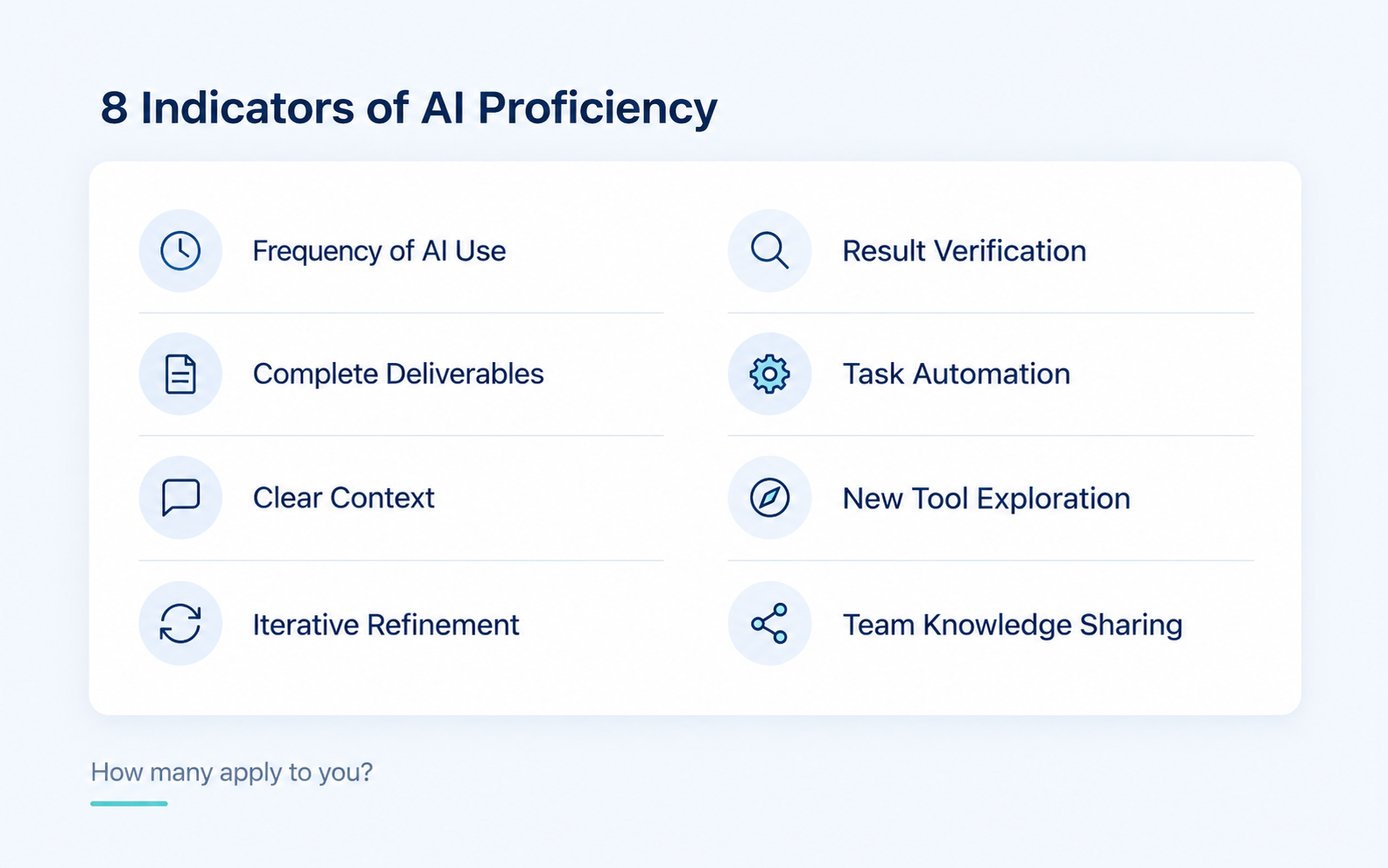
- How frequently do you use AI?
- Do you use AI only as a substitute for search, or do you use it to create documents, project plans, code, and other work deliverables?
- When writing an AI prompt, do you clearly explain your objective, relevant context, and desired output format?
- Do you accept the first AI-generated response, or do you refine the result through multiple rounds of feedback?
- Do you verify the facts and logic of AI-generated content before using it?
- Have you used AI to automate or standardize repetitive tasks?
- Do you actively explore new AI tools and evaluate whether they could improve your work?
- Have you shared useful AI tools, prompts, or best practices with your colleagues or team?
How many of these statements apply to you?
Even people who use AI every day may find it harder to answer “yes” as they move down the list. They may use AI frequently but only at a surface level.
This is often why people feel, “I use AI a lot, but I’m not sure I use it well.” Their frequency of use may be high, while the depth of their AI skills remains limited.
The Four Stages of AI Proficiency
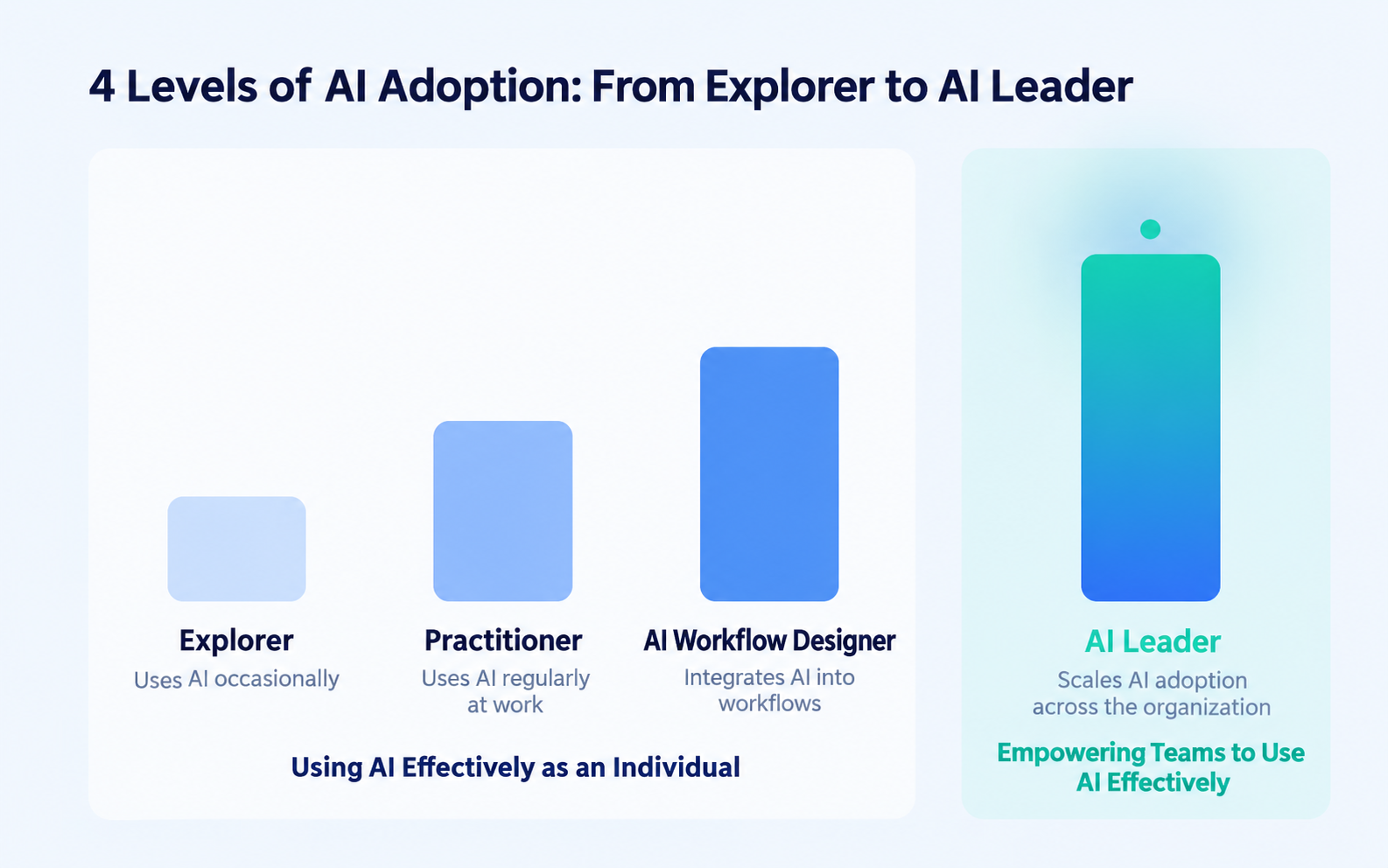
Taken together, these indicators suggest that AI proficiency can be divided into four stages:
- Explorer: You understand what AI is but rarely use it at work, or use it only occasionally to ask simple questions.
- Practitioner: You regularly use AI in your day-to-day work to create documents, plans, code, or other tangible outputs.
- Designer: You structure and refine prompts systematically and integrate AI into your existing workflows and business processes.
- Leader: You lead AI adoption within your organization and help your colleagues or team use AI more effectively.
The transition between the third and fourth stages deserves particular attention.
Up to the Designer stage, the focus is on how effectively you use AI as an individual. At the Leader stage, the question changes: Can you help your entire team use AI effectively?
Someone may know how to work faster and more efficiently with AI, but it is surprisingly rare for that person to share and standardize those methods across a team.
Individual AI Skills vs. Organizational AI Adoption
Using AI effectively as an individual is different from helping an organization adopt AI successfully.
An individual may know how to write effective prompts, refine AI-generated outputs, and automate repetitive work. However, organizational AI adoption requires that these practices be shared, standardized, and integrated into team workflows.
This is what separates an individual AI expert from an AI leader.
The highest level of AI proficiency is not simply about completing your own work faster. It is about helping others use AI safely, consistently, and effectively.
How Can You Assess Your Current AI Skill Level?
You can write “proficient in AI” on your résumé, but there is rarely anyone to verify what that phrase actually means. There is also no simple way to determine whether the colleague sitting next to you uses AI more effectively than you do.
Without clear AI competency standards, most people rely on intuition to evaluate their skills.
However, there is a simple way to get an initial idea of where you stand.
Take the three-minute AI Readiness Self-Assessment to find out which of the four AI proficiency levels best describes your current skills.

Reference
The Korea Times: Koreans’ Level of AI Utilization 1.7 Times the Global Average