How to Choose the Right AI Skills Assessment Tool for Your Organization

Why Employee Satisfaction Surveys Aren't Enough to Measure AI Training Success
The process is familiar.
You roll out an AI training program, send out a satisfaction survey, calculate the average score, and include a nice chart in your report.
Then comes the question that really matters:
"So... are our employees actually better at using AI now?"
A satisfaction score of 4.2 out of 5 doesn't necessarily mean your workforce has become more productive with AI. Enjoying a training course and developing real-world AI skills are two very different things.
This isn't just one company's challenge.
According to Hunet's 2026 Corporate Learning Outlook (surveying 371 HR and Learning & Development professionals in South Korea), 50.9% of organizations identified AI education as their highest learning priority for 2026. Yet when asked how they evaluate training effectiveness, 72% still rely primarily on learner satisfaction surveys, while only 22.9% use pre- and post-training assessments to measure actual skill improvement.
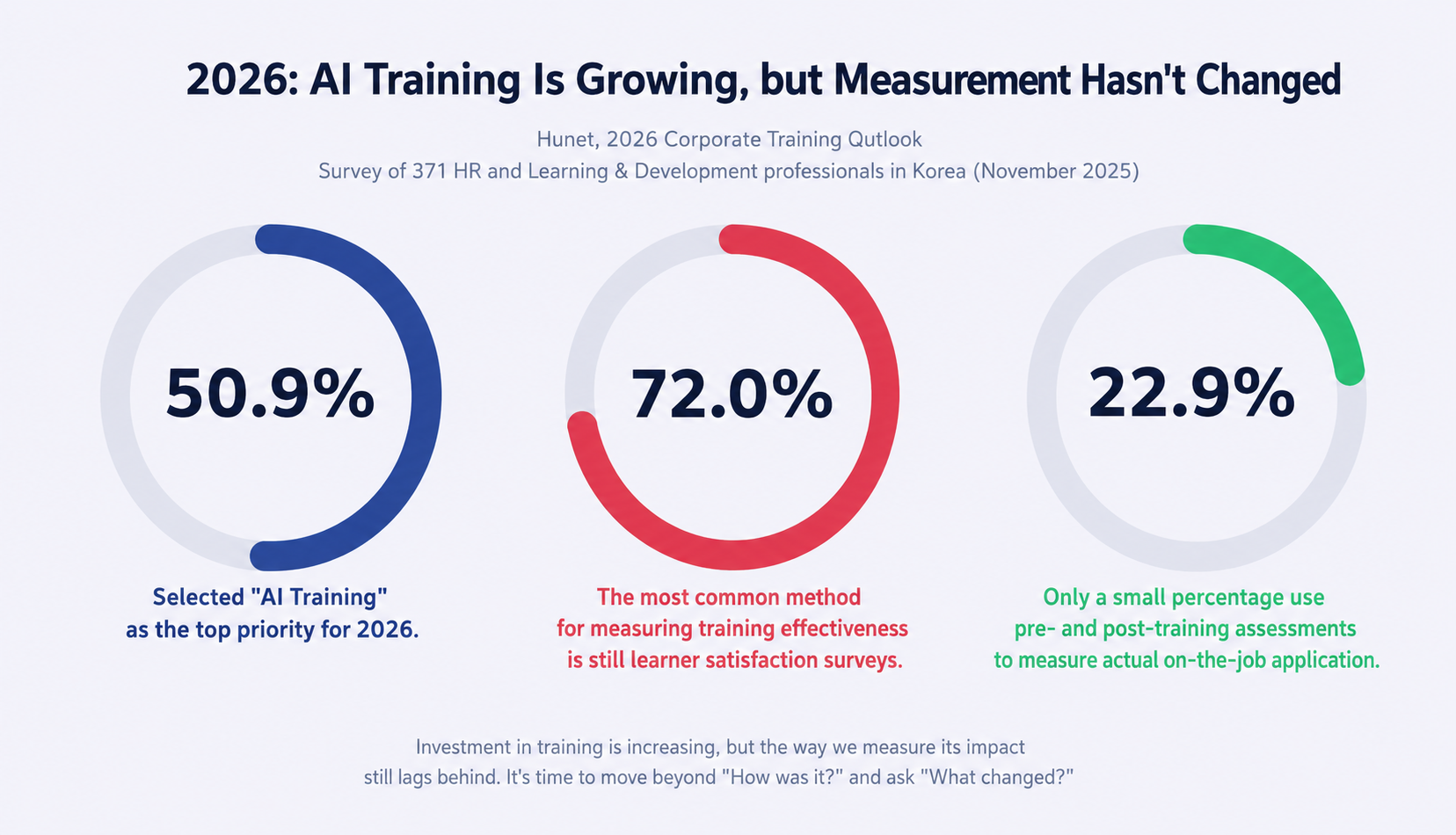
In other words, organizations are investing heavily in AI training—but many are still evaluating success by asking employees whether they enjoyed the experience.
When leadership asks at year-end:
"Was our AI training investment worth it?"
the only evidence many organizations can provide is a satisfaction score.
But that's not the question executives really want answered.
They want to know whether employees actually became more capable of using AI at work.
That's exactly why AI skills assessments are becoming an essential part of enterprise AI transformation.
Today, companies are using AI assessments not only for employee development, but also for hiring, workforce planning, and performance management.
The challenge is that not all AI assessments measure the same thing.
Some evaluate knowledge.
Others evaluate organizational readiness.
Others measure actual job performance.
This guide explains what to look for when selecting an AI assessment and compares several leading AI competency assessment services available in Korea.
3 Things to Look for in an AI Skills Assessment
Not every AI assessment is designed for the same purpose.
Before choosing one, consider these three questions.
1. Does it measure real work, not just AI knowledge?
Knowing what generative AI is and being able to use it effectively are completely different skills.
Multiple-choice quizzes can test whether someone understands AI concepts.
They cannot show whether that person can use AI to solve real business problems.
For example, there's a significant difference between:
- Explaining what a chatbot is
- Using AI to analyze scattered information, organize insights, and produce a decision-ready business report
The second requires practical workplace capability—not just theoretical knowledge.
2. Is it designed for different job roles?
Different roles require different AI competencies.
A marketer needs to know how to craft prompts that generate high-quality content.
A software engineer needs to know how to use AI to write, debug, and optimize production-quality code.
A customer service manager needs different AI workflows than an HR professional.
If everyone takes the same assessment, the results often fail to reflect the skills each role actually needs.
Role-specific assessments produce much more actionable insights.
3. Can it demonstrate measurable business impact?
A numerical score alone has limited value.
An effective AI assessment should answer questions such as:
- Which departments have the largest AI skills gaps?
- Which competencies need additional training?
- Which employees are ready for more advanced AI work?
- How much improvement occurred after training?
Assessment results should directly support future decisions about learning, hiring, and workforce development.
Otherwise, organizations are left guessing what to do next.
Comparing 4 AI Skills Assessment Services in Korea
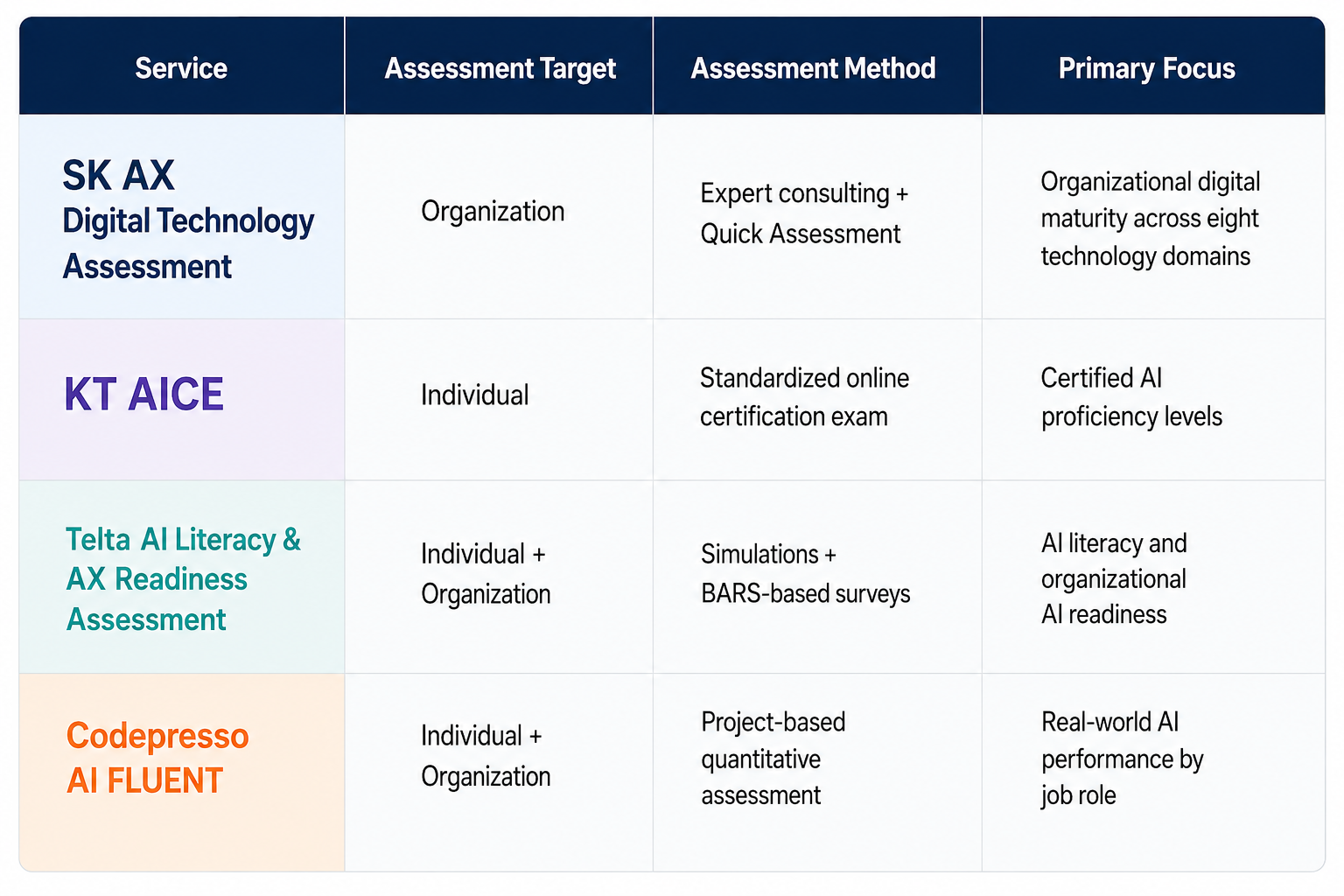
Several organizations in Korea now offer AI competency assessments, each serving different goals.
Rather than asking which one is "best," it's more useful to compare what they measure, who they assess, and how they evaluate AI capability.
SK AX Digital Technology Assessment
SK AX evaluates an organization's overall digital technology maturity across eight areas, including AI, cloud computing, ERP, ESG, smart factories, SCM, groupware, and digital transformation.
Organizations can receive a detailed expert analysis or complete a faster online Quick Assessment.
This assessment is particularly useful for executives and strategy teams that want to understand their organization's overall digital capabilities before launching AI transformation initiatives.
KT AICE
KT's AICE is a standardized AI certification program for individuals.
The certification framework spans multiple experience levels, from elementary students to professionals and includes five certification tiers:
- Future
- Junior
- Basic
- Associate
- Professional
The Basic level focuses on AutoML without programming, while the higher certification levels assess Python-based AI implementation skills.
Because every candidate is evaluated using the same standardized criteria, organizations can use AICE as an objective benchmark for hiring or employee certification.
Telta AI Literacy & AX Readiness Assessment
Telta combines individual AI capability measurement with organizational readiness evaluation.
Individuals complete:
- AI knowledge quizzes
- Virtual work simulations
- Job-specific simulations
- Competency surveys
Organizations are evaluated using Behaviorally Anchored Rating Scales (BARS), allowing HR and business leaders to identify behavioral bottlenecks that may be preventing successful AI adoption.
This approach is particularly useful for organizations seeking to understand why AI initiatives are not translating into workplace performance.
Codepresso AI FLUENT
Codepresso AI FLUENT evaluates AI capability through realistic work projects.
Instead of relying primarily on knowledge-based testing, participants complete practical tasks similar to real workplace scenarios.
The assessment quantitatively measures factors such as:
- Prompt quality
- AI workflow
- Final deliverables
- Code quality (for technical roles)
Separate assessment tracks are available for developers and non-technical professionals, ensuring each role is evaluated against relevant performance criteria.
The assessment is also designed as part of a continuous improvement cycle: Assessment → Learning → Reassessment allowing organizations to measure AI skill growth over time.
6 Questions to Help You Choose the Right AI Assessment
If you're still unsure which assessment best fits your organization, start by answering these six questions.
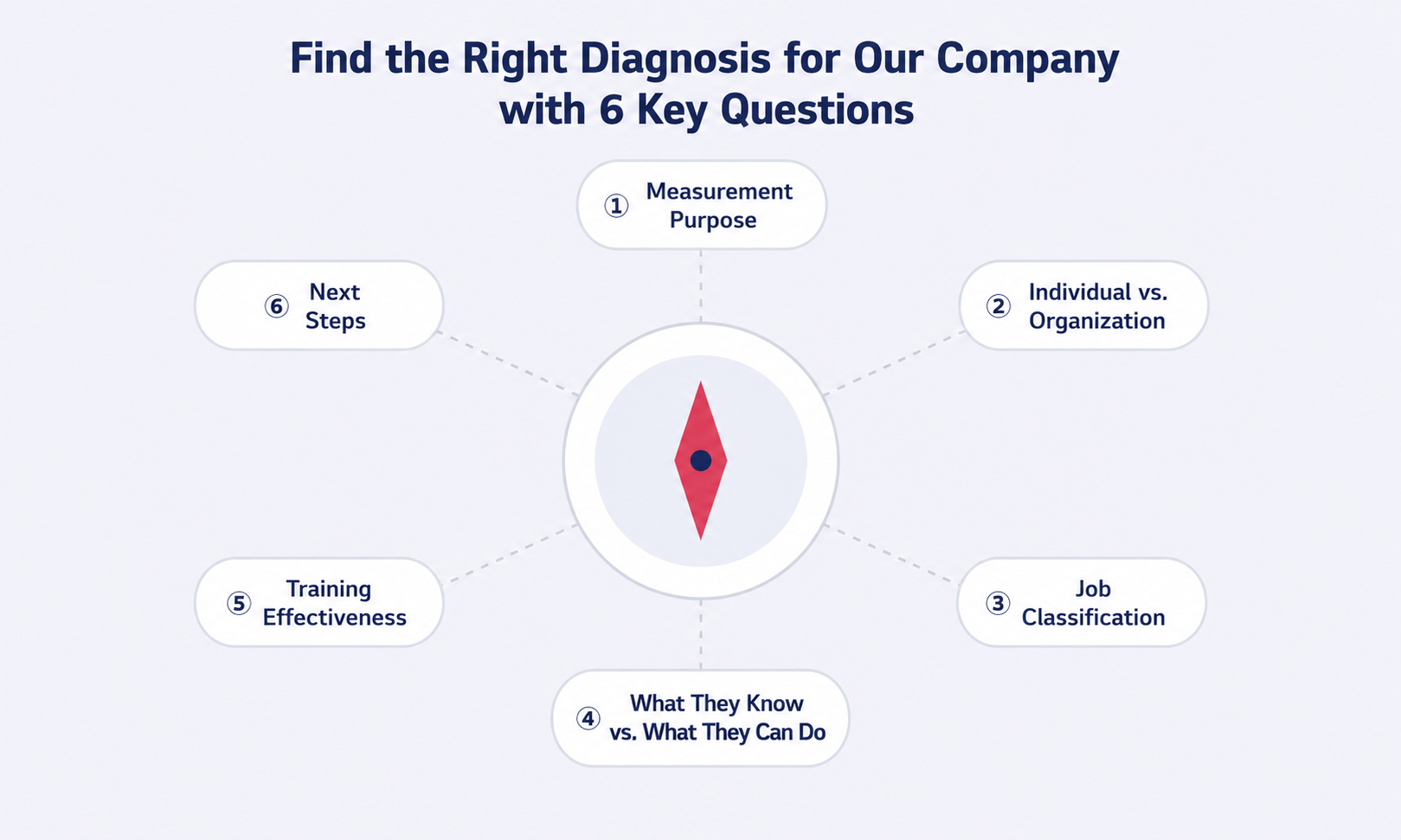
01. What is your primary goal?
Are you looking for:
- Hiring criteria?
- Employee certification?
- Workforce development?
- Organizational AI strategy?
Clarifying your objective is the first step.
02. Do you need to assess individuals, organizations, or both?
An organization's AI capability is more than the sum of individual scores.
If both perspectives matter, choose an assessment that evaluates both.
03. Should different job roles be assessed differently?
Developers, marketers, HR professionals, and operations teams all use AI differently.
Role-specific assessments provide far more meaningful insights than one-size-fits-all testing.
04. Are you measuring knowledge or workplace performance?
If your goal is simply to verify AI knowledge, multiple-choice exams may be sufficient.
If you need evidence that employees can successfully use AI at work, project-based assessments provide a much stronger measure.
05. Do you need to measure training effectiveness?
Pre- and post-training assessments allow organizations to demonstrate measurable learning outcomes instead of relying on subjective satisfaction surveys.
06. How will you use the results?
Assessment results should feed directly into future decisions about:
- Learning programs
- Hiring
- Career development
- Workforce planning
- Performance evaluation
The most valuable assessments don't just generate scores—they generate action.
The Best AI Assessment Is the One That Fits Your Goals
There is no universally "best" AI skills assessment. The right choice depends on what your organization is trying to achieve.
If your goal is to understand enterprise-wide digital maturity, an organizational technology assessment may be the best fit.
If you need standardized AI certification for employees, a certification exam may be appropriate.
If you're evaluating AI literacy alongside organizational readiness, a combined assessment offers valuable insights.
And if your priority is measuring how effectively employees can apply AI in real work, across different job roles and over time, a practical, project-based assessment may provide the most meaningful results.
That's the approach behind Codepresso AI FLUENT.
AI FLUENT evaluates employees through real workplace projects, measures performance using quantitative metrics, offers separate tracks for technical and non-technical roles, and delivers actionable reports that help organizations identify the next steps—not just the current score.
By connecting assessment, learning, and reassessment, organizations can track AI capability growth with measurable evidence.
After all, you can't improve what you don't measure.
The first step toward building an AI-ready workforce is understanding where your organization stands today.
How AI-ready is your team?