AI Transformation Training: Why Daily Generative AI Use Isn’t Enough


The Seoul CCEI AX Grow Case Study
|
1-Minute Summary 💡 |
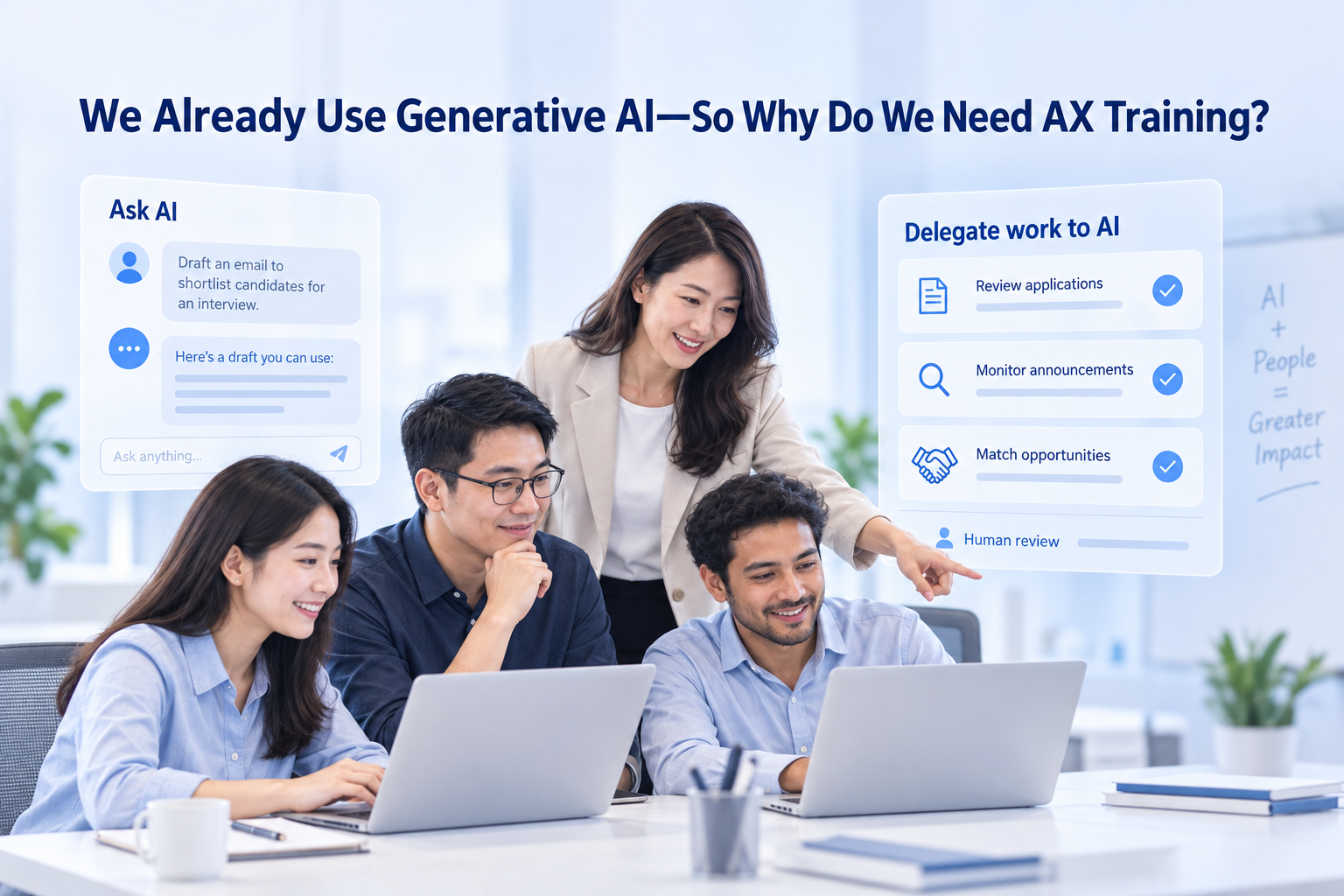
AI transformation (AX) training is not only for people who are new to AI. Most employees at the Seoul Center for Creative Economy & Innovation (Seoul CCEI) were already using generative AI in their daily work. Even so, AXMOS designed a dedicated AI agent onboarding program for the organization. The goal was to shift employees’ perspective from “asking AI questions” to “delegating work to AI.” Employees at every level, from the Center Director to interns, joined a half-day program featuring foundational concepts and five no-code demonstrations. The session helped participants see how AI agents could support startup-related operations, including application reviews, funding announcement monitoring, and open innovation matching. The overall structure of the program is outlined in the AX Grow program overview . |
From Individual AI Use to Team Automation
Why AI Transformation Training Matters
Organizations need AX training not because employees lack familiarity with AI, but because most have not yet learned how to move from individual AI use to organization-wide adoption. The starting point for this program was a clear gap: the organization had not yet established a systematic way to use AI agents and automation across teams.
The Seoul Center for Creative Economy & Innovation (Seoul CCEI) faced this exact challenge. Established in 2015 as a nonprofit foundation, Seoul CCEI is a public startup support organization that discovers promising startups, connects corporations with startups, facilitates venture investment, and runs incubation and growth programs.
Across departments, including the Startup Growth Division, which houses the Open Innovation and Startup Scale-Up teams; the Investment Operations Division, which includes the Venture Investment Team; and the Management Support Division, employees spend much of their time working with documents and information. Their responsibilities include reviewing business plans and applications, drafting program announcements, notices, and press releases, preparing investment review materials and conducting due diligence, managing matching requests and proof-of-concept (PoC) progress, and handling performance reporting and financial reconciliation.
According to the participant list, every attendee already used generative AI in their daily work. ChatGPT was the most widely used tool, and many employees had paid subscriptions. Some also used Claude, Gemini, Perplexity, and NotebookLM. AXMOS nevertheless designed an onboarding program for the organization because individual generative AI use and organization-wide AI agent adoption are fundamentally different challenges.
Employee AI Training
Seven Core Concepts for Working with AI Agents
The central idea of the employee AI agent onboarding program was captured in one simple definition. The course materials explained the difference between a chatbot and an AI agent this way: “A chatbot is a service representative that responds only in words. An AI agent is like a new colleague sitting next to you who can use tools directly and return with a completed deliverable.”
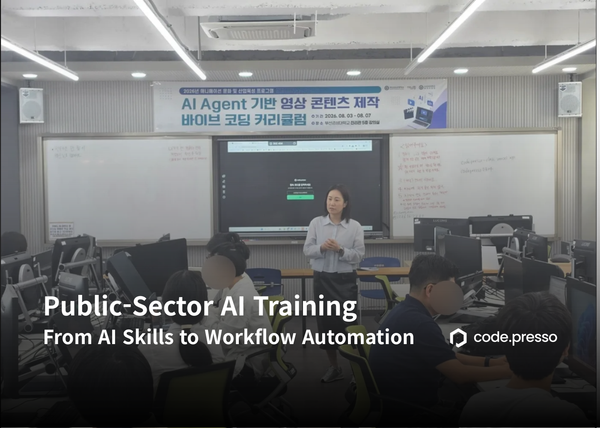
Designed by AXMOS, the half-day program was delivered onsite at Seoul CCEI in June 2026. Its defining feature was a compact format that covered seven sessions in a single afternoon.
| Session | Topic |
|---|---|
| 1 | Beyond Chatbots How AI Agents Differ and Why They Matter Now |
| 2 | Five CCEI Demonstrations Previewing the five practical AI demonstrations participants would experience during the onboarding session. |
| 3 | LLM Fundamentals & Context Understanding tokens, autocomplete behavior, context windows, and why hallucinations happen. |
| 4 | Prompt Engineering Applying the RICJ framework to write more effective prompts for workplace tasks. |
| 5 | Context Management Understanding the risks of long multi-turn conversations and the "One Chat, One Task" principle. |
| 6 | AI Agents & Claude Code How perception, planning, execution, and observation work together inside an AI agent workflow. |
| 7 | Program Wrap-Up Reviewing the five key takeaways participants should apply after the onboarding program. |
The final session summarized the purpose of the day as follows: “This is not a day for learning an entirely new technology. It is a day for developing a new perspective on how to use the AI you already rely on.”
No-Code AI Agents at Work
Five Practical Use Cases for Task Automation
The AX training did not cover software development or system implementation. Instead, five live, no-code demonstrations, with lightweight follow-along exercises, showed employees what AI agents could make possible.
| # | Exercise | Target Team | What It Demonstrated |
|---|---|---|---|
| 1 | Application and Selection Status Dashboard | Startup Scale-Up Team; all teams | Turning application data into status dashboards by program, stage, and region while automatically identifying unreviewed applications approaching their deadlines |
| 2 | Application and Document Eligibility Review | Startup Scale-Up and Evaluation Teams | Checking eligibility, required documents, duplicate submissions, and deadlines, then saving the workflow as a reusable tool for future application cycles |
| 3 | Q&A for Government Program Operations, Financial Reconciliation, and Security Policies | Management Support Division; all teams | Asking questions in natural language across fragmented policy documents and receiving answers with the relevant supporting provisions |
| 4 | Startup Support Program Announcement Monitoring | All teams | Having AI search and navigate public portals directly, then organize easy-to-miss announcements into a watchlist |
| 5 | Weekly Open Innovation Meeting Coordination | Open Innovation Team | Reading a meeting-request sheet, checking schedules, and preparing a draft notification email without sending it |
The five exercises increased gradually in complexity. They began with local document processing, moved to turning recurring tasks into reusable tools, and then demonstrated answers grounded in internal documents. The final exercises showed AI interacting directly with websites or connecting to external services such as Google Drive, email, and calendars.
Participants did not leave with finished tools. What they gained was a practical understanding of what AI agents could enable.
Employee AI Training for All Levels
Building a Shared Foundation in AI Agents
Another defining feature of the employee AI training was its audience. Rather than separating executives for strategic demonstrations, the program brought the Center Director, team leaders, managers, and interns together to observe the same no-code exercises.
The Open Innovation Team, which matches large corporations with startups, made up the core participant group. Employees from the Startup Scale-Up Team and Venture Investment Team also took part.
The course materials made it clear that onboarding was the beginning, not the end. They also presented a roadmap for team-specific advanced training after the initial program.
| Team | Potential Advanced Training Focus |
|---|---|
| Open Innovation Team | Corporate demand–startup matching briefs, PoC operations documents, and application review support |
| Startup Scale-Up Team | Selection and evaluation criteria checks, mentoring and Demo Day materials, performance aggregation, and financial reconciliation reviews |
| Venture Investment Team | Deal sourcing, market research, investment proposal structuring, due diligence, and investor relations material reviews |
| Management Support Division and Center Director | Drafting announcements, press releases, and performance reports; designing institutional AI adoption and governance |
The half-day onboarding program gave everyone a shared understanding of what an AI agent is. Advanced tool training and workflow automation were positioned as the next phase, to be delivered through separate programs.
Responsible AI Adoption in the Public Sector
Data Protection and Safety Guidelines
For public institutions, responsible AI adoption requires clear guardrails: excluding sensitive information, minimizing data use, verifying outputs, and maintaining audit trails. These safeguards are particularly important for Seoul CCEI because it handles startup intellectual property, including business plans and technical documentation, as well as personal information and government program data.
The course materials provided the following checklist:
- Exclude sensitive information: Do not enter startup intellectual property, personal information, nonpublic deal information, or government program data directly into external AI tools.
- Minimize data use: Use only the information that is necessary, prioritizing de-identified, summarized, or synthetic data.
- Verify outputs: AI is a support tool. Final responsibility for evaluations, selections, and investment decisions remains with the responsible staff members and review committees.
- Maintain audit trails: Because government grants and public programs are subject to audits, record the sources and processes behind AI-generated outputs.
- One chat, one task: Start a new conversation when the task changes to prevent unrelated context from becoming mixed.
All data used in the exercises was synthetic. No actual startup information or personal data was used.
After AI Training
Next Steps for Workflow Automation and AI Governance
The next steps after AX training can be understood through the learning pathway presented in the course materials. This onboarding program was only the first step. Advanced training for specific tools, workflow automation, and organization-wide AI governance were planned as subsequent stages.
| Stage | Focus |
|---|---|
| Completed | Onboarding Understanding chatbots versus AI agents, experiencing no-code exercises, and building foundational knowledge for safe AI use |
| Next: Self-Directed Learning | Individual Practice Selecting one recurring task and testing the day’s prompts using synthetic or de-identified data |
| Later: Separate Program | Advanced Tool Training Using Claude and Claude Code in depth and connecting services such as Google Drive, Slack, and Notion |
| Later: Separate Program | Workflow Automation Delegating recurring work to AI agents and standardizing shared team processes |
| Later: Organization-Wide Adoption | Safety, Governance & Scaling Establishing and scaling safety and governance: Expanding adoption across departments and developing an institutional AI strategy |
A single training session cannot complete an organization’s AI transformation. What this onboarding program demonstrated is that even organizations where employees already use AI individually still need a dedicated AX assessment and training program to identify what can, and should, be done differently at the organizational level.

Frequently Asked Questions (FAQs)
Our employees already use generative AI. Do we still need AX training?
Yes. As the Seoul CCEI case demonstrates, even organizations with widespread individual use of generative AI can benefit from dedicated onboarding on how to use AI agents systematically across the organization.
If you would first like to assess your organization’s current level of AI adoption, you can contact us to learn more about an AX assessment.
Is it appropriate for the Center Director and frontline employees to follow the same curriculum?
Yes. In this case, everyone from the Center Director to interns participated in the same foundational onboarding program.
The roadmap then outlined different advanced training paths for each team.
Can employees apply what they learn after only a half-day program?
This onboarding program focused on understanding AI agent concepts and building a practical sense of what is possible.
Advanced programs that lead to the development of real workplace tools and automation workflows can be designed separately based on the organization’s needs.