Analyzing Interviewer Question Patterns with AI Agents


_Insights from Codepresso's HR AX Training Program_
It is a familiar scene after an interview: three interviewers sit down to discuss the same candidate, and arrive with three very different evaluations.
One interviewer focused on the candidate’s work history. Another concentrated on personality and culture fit. A third simply says, “I had a good feeling about them.” The conversation eventually comes down to one question: “Should we hire this person?” Yet explaining exactly why the candidate should or should not be hired is often surprisingly difficult.
Codepresso’s Structured Interview Special Lecture was designed to address this challenge. This hands-on AX (AI transformation) training program enables HR professionals to work directly with an AI agent, without any coding experience, and create a customized draft interview guide for their organization during the session.
The program is designed for recruiters and HR professionals who have primarily used generative AI as a chatbot, as well as HR teams seeking more consistent organizational standards when interview questions and evaluation criteria vary by interviewer. In response to continued demand, the same curriculum has now been delivered four times.
In this article, we take a closer look at how the program was designed, what participants built, and how they responded during the workshop and in the post-training satisfaction survey. For organizations considering company-wide AX training, this program offers a practical example of how AI agents can be applied to HR workflows.
How Did Participants Create an Interview Guide Without Writing Code?
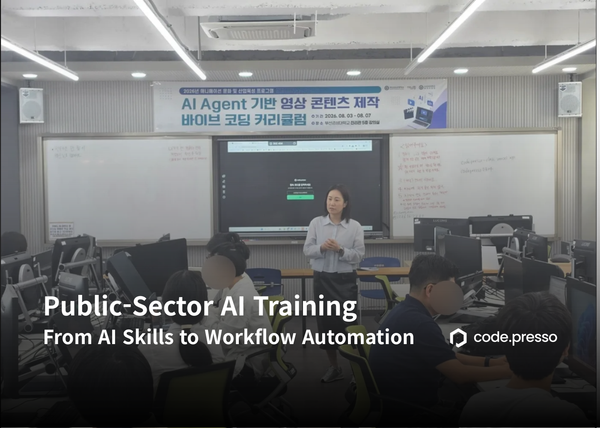
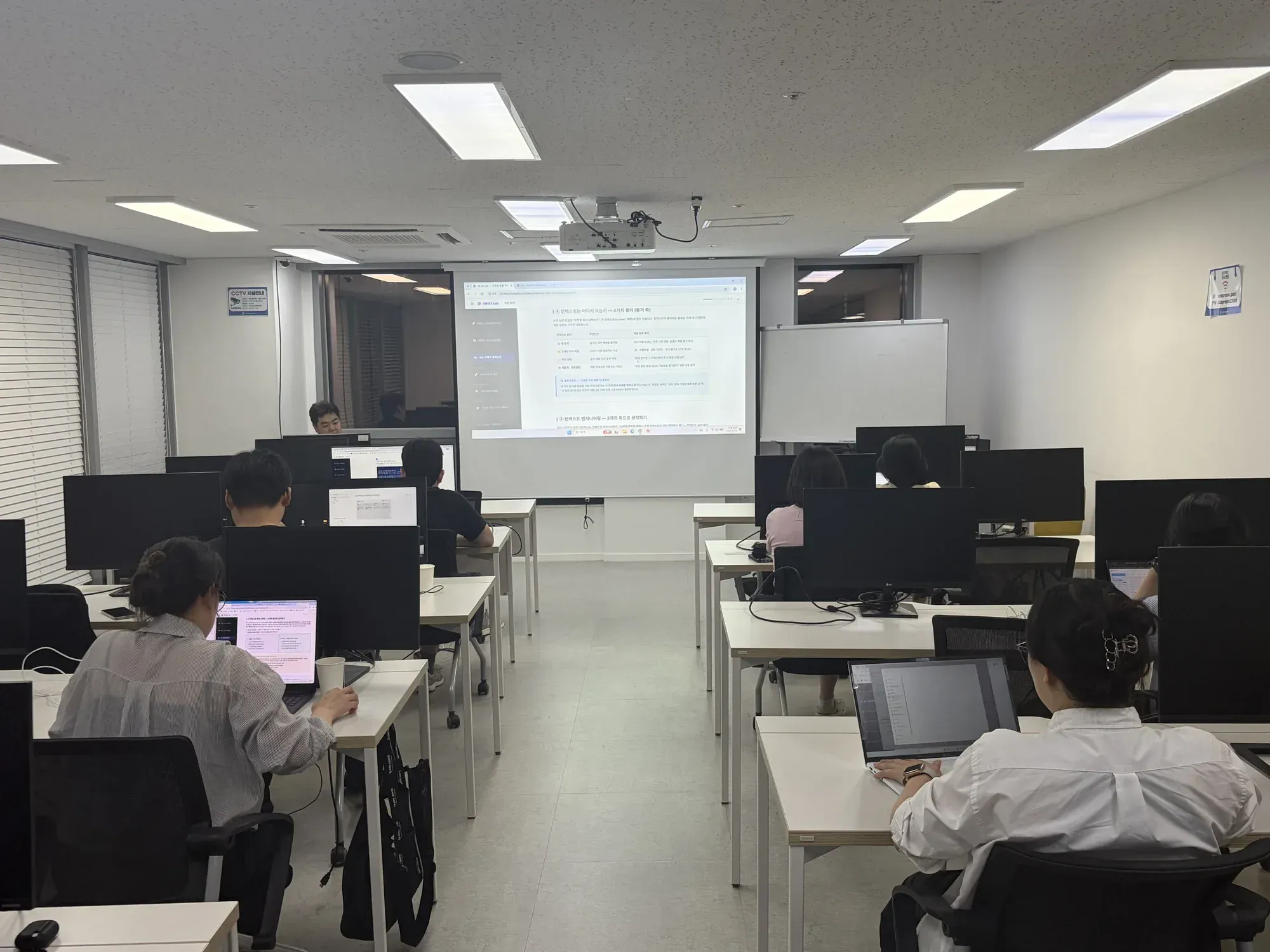
The special lecture was held as a one-day, in-person workshop from 7:45 p.m. to 10:00 p.m., lasting approximately two hours and 15 minutes. No coding experience was required. Participants only needed to bring a personal laptop and have a Claude Pro account. Installation and setup were completed together on-site.
Because the program was delivered in a small-group setting, it operated more like an interactive workshop than a traditional lecture. Participants had time to explore their own questions and work through tasks relevant to their organizations.
The hands-on portion of the session was organized around three stages of working with an AI agent.
The first stage was turning a process into a reusable Skill. Once the process was defined and saved, participants could reuse it without entering the same detailed instructions every time.
The second stage was connecting the organization’s own materials. Participants provided the AI agent with job descriptions, resumes, and evaluation criteria so it could work within the specific context of their organization.
The third stage was running the workflow with a single-line command. With an instruction as simple as “Create an interview guide,” participants could have the agent generate an actual file.
Through these three stages, participants moved beyond their previous experience of asking an AI chatbot questions and receiving text-based answers. Instead, they experienced what it means to operate an AI agent and delegate an entire workflow to it.
The final deliverable was a customized draft interview guide that could be adapted for use in the organization’s recruitment and interview processes.

Before Delegating Work to AI, What Should We Define First?
One principle guided the entire workshop:
Effective work requires clear standards, and only clearly defined work can be delegated to AI.
Participants applied this principle through three levels of delegation: instructing, delegating, and designing. Regardless of the level, one point remained essential: the final decision must always remain with a human.
The workshop placed particular emphasis on what we called a delegation check. Participants were encouraged to evaluate AI tasks using the same standards they would apply when assigning work to another person. Before delegating anything, they first needed to define what AI could handle, what required human oversight, and what should not be delegated at all.
Participants mapped the recruitment process to identify which tasks could be assigned to AI and where human judgment needed to take over.
For example, asking AI to summarize a resume is relatively straightforward. Defining what makes someone the right fit for your organization, however, remains a fundamentally human responsibility.
This led to one of the workshop’s central messages:
Before asking AI to become a better recruiter, people must first become better interviewers.
The Signals Behind a Resume: When Can Confidence Become a Trap?
Decades of research have consistently found that structured interviews are better predictors of future job performance than unstructured interviews. Although the exact figures vary across studies, the overall conclusion remains consistent: interviews are generally more reliable when candidates are evaluated using clearly defined competencies and standardized scoring criteria.
During the workshop, participants learned to identify five key signals in a candidate’s resume.
The competencies and scoring criteria remain consistent across candidates, while follow-up questions are customized based on the experience and context presented in each resume.
- Expansion of responsibilities: “When did the scope of your responsibilities expand the most?”
- Increasing problem complexity: “What was the most difficult problem you encountered, and how did you solve it?”
- “I” versus “we”: “What did you personally contribute to the project?”
- Decision-maker versus participant: “Who made the decision, and what role did you play?”
- Consistency in career decisions: “What factors influenced each of your career moves?”
Rather than attempting to build a perfect scoring system from the outset, participants learned to evaluate candidates along two dimensions after the interview: the interviewer’s level of confidence and the strength of the competency evidence.
When confidence and evidence align, the hiring decision is relatively straightforward.
The challenge arises when they do not.
Statements such as “I’m not sure why, but I really like this candidate” or “Something about this person concerns me” may point to areas where unconscious bias is influencing the evaluation.
A structured interview helps interviewers separate intuition from evidence, and explain the reasoning behind their decisions more clearly.
Questions Raised During the Workshop
Participants continued to raise practical questions throughout the session. Because the workshop was conducted in a small-group format, the discussion felt less like a traditional lecture and more like an open working session.
“How can we minimize Claude Code token usage and control costs when applying it to HR tasks?”
“We work in an industry with strict security requirements. What are some practical ways to protect or mask personal information?”
These questions reflected more than general curiosity. Participants wanted to understand how they could apply what they had learned within the real operational, financial, and security constraints of their organizations.
This highlighted an important feature of the program: its purpose was not simply to give participants a completed interview guide. Instead, the workshop gave them an opportunity to begin defining, organizing, and documenting their organization’s own hiring standards.
Throughout the session, participants followed a three-stage AI agent workflow to create a customized draft interview guide for their organization:
- Standardize the process.
- Connect the relevant organizational materials.
- Automate execution.
The principle connecting each stage can be summarized in one sentence:
Humans make the judgments; AI handles the organization and execution.
AI is highly effective at organizing, classifying, and summarizing resumes. However, defining the right candidate for an organization, and designing a structured interview process around that definition, remains a human responsibility.
Frequently Asked Questions
What is a structured interview?
A structured interview uses the same competency criteria and scoring framework for every candidate while allowing interviewers to customize follow-up questions based on each candidate’s resume and experience.
Research has shown that structured interviews are generally better predictors of future job performance than unstructured interviews, in which questions and evaluation standards may vary significantly among interviewers.
Can I participate without any coding experience?
Yes. The special lecture is designed around three stages: standardizing a process, connecting organizational materials, and automating execution.
Participants work directly with Claude without writing code. A Claude Pro account is required to complete the hands-on exercises.
Can the interview guide created during the workshop be used immediately?
The interview guide created during the workshop is a practical draft that can be adapted for workplace use.
Before incorporating it into a live recruitment process, however, HR teams should review and refine it based on the organization’s job requirements, competency definitions, evaluation standards, legal obligations, and internal policies.
Can this approach be used with AI tools other than Claude?
Yes. The same core process, standardize the procedure, connect the relevant materials, and automate execution, can be applied using other generative AI tools.
However, this workshop was specifically designed around Claude Pro, so the commands, features, and implementation process may need to be adjusted when using another platform.
What types of organizations are best suited for this AX training?
This training is particularly valuable for organizations where interview questions and evaluation standards vary among interviewers, making it difficult to compare candidates consistently.
It is also well suited for HR teams looking to use generative AI to improve recruitment workflows while maintaining clear standards and human oversight.
The program demonstrates how HR professionals can work directly with AI agents, without coding, to create structured interview guides tailored to their organization’s specific hiring needs.