Forward Deployed Engineer (FDE) Training | Codepresso Forward Fellowship

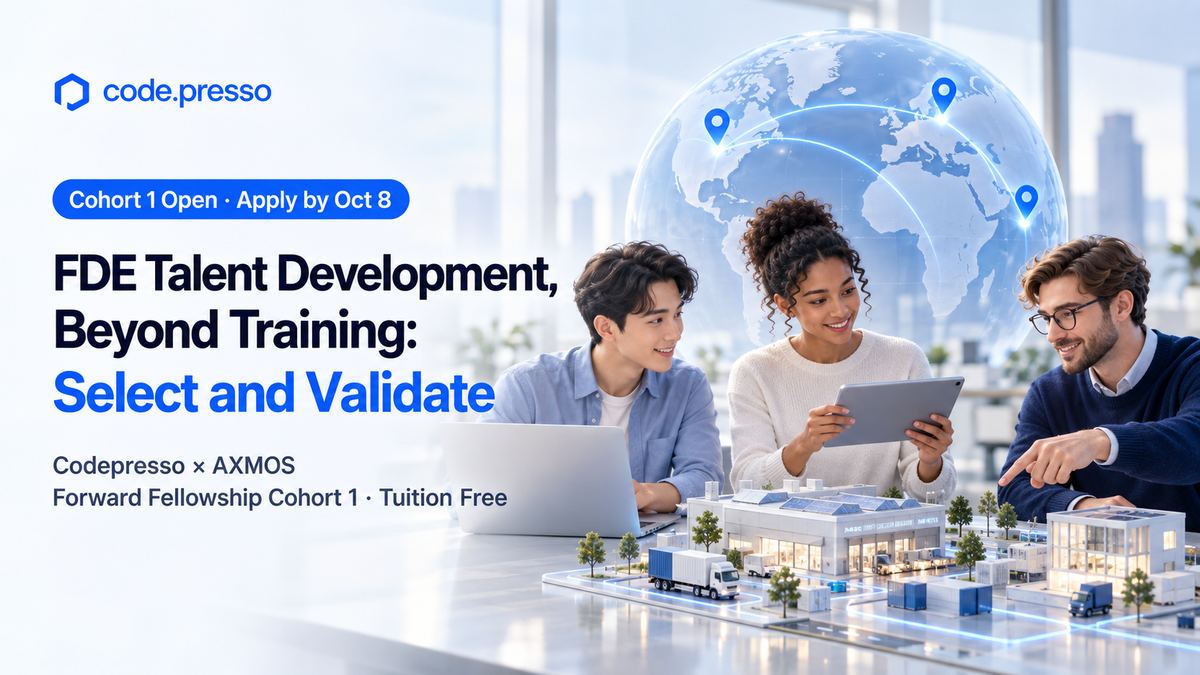
Forward Deployed Engineers (FDEs) cannot be developed through classroom training alone. Here are four ways companies can secure FDE talent, and how Codepresso’s seven-week Forward Fellowship identifies, develops, and validates future FDEs through real-world AI transformation projects.
|
One-Minute Summary 💡 |
A Forward Deployed Engineer (FDE) works directly with client organizations to identify business problems, implement AI solutions, and take responsibility for ensuring those solutions create meaningful operational change. According to a Financial Times report citing Indeed Hiring Lab analysis, monthly job postings for FDE positions increased by more than 800% between January and September 2025. Demand for Forward Deployed Engineers is also expanding rapidly in South Korea. Codepresso believes that FDE capability is not something that can be created through lectures alone. The better approach is to identify people who already demonstrate the right problem-solving potential, refine their capabilities, and validate them in real business environments.
That is why Codepresso, together with the
AXMOS Consortium, is launching
Forward Fellowship,
Korea’s first global fellowship dedicated to developing Forward
Deployed Engineers through a
seven-week selection, assessment, mentoring, and enterprise AI
project process.
Cohort 1: Oct. 12, 2026
Apply by: Oct. 8
Duration: 7 weeks
Cost: Fully funded
|
One Forward Fellow who majored in U.S. law and political philosophy is currently automating settlement operations for Namdo Market, a wholesale commerce platform.
Hundreds of receipts arrive from wholesalers every day. Employees previously had to manually check product names, quantities, amounts, and vendors one by one. The Fellow is now building an AI workflow that reads those receipts automatically and reconciles them against order data.
This Fellow did not major in software engineering. Yet the work they are doing is precisely what a Forward Deployed Engineer does.
In this article, we explain what an FDE is, how companies can secure FDE talent, and how Codepresso’s Forward Fellowship is designed to identify and develop the next generation of AI implementation professionals.
What Is a Forward Deployed Engineer (FDE)?
FDE stands for Forward Deployed Engineer.
Unlike engineers who remain within a centralized product or development team, FDEs work directly within customer environments. They learn how the organization operates, identify the problems that matter most, design and implement AI-powered solutions, and remain involved until those solutions produce measurable business results.
The role was originally established and popularized by data analytics company Palantir in the early 2010s. Palantir still describes its Forward Deployed Software Engineer position as the original forward-deployed engineering role.
An FDE's work can generally be divided into three stages.
1. Identify the Right Problem in the Field
The FDE first develops a deep understanding of the client’s industry, workflows, constraints, and business priorities. Rather than simply receiving specifications, the FDE helps determine which problem should actually be solved.
2. Build the Solution with AI
The FDE then designs and implements an AI solution that works within the organization’s actual operational environment, systems, data, and constraints.
3. Drive Real Operational Change
Deployment is not the end of the job. The FDE continues improving the solution until it becomes embedded in the workflow and produces measurable business outcomes.
When venture capital firm Andreessen Horowitz (a16z) announced its FDE Fellowship in May 2026, it described strong FDEs as professionals who combine technical depth with customer empathy, navigate complex organizations, earn stakeholder trust, and deliver measurable outcomes.
You can learn more about the origins and responsibilities of the role in the AXMOS article, “What Is a Forward Deployed Engineer (FDE)?”

Why Is FDE Talent Development Becoming So Important?
The biggest bottleneck in enterprise AI adoption is shifting.
Previously, organizations spent significant time selecting and accessing AI models. Today, powerful generative AI models can often be integrated through a simple API. The difficult part is no longer simply gaining access to AI.
The real challenge is integrating AI into a specific organization’s workflows, data, systems, and people, and turning that integration into measurable operational results.
That work still requires people operating close to the business. As a16z has noted, much of what happens in the field with AI-native products today goes beyond traditional deployment. It increasingly resembles research and development conducted directly inside the customer environment.
The growing demand for FDE talent is already visible in hiring data. According to a Financial Times report citing analysis from Indeed Hiring Lab, monthly job postings for Forward Deployed Engineers increased by more than 800% between January and September 2025.
South Korea is seeing the same trend. In September 2026, AI Times reported that companies including MakinaRocks, CJ Olive Young, Superb AI, S2W, Day1Company, Madras Check (Flow), Allganize Korea, and 42Maru had adopted or begun developing FDE roles.
Channel Corporation, the company behind Channel Talk, has also recruited for Forward Deployed Engineer positions.
In a 2025 interview, Korean Deep Learning CEO Jihyun Kim described the role as one requiring professionals to fully understand both customer communication and technology.
That combination is difficult to find. As job openings grow faster than the supply of experienced FDEs, more companies are beginning to explore ways to develop Forward Deployed Engineers internally rather than relying exclusively on external hiring.
How Is an FDE Different from a Software Engineer or Consultant?
A Forward Deployed Engineer combines three capabilities that are often distributed across separate roles: the implementation skills of a software engineer, the problem-definition skills of a management or IT consultant, and the domain understanding of a business practitioner.
The differences become clearer when the roles are compared directly.
| Category | Software Engineer | Management / IT Consultant | Forward Deployed Engineer |
|---|---|---|---|
| Primary workplace | Internal development organization | Client site during a project | Client environment until outcomes are achieved |
| Defines the problem | Product manager / planner | Consultant | FDE |
| Implements the solution | Engineer | External or internal development team | FDE |
| Primary accountability | Feature or product release | Report or roadmap | Measurable operational improvement |
| Core capabilities | Coding and system design | Analysis and communication | Problem definition + AI implementation + operational adoption |
Because an FDE must perform all three functions, experienced candidates are naturally difficult to find in the hiring market.
How Can Companies Secure Forward Deployed Engineer Talent?
There are four main approaches:
- Hiring experienced FDEs
- Transitioning existing employees into FDE roles
- Recruiting graduates from external FDE training programs
- Partnering with selective FDE fellowships
Each option works best under different circumstances.
| FDE Talent Strategy | Advantages | Limitations | Best Fit |
|---|---|---|---|
| Hire experienced FDEs | Candidates can contribute immediately | Limited talent supply and intense compensation competition | Large enterprises and AI-native companies |
| Transition internal developers or domain experts | Existing employees already understand the organization and domain | Additional AI implementation and problem-definition training is required; validation standards may be unclear | Manufacturing, finance, and other industries with strong internal domain expertise |
| Recruit graduates from paid external training programs | Structured curriculum | Course completion alone does not prove field capability; additional validation is often needed before deployment | Companies with training budgets and internal assessment systems |
| Partner with a selective fellowship such as Forward Fellowship | Candidates undergo selection, assessment, mentoring, and real enterprise projects before internship or hiring; no training cost | Cohort size and schedules are fixed | Companies planning AI transformation projects and looking for validated junior FDE talent |
The first three approaches often begin with an assumption:
If we train someone sufficiently, they can become an FDE.
Codepresso takes a somewhat different view.During a Forward Fellowship planning meeting on August 27, 2026, Codepresso CEO Donghoon Lee explained the philosophy behind the program:
“We do not believe FDE capability can simply be taught. It is closer to finding people who already have the potential, refining that capability, and selecting those who demonstrate it.”
This is why Forward Fellowship emphasizes selection and real-world validation rather than classroom instruction alone.
How Does the Forward Fellowship FDE Development Program Work?
Forward Fellowship is Korea’s first global fellowship dedicated to developing Forward Deployed Engineers. The program is operated by Codepresso together with the AXMOS Consortium.
AXMOS, short for AX for Manufacturing OS, is a manufacturing AI transformation consortium launched in March 2026. Within the consortium, Codepresso is responsible for AI transformation education and talent development.
If FDE is the name of the profession, Forward Fellowship is the journey toward becoming one. Participants are called Forward Fellows.
Cohort 1 begins on Monday, October 12, 2026, and concludes with a Demo Day at the end of November. The seven-week program consists of five weeks of online learning and assessment followed by two weeks of intensive offline enterprise project work.
The same curriculum is delivered across four Korean hubs, Seoul/Gyeonggi, Jeonbuk, Daegu/Gyeongbuk, and Busan/Gyeongnam, as well as international hubs in Singapore, Austin, Texas, and Atlanta, Georgia.
Training, assessment, mentoring, and project participation are fully funded.
| Week | Program | Content | Assessment |
|---|---|---|---|
| Weeks 1–2 | Foundation Program — Online | Weekly live session of approximately two hours, self-directed learning, assignments | Assignment evaluation and competency assessment |
| Week 3 | Foundation Program — Offline Hub | In-person mentoring by regional hub and mid-program presentation | Learning progress review |
| Weeks 4–5 | Foundation Program — Online | Selection for advanced-stage participation | Competency assessment |
| Week 6 | Advanced Program — Seoul Offline | Team formation, enterprise AI transformation project kickoff, intensive mentoring | Mid-project evaluation |
| Week 7 | Advanced Program — Seoul Offline | Project completion and Demo Day | Selection of outstanding Fellows |
The initial selection process includes: application screening, optional online AI and Python competency assessments that provide additional consideration, and interviews.
Participants continue to be evaluated throughout the fellowship. Weekly competency assessments determine who advances to the next stage. Outstanding Forward Fellows may receive additional opportunities.
Overseas Internship Opportunities
Selected Fellows may participate in international AI transformation internships, subject to separate visa and language requirements.
Internship and Employment Matching in Korea
High-performing Fellows may be connected with partner companies for internships and full-time employment opportunities.
Support for the CP-FDE Private Certification
Participants may also receive support for obtaining CP-FDE _ Codepresso Forward Deployed Certification, a private qualification registered by Codepresso on September 3, 2026.
Registration number: 2026-006518
CP-FDE is a privately registered qualification and is not a government-accredited national certification.
Partner companies, hiring processes, and joint project structures involving Korea, the United States, and Singapore may change depending on participating companies and partnership agreements.
What Problems Do Forward Deployed Engineers Solve in the Real World?
The work of an FDE is often less about developing a sophisticated new AI model and more about automating repetitive, manual business processes from beginning to end.
Six AI transformation projects completed by Forward Fellows demonstrate the nature of this work.
| Industry | AI Transformation Project | Before | After | Impact |
|---|---|---|---|---|
| Finance / Venture Capital | Automated consolidation of operating reports from 100 portfolio companies | 3–5 days | Approximately 1 hour | 90% reduction in processing time |
| Logistics | AI automation for 400,000 monthly delivery inquiries | Handled by customer service agents | AI handles 90%, 24/7 | Human agents focus on complex cases |
| Healthcare / Ophthalmology | Automated eye examination image processing and chart storage | 5–9 minutes per patient | 2 minutes | 75% faster, zero incorrect file placements |
| Tax / Accounting | Automated corporate tax report and invoice generation | 10–20 hours for 20 corporations | 30 minutes | 95% reduction |
| E-commerce | Automated settlement and statement delivery for 100 sellers | 2–3 hours | 30 seconds | 99% reduction |
| Content / Media | Automated short-form video creation from scripts | 2–4 hours per video | 5 minutes | 95% reduction, 5× daily production volume |
Across all six cases, the person who identified the problem, built the solution, and drove adoption in the field was the same person.
That is the essence of Forward Deployed Engineering.
Who Can Become a Forward Deployed Engineer?
Your major or previous job title does not necessarily determine whether you can become an FDE.
Forward Fellowship places greater emphasis on one characteristic: the persistence to stay with a difficult problem until it is solved.
Cohort 1 is open to applicants with a bachelor’s degree or higher, including students expected to graduate by February 2027.
Applicants from any academic major, industry, or professional background may apply. Current employees and job seekers are evaluated through the same selection process.
The following are preferred qualifications, but they are not mandatory requirements: AI competency, Python competency, Business English, AI project experience, Industry or domain expertise.
The Fellow introduced earlier made a similar observation in an interview with Codepresso. Because they were not a software developer, they tended to begin with the business problem rather than the system.
Their first question when entering the workplace was simple:
“How do you currently do this work?”
The Fellow explained:
“I think being a non-developer can actually mean that I am able to understand the field more deeply.”
This is also why Codepresso does not impose strict academic-major restrictions during open recruitment. Strong FDE potential can come from unexpected backgrounds. The purpose of assessment is to discover that potential.
Codepresso has already been evaluating employee AI capabilities through AI Fluent and practical technology competencies through SkillCertify.
Forward Fellowship applies a similar philosophy to FDE selection. The key question is not whether someone completed a training course. It is whether they can identify a real problem, build a working AI solution, and carry that project through to measurable results.

What Should You Check Before Applying?
Before applying for Forward Fellowship Cohort 1, confirm these three points.
- You can commit to the seven-week program from October 12 through the end of November.
- You can participate in the Week 3 regional offline session and, if selected for the advanced stage, attend the Week 6–7 offline enterprise project in Seoul.
- You have a business or industry problem you have encountered or are deeply interested in that you would like to solve with AI.
If the third point applies to you, describe that problem as specifically as possible in your application.
Your experience of staying with a difficult problem until it is solved may be exactly the kind of persistence Forward Fellowship is designed to identify.
Frequently Asked Questions
Do I Need to Be a Software Developer to Become an FDE?
No.
Forward Deployed Engineers need three core capabilities: problem definition, AI implementation, and operational adoption.
Coding is one component of the role, but it is not the entire role.
Forward Fellowship Cohort 1 accepts applicants regardless of academic major or professional background. AI and Python competency can provide additional consideration during selection, but they are not mandatory entry requirements.
However, participants must pass ongoing competency assessments throughout the seven-week program to advance to later stages.
How Is Forward Fellowship Different from Other FDE Training Programs?
Forward Fellowship places greater emphasis on selection and validation than on course completion.
Participant capabilities are assessed every week through assignments, presentations, competency evaluations, and enterprise AI projects.
Only Fellows who successfully pass the required stages advance to the intensive offline enterprise project phase.
Participation is fully funded.
Outstanding Fellows may also receive opportunities for international internships, employment matching with Korean partner companies, and support toward the CP-FDE private certification.
Can I Participate While Working Full-Time?
Yes.
Weeks 1–5 primarily consist of one approximately two-hour live session per week combined with online self-directed learning.
However, participants must be able to attend the regional offline program during Week 3.
Those selected for the advanced stage must also participate in the offline enterprise project in Seoul during Weeks 6–7.
How Can Companies Hire Forward Fellows or Participate in Enterprise AI Projects?
Forward Fellowship connects high-performing Fellows with Korean partner companies for internship and employment opportunities.
During Weeks 6–7, Fellows also work on real enterprise AI transformation projects based on actual business challenges.
Companies interested in hiring Forward Fellows or participating as project partners can contact:
Where Can I Apply or Ask Questions?
Applications for Forward Fellowship Cohort 1 are open until Thursday, October 8, 2026 through the official Forward Fellowship website.
For both applicant inquiries and corporate partnership inquiries, contact:
References
- AXMOS — Forward Fellowship Cohort 1
- a16z — “Introducing the a16z FDE Fellowship,” May 28, 2026
- Financial Times — “The New Hot Job in AI: Forward-Deployed Engineers,” November 2, 2025, citing Indeed Hiring Lab analysis
- AI Times — FDE Adoption and Growing Training Demand, September 25, 2026
- Channel Corporation — Forward Deployed Engineer Recruitment
- Palantir — Forward Deployed Software Engineer
Contact: axmos@codepresso.io
Written by Codepresso Global GTM & Partnerships (GGP) | Last updated October 1, 2026