
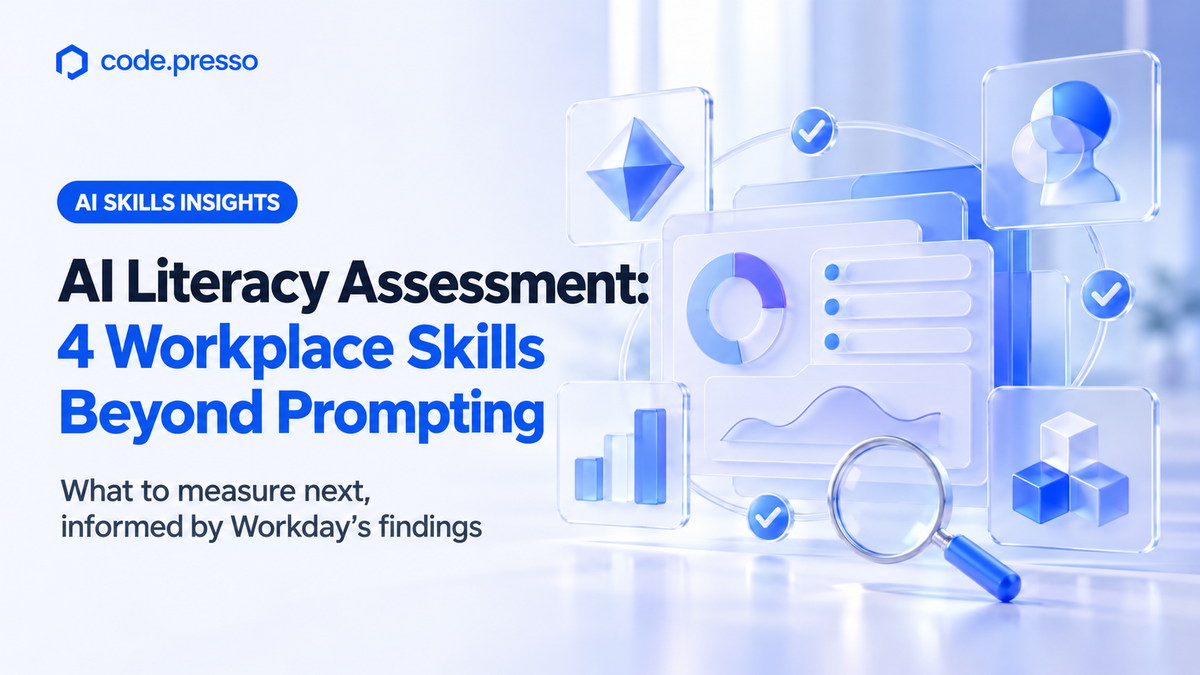
AI Literacy Assessment: 4 Workplace Skills Beyond Prompting

|
One-Minute Summary 💡 |
Workday’s analysis of job postings from more than 550 employers found that demand for basic AI skills fell 25% after peaking in January 2026. Meanwhile, demand for AI tool development, workflow automation, and AI engineering increased 51% between September 2025 and July 2026.
550+ employers analyzed
−25% basic AI skill demand
+51% advanced AI skill demand
For employers, these findings raise a practical question:
Does your AI literacy assessment measure what employees can
actually do at work?
An effective assessment should examine practical workplace capability, not only knowledge of AI concepts or tools.
1. Task Structuring
Can employees break down work and define what AI should handle?
2. Output Validation
Can they review AI-generated results for accuracy and usefulness?
3. Responsible Judgment
Can they make appropriate decisions about risk, privacy, security,
and human oversight?
4. Usable Deliverables
Can they turn AI-assisted work into a finished output that can
actually be used in the workplace?
|
Prompting skills alone can no longer fully describe the AI capabilities employers need. Workday’s global workforce report, released on October 5, 2026, points to growing demand for more advanced, practical applications of AI.
An AI literacy assessment measures whether someone understands AI’s capabilities and limitations, can apply it to real work, can verify its outputs, and can take responsibility for the final decision.
Knowledge of tool names or prompting formulas provides only part of that picture.
This article helps HR and learning and development leaders identify what to include in an AI literacy assessment. It examines Workday’s findings alongside the assessment structure of Codepresso’s AI Fluent.
What Should an AI Literacy Assessment Measure?
An AI literacy assessment should establish whether employees can define a work objective, review AI-generated results, and turn them into a usable deliverable.
For workplace assessment, four areas deserve attention: AI understanding, practical application, output validation, and responsible judgment. Each can be evaluated through tasks relevant to the employee’s role.
| Assessment Area | What Employers Should Ask | Evidence to Review |
|---|---|---|
| AI understanding | Can the employee distinguish tasks AI can support from decisions requiring human judgment? | Task breakdown and defined scope of AI use |
| Practical application | Can the employee delegate work with clear objectives and requirements, then complete a usable deliverable? | Prompt histories and intermediate outputs |
| Output validation | Can the employee identify and correct factual errors, omissions, bias, and formatting problems? | Review records and outputs before and after revision |
| Responsible judgment | Can the employee recognize security, copyright, and privacy risks while retaining human responsibility for final decisions? | Supporting evidence and approval or rejection records |
Multiple-choice questions can help assess foundational knowledge across a large workforce. To understand practical capability, however, organizations also need evidence of how employees perform a task.
Two employees may produce similar answers through very different processes. Their instructions, error detection, and reasons for accepting or rejecting an output reveal important differences in capability.
Our Guide to Choosing an AI Competency Assessment Service explains how to evaluate assessment providers. Here, we apply those considerations to the four areas of AI literacy.
What Does Workday’s Report Reveal About Demand for AI Skills?
Workday’s report indicates that employers are increasingly seeking people who can build AI tools and automate workflows.
Demand for basic AI skills fell 25% after its January 2026 peak. Demand for AI tool development, workflow automation, and AI engineering grew 51% between September 2025 and July 2026.
These figures come from anonymized skills data in job postings from more than 550 employers using Workday Recruiting. They suggest that employers are becoming more specific about the capabilities they expect beyond experience using AI tools.
| Finding | Figure | Implication for Learning and Development |
|---|---|---|
| Demand for basic AI skills | Down 25% after peaking in January 2026 | Training needs to extend beyond tool introductions and sample prompts |
| Demand for AI development, automation, and engineering | Up 51% from September 2025 to July 2026 | Assessment should examine role-specific workflows and practical deliverables |
| Employees who know which skills they need | 79% | Employees already recognize the need to develop their skills |
| Employees who say their company supports skill development | 66% | A 13-percentage-point gap exists between awareness and perceived organizational support |
Workday also conducted a separate survey of 6,000 full-time employees and business leaders.
The 13-percentage-point gap between knowing which skills to develop and feeling supported by an employer points to a broader learning challenge. Offering a course is one step. Organizations also need to assess current capability, assign relevant practice, and evaluate progress using consistent criteria.
Is Prompt Training Enough for Corporate AI Education?
Prompt training is necessary, but it is only one part of working effectively with AI.
Employees also need to define tasks, validate outputs, improve results through revision, and apply their work in a real business setting.
Following a well-designed example during a workshop can produce a convincing result. Back at work, employees face additional requirements: internal document formats, customer data protection, approval processes, and department-specific quality standards.
Meeting those requirements depends on understanding the task and knowing how to review the result.
In the non-technical AI training examples discussed in our October 2 article, few programs explicitly described post-training assessment. Our subsequent guide to four steps for workplace adoption after generative AI training explained how task selection, deliverable creation, application records, and reassessment can form one connected learning process.
Prompting is the starting point. AI literacy also includes deciding whether an output is suitable for work—and knowing how to correct it when it is not.
A practical curriculum should therefore ask participants to select a real task, define what AI will do, identify what a person must review, and submit both the completed deliverable and a record of revisions.
How Do Workday’s Findings and AI Fluent Serve Different Purposes?
Workday’s report shows how demand for skills is changing across employers. AI Fluent assesses the current capabilities of people within a specific organization.
Codepresso’s approach uses role-specific tasks to evaluate both the working process and the final result against a shared competency model.
| Dimension | Workday Global Workforce Report | Codepresso AI Fluent |
|---|---|---|
| Purpose | Identify changes in skills demand through recruiting and workforce data | Assess current AI competency at individual and organizational levels |
| Population | Job postings from more than 550 employers, plus a separate survey of 6,000 employees and leaders | Employees in marketing, HR, business administration, customer service, R&D, software development, and other roles |
| Evidence | Skills listed in job postings and survey responses | Prompt histories, intermediate outputs, and final deliverables |
| Evaluation structure | Trends in demand across the analyzed market | Role-specific tasks, a shared organizational competency model, and four proficiency levels |
| Connection to training | Indicates which skills are becoming more sought after | Connects baseline assessment, tailored learning, and reassessment to measure progress |
AI Fluent offers seven tracks and four competency levels: Entry, Beginner, Intermediate, and Professional.
Tasks vary by job function, while a shared scoring framework enables comparison across departments. Assessing prompt histories and intermediate outputs alongside final deliverables helps distinguish a strong result obtained by chance from one developed through deliberate review and revision.
For another example of connecting training with demonstrated performance, see Anthropic’s Practical Assessment and Reassessment After a 12-Week Residency.
As employers place greater emphasis on practical capability, internal training completion standards should also include evidence that employees can apply their learning at work.
How Does Individual AI Literacy Assessment Differ from Organizational Assessment?
An individual assessment identifies what one employee can do with AI and where they need development.
An organizational assessment reveals the distribution of capabilities across departments and highlights shared gaps that can inform training, role assignment, and governance.
Role-specific tasks combined with common scoring criteria provide a useful basis for these comparisons.
| Dimension | Individual Assessment | Organizational Assessment |
|---|---|---|
| Core question | What work can I perform effectively with AI? | Which roles and stages of work have capability gaps? |
| How results are used | Personal learning pathways, role assignment, and development goals | Training priorities, department-specific curricula, and an AI transformation roadmap |
| Required framework | Clear levels that explain individual proficiency | A shared competency model that supports comparison across job functions |
The purpose of organizational assessment is to identify common weaknesses and set development priorities.
One team may understand AI well but keep weak validation records. Another may be capable of automation but need stronger judgment about security risks.
Understanding these differences helps learning leaders direct resources toward the areas that need attention and tailor training accordingly.
How Should Organizations Measure AI Literacy Training Effectiveness?
Use the same competency model and practical tasks of comparable difficulty before and after training.
Completion rates and satisfaction scores remain useful operational indicators. Evidence of changes in working processes, output quality, and workplace application should be central to evaluating learning outcomes.
- Assess before training. Use role-specific tasks to identify current competency and development needs.
- Tailor learning to proficiency. Adjust task difficulty and learning content to assessment results, including differences among employees in the same role.
- Require workplace deliverables. Ask participants to submit documents, analyses, or automation outputs that can be used in actual work.
- Reassess using consistent criteria. Score prompt histories, intermediate revisions, and final results again to identify changes in performance.
This approach gives learning leaders more meaningful evidence for year-end reporting. Alongside the number of employees who completed training, they can explain which capabilities improved, in which roles, and where further development is needed.

Frequently Asked Questions
What Does an AI Literacy Assessment Measure?
It measures understanding of AI’s capabilities and limitations, the ability to apply AI to work, the ability to validate outputs, and judgment about security, copyright, and privacy risks.
For workplace assessment, knowledge questions can be combined with practical tasks that capture prompt histories, intermediate outputs, and final deliverables.
Is Prompt Training Enough for Employees to Use AI Effectively?
No. A comprehensive program should also cover task breakdown, delegation boundaries, output validation, completion of practical deliverables, and reassessment after training.
Together, these elements help organizations evaluate workplace application and changes in competency.
Does an AI Literacy Assessment Need Coding Questions?
Not for every role.
Employees in HR, marketing, sales, and business administration can be assessed through realistic document, analysis, and decision-making tasks. Software development roles can use coding and system design tasks.
A shared competency framework should support comparison across these different assessments.
How Can We Plan AI Literacy Assessment and Training for Our Organization?
Contact sales@codepresso.kr to discuss role-specific AI Fluent assessments, training tailored to proficiency levels, and pre- and post-training evaluation.
Share your target job functions, participant count,
and any AI
When Should Employees Recheck What AI Remembers?
Learn how to verify the sources and validity of information AI remembers, practice updating changing business requirements, and assess employee competency before and after training.
One-Minute
Summary 💡
*
1
Meta announced Muse Wonder on October 12, 2026,
introducing Active Memory to carry important Measure AI ROI beyond usage rates. Explore three priorities, clear accountability, cost visibility, and business outcomes, and why employee AI skills matter.
One-Minute
Summary 💡
AI adoption is growing rapidly, yet only
7% of leaders reported achieving a return on their
AI investment, according to KPMG’s 2026 survey of Learn how to separate AI training environments from live business operations, and assess whether employees know when to stop, report an issue, and seek approval before continuing.
One-Minute
Summary 💡
*
1
On October 9, 2026, Anthropic disclosed
four categories of unintended AI behavior
observed during internal evaluations and use. These Learn how to check source data, calculation rules, and refresh times in AI-generated reports, and assess employees’ verification skills before and after training.
One-Minute
Summary 💡
*
1
Anthropic announced Claude Dashboards on
October 8, 2026, introducing features that let users inspect
how chart figures are calculated and
when theRead more
AI Memory in the Workplace
How to Measure AI ROI: 3 Priorities Beyond Adoption Rates
Safe AI Training: Prevent Accidental Submissions
How to Verify AI-Generated Analytics: Numbers & Data Accuracy