How AI Agents Are Transforming Marketing: The Pizza Hut AX Grow Case Study

We recently delivered Day 1 of AX Grow, AXMOS’s organizational AI transformation program, for Pizza Hut Korea’s Brand, CRM, and Digital marketing teams.
The session explored how work is changing in the AI-native era, how AI agents differ from traditional AI chatbots, and how agents can support real marketing workflows. Through live demonstrations, participants saw an AI agent create a competitor trend brief, reconcile coupon settlements, and build an interactive sales dashboard.
These demonstrations were based on questions the Pizza Hut Korea marketing team encounters in its day-to-day work:
- What new menu items and promotions have competing pizza brands launched this month?
- Why do Pan Pizza and Rich Gold appear to drive repeat purchases?
- Have this month’s coupon settlements been accurately reconciled across stores?
- Which time slots, lunch or dinner, are most effective for promotions?
Because these questions span the Brand, CRM, and Digital teams, we incorporated them directly into the Day 1 demonstration scenarios.
The session was more than an introduction to AI tools. It focused on a more fundamental shift: What is the difference between asking AI for an answer and delegating an entire task to AI? What makes that shift possible? And how much of a marketer’s day-to-day work can an AI agent actually handle?
Pizza Hut entered the Korean market in 1985 and has operated in the country for more than 40 years. Today, the company is strengthening its position as the “original premium” pizza brand. At the same time, as the market continues to shift toward delivery and digital channels, marketing teams face growing pressure to move faster and make decisions based on increasingly complex data.
We previously introduced the overall program in Introducing the AX Grow Program. In this article, we take a closer look at what Pizza Hut Korea’s marketing team experienced during Day 1.
How Will Marketing Work Change in the AI-Native Era?
Over the past two years, marketing has undergone a quiet but fundamental transformation.
Market research, recurring reports, data consolidation, and customer review analysis are among the areas most affected by AI. We began the training by explaining this transformation in three phases.
Phase 1: Working without AI
In this phase, marketers perform most tasks manually. They consolidate weekly sales data from Excel files exported from the company’s app and delivery platforms. They reconcile coupon settlements by comparing usage records with store claims one by one. They read customer reviews individually and research competitor trends by visiting websites and manually recording new products, prices, and promotions.
Phase 2: “Asking” AI
In this phase, marketers use prompts such as “Summarize these reviews” or “Organize this sales table” and receive a written response.
Although the answer may be useful, someone still needs to transfer the information into a report, checklist, presentation, or dashboard. As a result, marketers may feel that they are using AI while seeing little change in their actual workload or overtime hours.
This is where many professionals are today.
Phase 3: “Delegating” work to AI
In this phase, the user gives AI a goal rather than asking a single question.
For example:
“Read this week’s sales Excel file and create a dashboard with charts organized by channel and time slot.”
The AI agent can read the data, perform the necessary calculations, and build the interface. The marketer’s role shifts from completing every step manually to setting the direction, reviewing the results, and making decisions.
Day 1 focused on the transition from Phase 2 to Phase 3. Even when the task itself remains the same, the amount of hands-on work required can change dramatically depending on whether marketers are asking AI for help or delegating the workflow to an agent.
How Are AI Agents Different from the AI Tools We Have Used Until Now?
The technological shift that makes Phase 3 possible is the emergence of AI agents.
During the training, we explained the difference with a simple analogy:
A chatbot is like a call center representative who answers your questions verbally. An AI agent is like a junior colleague sitting beside you who can use tools to produce an actual deliverable.
There are three key differences.
First, AI agents can execute tasks, review their work, and determine what to do next.
After receiving a goal, an agent creates a plan (Think), uses tools to carry it out (Act), evaluates the results (Observe), and then returns to the planning stage. It repeats this process until it reaches the goal.
During the demonstrations, participants could see the agent calling tools to read and write files, execute commands, and perform other actions in real time. This was the agent’s execution loop at work.
Second, agents produce more than text, they can create files and working interfaces.
When asked, “How did sales perform this week?” a chatbot might provide a written summary.
When instructed to “Create a sales performance dashboard from this Excel file,” an AI agent can produce a functioning dashboard. It can open and analyze Excel files and documents, browse competitor websites, and work across business applications such as email, calendars, and cloud storage.
Users do not necessarily need to write the code themselves. They can describe the desired outcome in natural language and have the agent build the required tool or interface. This approach is commonly known as vibe coding.
Third, AI becomes more reliable when it has access to stronger evidence.
AI hallucinations, plausible-sounding but inaccurate outputs, are not simply random errors. They are a characteristic of how language models generate responses and become more likely when the model lacks sufficient supporting information.
To improve reliability, agents can be grounded in four primary sources of evidence: the web, files, previous conversations, and memory.
For example, when an agent receives a complete set of customer review data, it can answer questions while citing its sources and reporting how often certain topics were mentioned. The training also introduced practical prompting frameworks because the quality of an agent’s results depends heavily on how clearly the task, context, and expected output are defined.
How Did the Agent Address Questions from the Brand, CRM, and Digital Teams?
Instead of explaining these capabilities through theory alone, we demonstrated them live.
We used questions that the three marketing teams genuinely wanted to explore and showed how an agent could process them in real time.
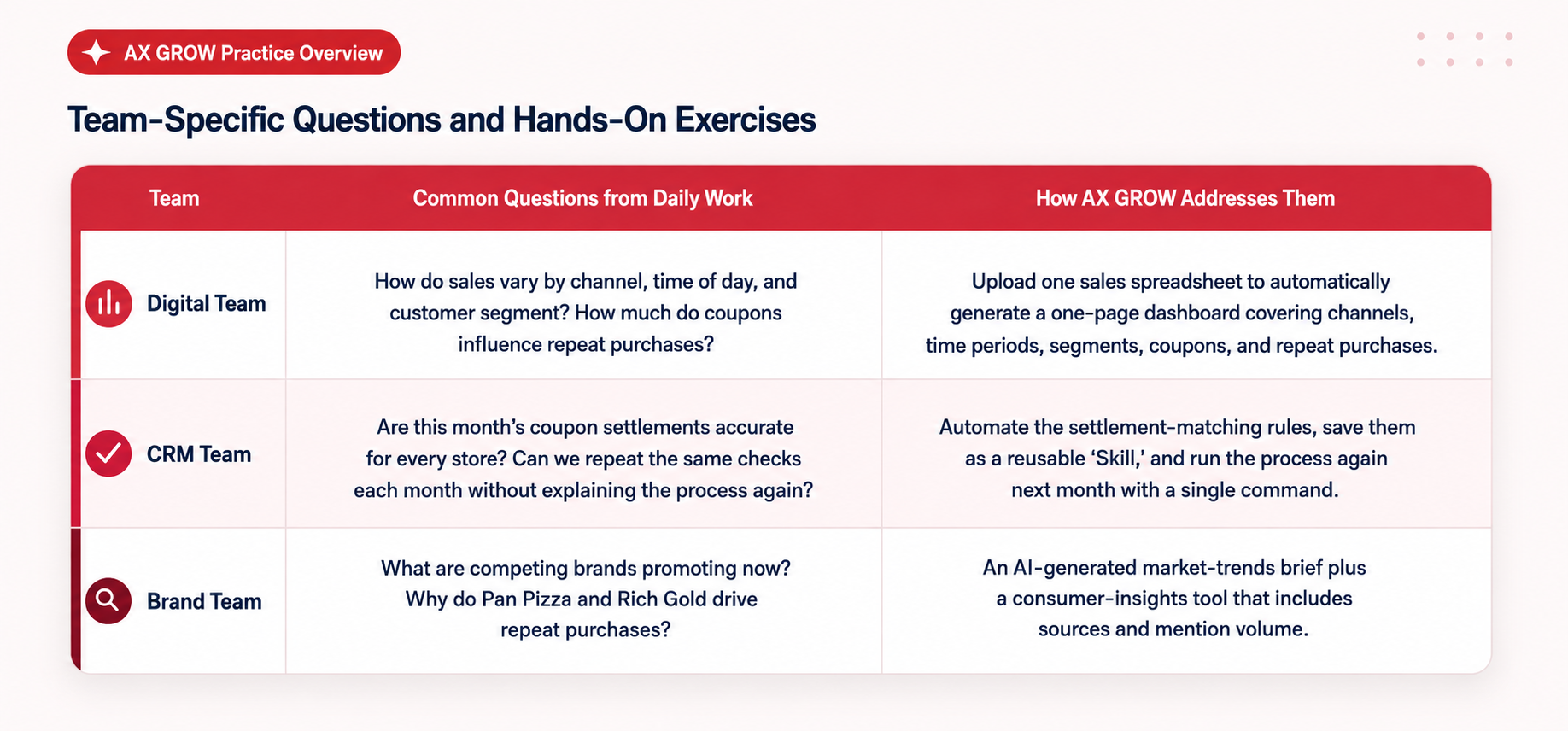
The Brand team focused on competitor activity, consumer trends, and brand perception. The CRM team focused on coupon settlements and performance reporting. The Digital team focused on sales and event data.
Based on these priorities, the Day 1 demonstrations were organized into three areas.
Digital Team: Analyzing Sales by Channel, Time Slot, and Customer Segment
The Digital team wanted to analyze sales from Pizza Hut’s app and third-party delivery platforms by channel, product category, customer age and gender, and time slot, particularly lunch and dinner.
The team also wanted to examine repeat-purchase cycles and the impact of coupon usage.
For the demonstration, we uploaded a single Excel file containing sales data and described the desired interface in natural language. The agent then created a dashboard that brought together channel-level sales, time-based trends, customer segments, coupon performance, and repeat-purchase metrics on one screen.
When we asked the agent to add another customer segment, it immediately recalculated the relevant figures and updated the dashboard.
The key takeaway was straightforward: time previously spent producing the numbers could instead be used to interpret those numbers and design more effective marketing campaigns.
CRM Team: Turning Coupon Reconciliation into a Reusable Asset
The CRM team wanted to improve the accuracy and efficiency of monthly coupon reconciliation, a process in which settlement rules may vary by store or coupon type.
The task involves comparing coupon usage records with store settlement claims to identify mismatched amounts, unclaimed balances, overcharges, duplicate claims, and coding errors.
During the demonstration, the agent performed these checks and flagged exceptions. We then went one step further by saving the reconciliation rules as a reusable Skill.
Next, we opened a new session, uploaded the following month’s data, and invoked the same Skill with a single instruction. The agent repeated the reconciliation process using the previously defined rules.
The result was more than a one-time deliverable. The team gained a reusable asset that could support the same process every month.
Brand Team: Connecting Scattered Market and Consumer Signals
The Brand team is responsible for understanding market trends, competitor activity, and consumer sentiment.
The team wanted to know which new products and promotions competing pizza brands were launching and which themes were emerging across customer reviews, social media, and online communities.
During the demonstration, the agent used a browser to visit competitor websites, review new menu items and promotions, and organize the findings into a concise, one-page brief.
We then provided the agent with consumer feedback collected from delivery app reviews, social media, and online communities. It analyzed the materials and generated evidence-based answers that included source references and mention counts.
This allowed the team to explore questions such as how consumers were responding to Pizza Hut’s “original premium” positioning and why Pan Pizza and Rich Gold appeared to drive repeat purchases—all while grounding the analysis in supporting evidence.
What Remains After the Demonstration Ends?
The most important outcome is not the dashboard or competitor brief itself. It is the ability to create them again.
The immediate deliverables are valuable, but AX Grow is designed to leave participants with something more lasting: an understanding of how to build the solution when a similar need arises, supported by reusable prompts and Skills.
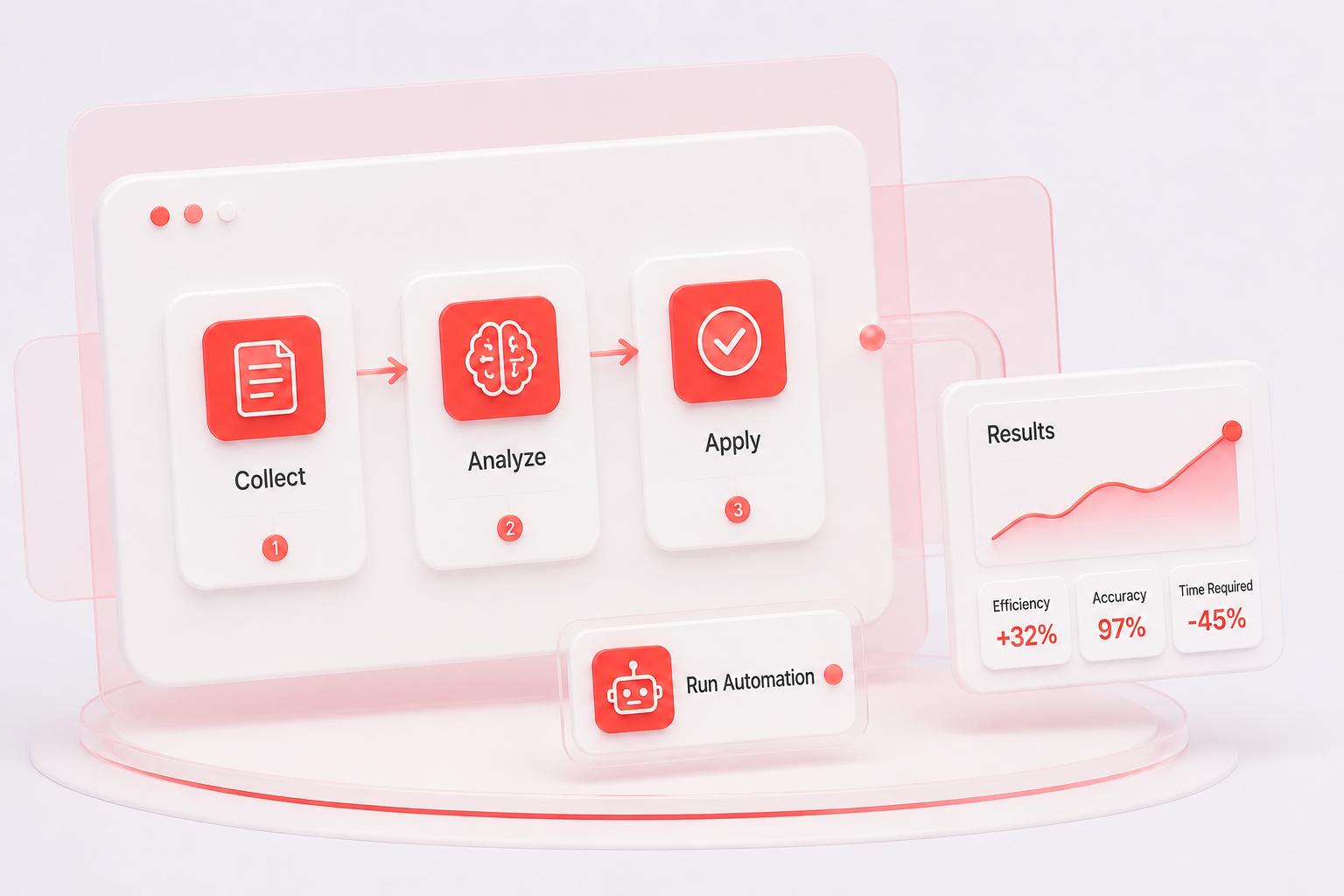
There is a fundamental difference between having AI create a report for a marketer once and enabling that marketer to create and adapt reports independently in the future.
Day 1 gave participants an opportunity to see that potential firsthand. The next step is for them to bring their own workflows into the program and begin building solutions themselves.
Once team members can investigate business questions independently, the benefit extends far beyond faster execution. Instead of submitting a request to another department and waiting for a response, they can open the relevant data, test their questions, and explore the results in real time.
Ultimately, becoming a truly data-driven team means developing this capability until it becomes part of the team’s everyday way of working.

Frequently Asked Questions
How is an AI agent different from an AI chatbot such as ChatGPT?
A chatbot primarily responds to questions with text. An AI agent receives a goal, selects and uses the appropriate tools, and produces actual deliverables.
The key difference is the agent’s iterative execution loop. It creates a plan (Think), uses tools to complete actions (Act), reviews the results (Observe), and then determines what to do next.
As a result, its output is not limited to text. An agent can also produce files, tables, dashboards, and working interfaces.
Did the demonstrations use actual Pizza Hut sales, coupon, or customer review data?
No. All information used during the training was synthetic data created solely for educational purposes. It was not connected to Pizza Hut Korea’s actual sales, settlement, or consumer data.
The purpose of the training was to demonstrate the methodology—not to validate or present specific business results.
Day 1 focused primarily on demonstrations. Will participants have opportunities to build solutions themselves?
Yes. AX Grow is a multi-course program.
Day 1 helps participants understand what AI agents are and what they can accomplish by showing the technology in action. Participants then progress to AI Agent Onboarding, where they learn to connect business tools and delegate more complex tasks to AI agents.
The program also includes an intensive hands-on stage in which participants build tools tailored to their own work. This is where they turn what they observed during the demonstrations into practical solutions for their own teams.
Can this approach be applied to other marketing organizations?
Yes. This approach can be applied broadly to marketing organizations that manage recurring tasks such as sales analysis, coupon and CRM reconciliation, performance reporting, customer feedback analysis, and market research.
AX Grow helps participants identify repetitive work within their existing workflows and turn those tasks into hands-on training projects. This allows each team to determine where AI agents can create the greatest practical value in its specific business environment.