SK Hynix’s New Hiring Approach

When reading a polished application essay, recruiters may find themselves wondering: Did the candidate genuinely write and think through this response or did they simply ask AI to make it sound more impressive?
On July 30, 2026, SK hynix announced changes to its hiring process for the second half of the year. The company eliminated application essays and replaced traditional 20- to 30-minute interviews with half-day practical assessments.
At first glance, this might appear to be a routine administrative change. A closer look, however, reveals something more significant: a fundamental rethinking of how companies should evaluate talent in an era when AI is making individual outputs increasingly difficult to distinguish.
In this article, we examine why SK hynix replaced traditional application essays with half-day practical assessments, and what this shift suggests about the questions organizations should be asking not only during recruitment, but across the entire employee lifecycle.
SK Hynix Shifts from Essays to Skills-Based Hiring
The core changes to SK hynix’s hiring process are straightforward. Traditional application essay questions have been removed and replaced with a new application format in which candidates describe their AI capabilities and semiconductor expertise directly.
SK hynix will also conduct hub-based recruitment activities in four regions: Seoul, Cheongju, Daegu, and Gwangju. In the fourth quarter, the company plans to host an AI hackathon and offer high-performing participants a fast-track opportunity to bypass the document screening stage.
At the center of the new process is a half-day in-depth interview and practical assessment.
SK hynix explained the change as follows:
“We have redesigned our hiring system to move beyond résumé- and document-based evaluations and more closely assess candidates’ fundamental problem-solving abilities and practical capabilities.”
This approach reflects what SK Group Chairman Chey Tae-won has described as “thinking muscles”, the ability to question the fundamental nature of a problem and think critically about how to solve it.
But the real limitation of application essays was never their character count or question format.
The deeper issue was structural: candidates were being asked to describe their own capabilities in writing.
Now that AI can generate a polished first draft in seconds, it has become increasingly difficult to determine whether a well-written application reflects the candidate’s actual thinking and communication skills or the capabilities of the AI used to create it.
In that sense, self-reported application materials are becoming less effective at differentiating candidates.
Strong Candidates Prove Skills Through Execution
Traditional 20- to 30-minute interviews primarily measure a candidate’s ability to explain.
Can the candidate respond smoothly?
Can they organize their thoughts and communicate them clearly?
Can they present their experience and reasoning persuasively?
A half-day practical assessment, by contrast, gives evaluators greater visibility into how a candidate actually approaches and works through a problem.
What companies ultimately need is not simply the ability to explain; it is the ability to execute.
Research has repeatedly shown that strong interview performance does not always translate into equally strong workplace performance. This suggests a meaningful gap between explaining what you can do and demonstrating that you can actually do it.
SK hynix’s decision to introduce half-day practical assessments can therefore be viewed as an effort to narrow that gap.
Why Hiring Assessments Must Look Beyond Final Output
This is where the real challenge begins.
When candidates are allowed to use AI tools freely during an assessment, the quality gap between their final outputs may become much smaller.
Whether the task involves writing code, preparing a business proposal, or producing an analytical report, it can be difficult to determine from the final deliverable alone whether its quality reflects the candidate’s capabilities or those of the AI model they used.
Consider two candidates completing the same task.
The first gives AI a single instruction:
“Create this according to the requirements.”
The candidate then submits the result without reviewing or refining it.
The second candidate breaks the requirements into specific functions and constraints, defines the expected input and output formats, anticipates potential failure scenarios, and evaluates the AI-generated result against predefined criteria before requesting revisions.
The two candidates may ultimately submit deliverables that look very similar.
However, the second candidate’s interaction history reveals how they broke down the problem, established criteria, evaluated the output, and improved the result through iteration.
This is where traditional assessment methods based solely on the final deliverable begin to fall short.
If AI can help candidates produce similar outputs, organizations may need to evaluate not only what candidates produce, but also how they produce it.
Why Hiring Assessments Must Evaluate the Process
Codepresso’s AI competency assessment service, AI Fluent, was built around this principle.
Its core objective is:
Measure not only what people know about AI, but also their ability to produce meaningful results with it.
Rather than asking candidates to complete conventional test questions, AI Fluent presents them with practical, work-based assignments.
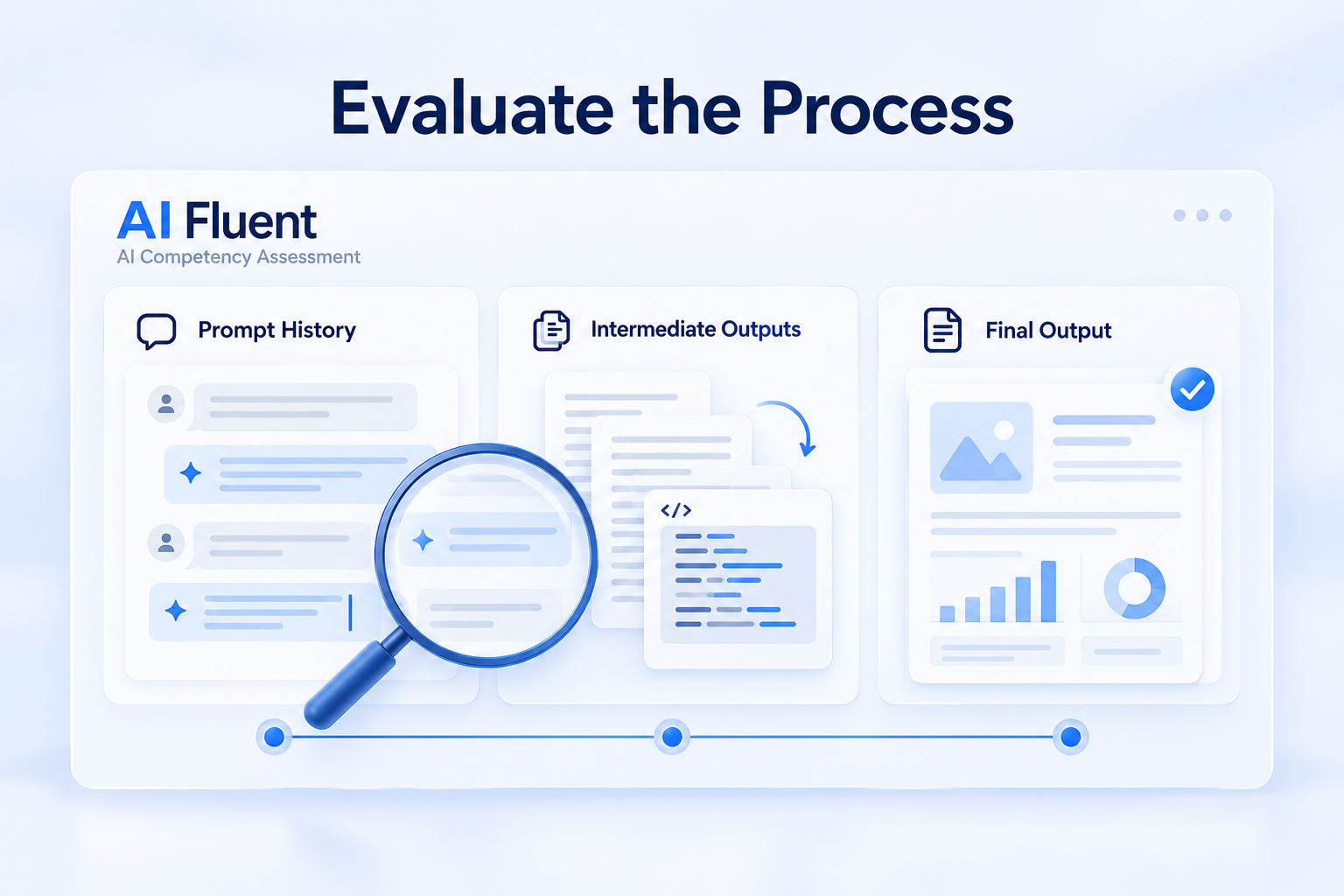
For example, candidates may be asked to use AI to analyze fragmented logs, datasets, and policy documents; independently identify problems and opportunities; define system structures and requirements; and implement validation logic for potential exceptions and failures.
The assessment does not end with the final deliverable.
Prompt histories and intermediate outputs are also included in the evaluation.
The assessment covers six competency areas:
- Workflow Design: How effectively did the candidate break down the problem and structure the sequence of tasks?
- Specification and Context: How clearly did the candidate define the requirements, conditions, and relevant background?
- Agent Design: How effectively did the candidate structure recurring tasks for AI-driven execution?
- Orchestration: How effectively did the candidate combine multiple tools and stages within a single workflow?
- Validation and Iteration: Did the candidate evaluate the output against clearly defined criteria and make appropriate improvements?
- Resource Efficiency: How effectively did the candidate manage time and cost?
Proficiency is assessed across four levels: Entry, Beginner, Intermediate, and Professional.
Separate tracks can also be applied to developers and non-developers within the same organization. In other words, employees are not all evaluated using the same criteria.
But this question extends beyond recruitment.
SK hynix is applying a new evaluation standard to the people it plans to hire. What about those who are already part of the organization? Can companies answer the same questions about their current workforce?
According to Skillsoft’s 2025 Global Skills Intelligence Survey, 91% of HR professionals said employees overestimate their AI capabilities. However, only 18% of organizations regularly measure those capabilities throughout the career development process.
Many organizations have increased their investment in AI training, yet continue to measure success primarily through course completion rates and satisfaction scores.
If an organization changes its hiring process to evaluate candidates based on their “thinking muscles,” it should apply similarly rigorous standards after those candidates join the organization.
SK hynix’s hiring reform is not simply about eliminating an application form.
It represents a broader effort to answer a fundamental question:
How should organizations evaluate people when AI makes individual outputs increasingly difficult to distinguish?
A short interview may reveal how well someone can explain their abilities. A half-day practical assessment—combined with the prompt history behind the final deliverable—can reveal how that person actually approaches and solves a problem.
What cannot be measured cannot be managed.
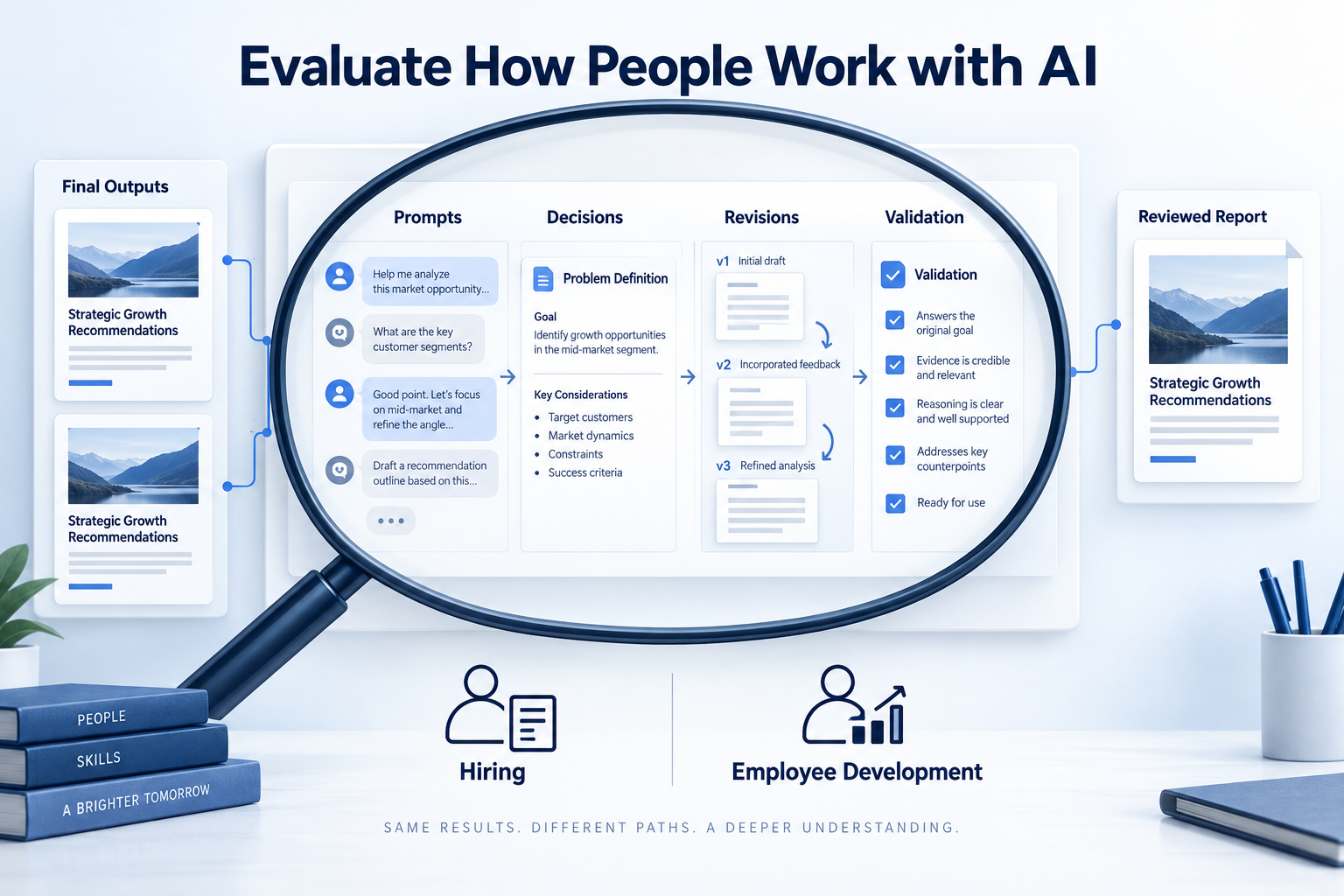
Organizations must therefore evaluate not only the result, but also the process that produced it.
This principle should not be limited to entry-level or experienced-hire recruitment. It also applies to the development and evaluation of existing employees.
The broader question is:
Is your organization evaluating employees’ AI capabilities based only on what they produce or also on how they produce it?
Frequently Asked Questions
How can “thinking muscles” be measured?
Instead of evaluating only the final output, organizations can assess the process used to create it.
Prompt histories and intermediate deliverables can show how a candidate broke down a problem, established evaluation criteria, tested the results, and improved the output. These behaviors can then be evaluated using defined competency indicators.
How can you tell whether an output was created by AI?
It is difficult, and often impossible, to determine this from the final output alone.
In an AI-enabled workplace, the quality gap between candidates’ deliverables may become significantly smaller. For this reason, an effective assessment should consider both the final result and the interaction history showing how the candidate reached it.
The goal is not simply to detect whether AI was used. It is to understand how effectively and responsibly the candidate used it.
What does it mean to evaluate prompt logs?
Evaluating prompt logs means reviewing the interaction history to understand:
- How the candidate broke the requirements into specific tasks
- Whether the candidate anticipated potential failure scenarios
- Whether clear evaluation criteria were established
- Whether the candidate validated the AI-generated output
- Whether problems were identified and appropriate revisions were requested
This makes the candidate’s problem-solving and decision-making process, previously hidden behind the final deliverable, more visible and measurable.
Can AI competency assessments be used for purposes other than recruitment?
Yes. The same approach can be applied to both job candidates and existing employees.
For individuals, the assessment can identify strengths and areas for improvement. For organizations, it can provide insights into AI competency levels across teams and job functions, helping leaders set priorities for future training and workforce development.
This makes it possible to apply a consistent competency framework across both talent acquisition and employee development.
Are different standards used for different job functions?
Yes. Different assessment tracks and evaluation criteria can be applied to developers and non-developers within the same organization.
Proficiency can also be measured across four levels: Entry, Beginner, Intermediate, and Professional, allowing organizations to evaluate individuals according to their role and current level of AI capability.