AI Adoption in Manufacturing: How Leading Companies Scale AX

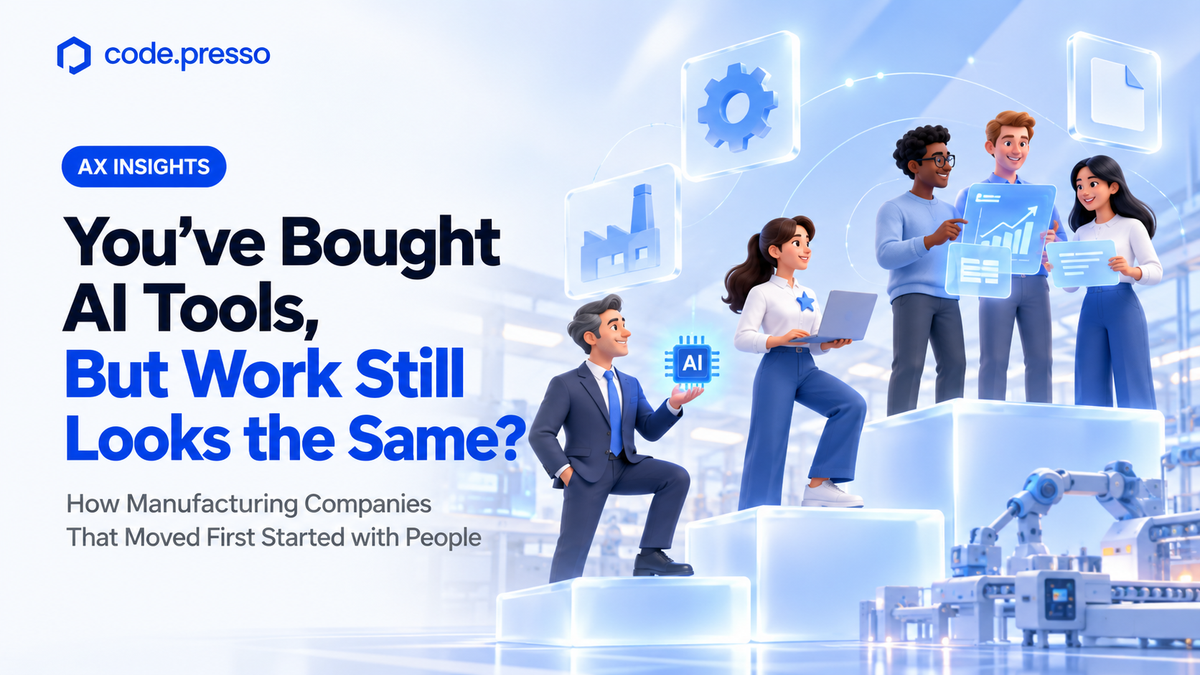
At the Busan Manufacturing AX Roundtable, the companies that had made the most progress all started with people. Their approach can be summarized in three stages: Leadership, Champions, and Scale.
|
One-Minute Summary 💡 |
At the Manufacturing AX Roundtable held in Busan on September 22, the issue manufacturing leaders raised most often was not technology, but people. They spoke repeatedly about employees leaving after being trained, critical know-how existing only in the minds of experienced workers, and ways of working remaining unchanged even after new equipment had been introduced. The companies that had successfully moved ahead shared a clear pattern: the CEO learned first, key practitioners were given the time and authority to experiment, and successful practices were then expanded across the organization. Codepresso CEO Donghoon Lee summarized this process in three stages:
1. Leadership
2. Champions
3. Scale
|
Your company has already subscribed to AI tools and perhaps even run a training session. Yet several months later, meetings are conducted the same way and reports are still produced the same way.
That situation may sound familiar.
The same concerns emerged at the “Busan Manufacturing AX Ecosystem Roundtable with Opinion Leaders,” held in Busan on September 22, 2026. The event was hosted by the AXMOS Alliance in collaboration with the Busan Center for Creative Economy & Innovation, the Busan IT Industry Promotion Agency, and the Busan Venture Business Association. Codepresso CEO Donghoon Lee also participated as a case-study presenter.
This article focuses specifically on what was discussed at the roundtable regarding people and organizational change.
Ha Jung-woo, Executive Vice Chair of the National AI Strategy Committee, delivering a keynote presentation during the first session of the Busan Manufacturing AX Roundtable. Source: Screenshot from Ha Jung-woo TV.
The Most Common Concern at the Roundtable Was “People”
Although the participating companies came from different industries, their concerns were remarkably similar. Comments below have been anonymized by industry.
- Robotic welding equipment company: Welding quality depends heavily on the judgment of experienced workers, yet trained employees often leave the company.
- Seafood processing company: Roughly 30% of employees have been with the company for less than one year, and around 100 employees turn over each year.
- Shipbuilding equipment company: Locally recruited talent tends to leave within about a year.
- Secondary battery materials company: Even under the same conditions and using the same production recipe, results can vary. The company is therefore exploring ways to record experienced workers performing tasks on video and use those recordings for training.
The common problem is clear: much of the company’s competitive advantage exists inside employees’ heads, while those employees may not remain with the organization for long.

When this is combined with previous investments in smart factory equipment that failed to produce noticeable improvements, companies naturally become cautious about adopting yet another new approach.
An Individual Using AI Is Not the Same as a Company Creating Value with AI
A McKinsey survey cited by Donghoon Lee during his presentation illustrates this gap clearly.
According to the survey, 80% of respondents said AI had improved individual productivity, while only 37% said AI use had contributed at least somewhat to company EBIT (McKinsey, The State of AI 2026).
In other words, there is a significant distance between an employee completing tasks faster with AI and an organization actually generating measurable business results from AI.
Lee explained that companies succeeding in closing this gap had invested in changing people and ways of working before focusing on tool adoption alone.
The Companies That Moved First Started with People
During the third session of the roundtable, companies that had already integrated AI into their operations shared their experiences.
Food manufacturer Nuldam explained that CEO Jinhae Soo first learned how to use AI himself and then personally trained employees. The company also organized weekend study sessions to increase employees’ willingness to adopt the technology.
Without major equipment investments or a dedicated development team, the CEO reportedly used AI to build seven internal systems covering areas such as production and HACCP, accounting, HR and payroll, and attendance management.
When the company introduced a new attendance system, it also adjusted the responsibilities and compensation of on-site managers. Wholesale marketplace platform Namdo Market, meanwhile, identified organizational culture as the biggest driver of change.
CEO Seungwoo Yang explained that when two or more employees raise the same operational issue, the problem is added to a shared planning document and moved directly into development.
Both companies had one important characteristic in common: they clearly defined who should move first. The AI tools themselves may have been similar, but the people leading the change, and the time and authority given to them, were different.
Leadership, Champions, Scale: A Three-Stage Approach
In his presentation, Donghoon Lee proposed a three-stage sequence for embedding AI into an organization.
| Stage | Who | What to Do | What Organizations Often Miss |
|---|---|---|---|
| 1. Leadership | CEO or senior leader | Select one of your own tasks and perform it directly with AI for two weeks. | If leaders only receive reports, it is difficult to understand what they should expect from employees. |
| 2. Champion | The person responsible for a task that “stops if this person is absent” | Apply AI to that task and share the results with the team. | Do not simply give someone the title of champion. Give them the time and authority to experiment. |
| 3. Scale | Teams and the broader organization | Extend the champion’s working methods to other tasks and departments. | Work processes must be documented and transferred into systems so that knowledge remains even when employees change. |
One particularly important recommendation was to identify champions by asking: “Which work would stop if this person were not here?”
Those tasks are often where the largest amount of tacit knowledge has accumulated, and where the organization becomes most vulnerable when experienced employees leave.
When a champion uses AI to structure and improve that work, the organization gains both an operational improvement and a reusable record of how the work is performed.
What Stage Is Your Company At?
Check These Four Questions
- Has your CEO or senior leader personally completed at least one real task using AI?
If not, it may be best to begin with Stage 1. - Can you identify the tasks that would stop if a specific employee were absent?
Those tasks, and the people responsible for them, are strong candidates for the champion stage. - Has your champion been given official working time to learn and apply AI?
If AI experimentation is expected to happen only outside normal working hours, it is unlikely to be sustained. - Can successful practices be documented and replicated by other teams?
Scaling requires a clear way to record, share, and reproduce what works.
You can find additional examples of manufacturing companies beginning AX without major equipment investments, as well as policy insights from the event, in the AXMOS blog article, Busan Manufacturing AX Roundtable Insights.
Programs Continuing in Busan
At the roundtable, Codepresso also introduced several free programs being operated together with AXMOS: AX Leaders Insight, AX Lab, and AX Builders.
- AX Leaders Insight: A breakfast seminar for CEOs and senior executives. The first session will be held on October 6, with participating companies receiving separate information.
- AX Lab · AX Builders: Practitioner workshops and in-house business challenge builderthons held in Busan.
If you want to understand the starting level of your organization’s AI champions, one option is to assess them first with AI Fluent.
The results can help determine the direction of training, and a follow-up assessment after training can be used to measure improvement.
You can also see how companies have changed their ways of working through AX Grow in the DRIMAES AX Grow case study.

Frequently Asked Questions
Does the CEO really need to learn AI personally?
The companies presenting at the roundtable all started with their CEOs.
When a CEO spends around two weeks using AI directly on one of their own tasks, it becomes much easier to determine what should reasonably be expected from employees and where the organization needs to allocate time and resources.
Who should be selected as an AI champion?
A strong candidate is the person responsible for a task that would effectively stop if they were absent.
That person understands the work better than anyone else, and the benefits of improving the process are usually immediately visible.
However, simply assigning the title of “champion” is not enough. The person should also be given dedicated time and sufficient authority to learn, experiment, and apply AI.
If trained employees leave the company, doesn’t that make the training ineffective?
This concern was raised repeatedly during the roundtable.
That is precisely why training should be combined with documenting work processes and transferring knowledge into systems.
Even if employees change, the organization can retain decision criteria, workflows, and tools. When knowledge remains with the company, the value of training remains as well.
How can we assess our organization’s current AI capability?
A satisfaction survey alone is not enough.
A more accurate approach is to evaluate how employees actually work with AI in realistic business scenarios.
References
- AXMOS Alliance Secretariat, Busan Manufacturing AX Ecosystem Roundtable Insight Book, based on presentations delivered at the September 22, 2026 roundtable
- McKinsey, “The State of AI: Global Survey 2026,” August 2026
- Seoul Economic Daily, coverage of the partnership agreement between the Busan Center for Creative Economy & Innovation, AXMOS Alliance, and NC AI, September 28, 2026