AI Agent Adoption Guidance

|
Summary
|
Only 11–14% of AI agent pilots make it into production. The remaining 86–89% end at the pilot stage. The primary reason is not poor AI performance, but fragmented governance and unclear accountability. Only 7–8% of organizations have a unified system for managing agents across departments, while just 23% can fully trace what their agents have done. Before adopting AI agents, organizations should evaluate three areas: Do the agents use open standards such as MCP and A2A? Are there activity logs and human approval processes? Can multiple agents be centrally governed and controlled? The practice of designing and managing multiple agents as a coordinated system is known as AI agent orchestration. |
The statistics cited in this article are from FifthRow’s report, “AI Agent Orchestration Goes Enterprise: The April 2026 Playbook,” published on May 4, 2026.
Eight out of ten AI agent initiatives stall for reasons that have little to do with the technology itself. AI models continue to improve every quarter, so why are so few pilots making the transition into real business operations?
An AI agent is software that can independently complete multiple steps and deliver a result when given an instruction such as, “Handle this for me.” Your organization has probably experimented with one already. The challenge is that few of these pilots become part of an organization’s formal operating processes.
Why Do AI Agent Pilots Fail to Reach Production?
According to FifthRow’s research, only 11–14% of AI agent pilots reached the production stage. In other words, more than eight out of every ten initiatives stopped before full deployment. Then, in the following quarter, another team often began a similar pilot from scratch.
Most of the reported causes had little to do with AI performance:
- Fragmented accountability: No one is clearly assigned to manage the agent over time or take responsibility for its actions.
- Lack of governance: There is no organization-wide system for overseeing agents deployed across different departments.
- Legacy systems: Internally developed systems built years ago make integration difficult.
- Integration complexity: Problems arise when connecting agents to other systems.
- Vendor lock-in: Dependence on a specific vendor makes future expansion and migration difficult.
The financial burden is also significant. Building a single agent can cost between $60,000 and $300,000, approximately KRW 80 million to KRW 400 million. Integration and governance infrastructure alone can account for up to 60% of the total budget, with maintenance adding another 20–50%.
In other words, the greatest expense is not making the AI smarter. It is making the AI work reliably within the organization.
Checkpoint 1: Are Your AI Agents Using a Common Language?
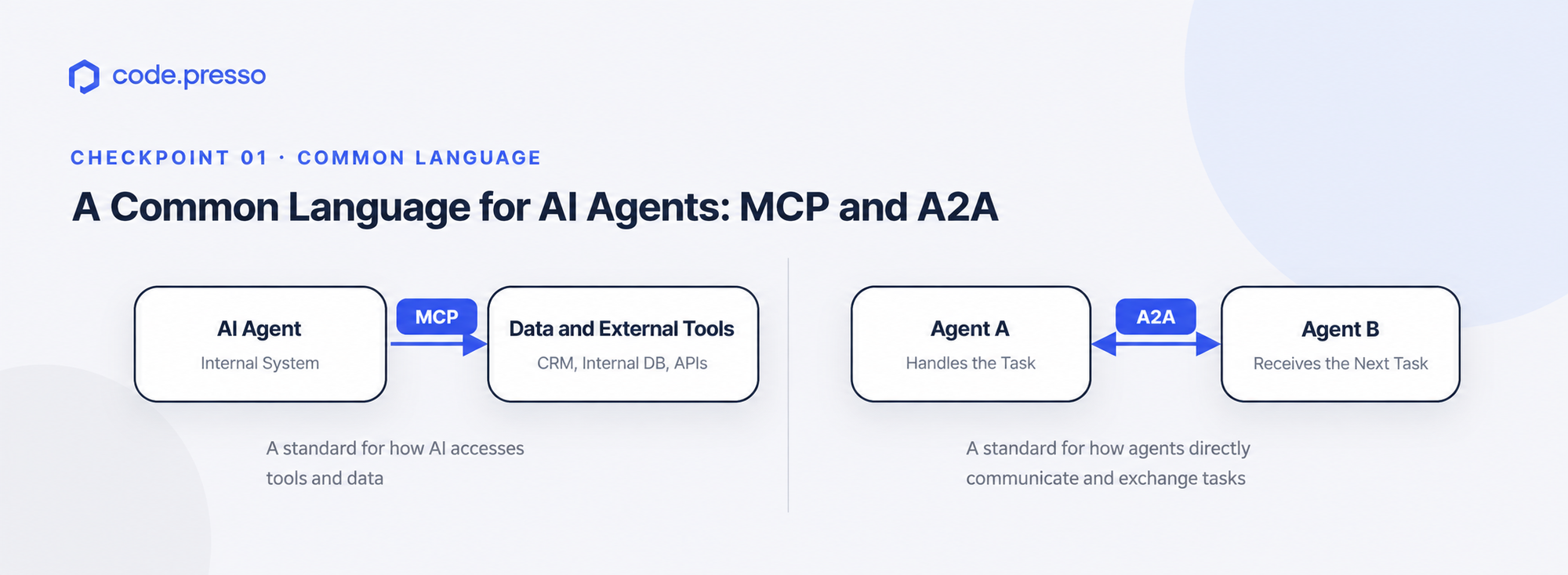
If an agent is built using a proprietary vendor-specific approach, migrating to another system later may require rebuilding everything from the ground up.
The first thing to examine when adopting an AI agent is not its performance, but how it connects to other systems. We can make phone calls across different carriers because they follow common communication standards. Similar standards are now taking shape for AI agents.
MCP (Model Context Protocol) defines how AI systems access external tools and internal data. Originally introduced by Anthropic, it has effectively become an industry standard as OpenAI, Google, Microsoft, and Amazon have moved to support it. MCP has already been implemented across more than 10,000 enterprise servers.
A2A (Agent2Agent Protocol) defines how agents communicate directly and exchange tasks. It is managed by the Linux Foundation and is being used in real-world operations by more than 150 organizations.
These numbers are growing quickly and may already be higher by the time you read this article.
Industry sentiment is also moving in this direction. Eighty-seven percent of IT leaders said that enabling their agents to connect with systems outside their own organizations was a top priority. Another 51% said they would prefer to add open standards on top of their existing vendor systems rather than replace those systems entirely. Meanwhile, 76–81% expressed concerns about vendor lock-in.
Here is one practical question to ask: Does the solution you are considering support MCP or A2A? If not, what will you need to rebuild when you migrate to another product three years from now?
However, it is important to understand what these standards do and what they do not do. Common standards define how agents communicate. They do not determine who monitors those conversations or who is ultimately accountable for the results.
That responsibility must still be defined by the organization. This leads to the second checkpoint.
Checkpoint 2: Can You Trace Who Did What?
Only 23% of organizations can fully trace their agents’ activities.
AI is already spreading across organizations. The sales team deploys one agent, HR introduces another, and the development team builds a third. Each agent may work well on its own, but no one has a complete view of them all.
According to FifthRow, only 7–8% of organizations have a unified system for managing agents distributed across multiple departments. Just 23% can trace the complete process behind an agent’s decisions and actions.
This means that seven or eight out of ten organizations have only partial visibility into what their AI agents are doing.
The risks often become clear only after something goes wrong. If an incorrect quote is sent to a customer and the organization cannot identify where the decision was made or who approved it, determining the cause, and preventing the same mistake from happening again, becomes extremely difficult.
Organizations therefore need two fundamental safeguards:
- Maintain tamper-resistant activity logs. The organization must be able to verify when the agent acted, which data it used, and what decisions it made.
- Define human approval points through a human-in-the-loop process. People cannot review every action. The key is to establish clear thresholds in advance, such as transaction amounts, external communications, or access to personal information.
Regulations are also focusing on these issues. The EU AI Act classifies the use of interconnected agents in areas that can significantly affect people’s lives, such as recruitment and credit assessment, as high-risk. It requires human oversight, tamper-resistant activity logs, pre-deployment testing, and agent identity verification.
The US state of Colorado has also introduced legislation requiring annual risk assessments and consumer disclosures.
Compliance becomes significantly more expensive when it is treated as something to add at the end. Logging methods and human review points should be incorporated during the design stage to avoid costly system redesigns later.
Checkpoint 3: Can You Maintain Central Control as the Number of Agents Grows?
Building one effective agent and coordinating several agents are fundamentally different challenges.
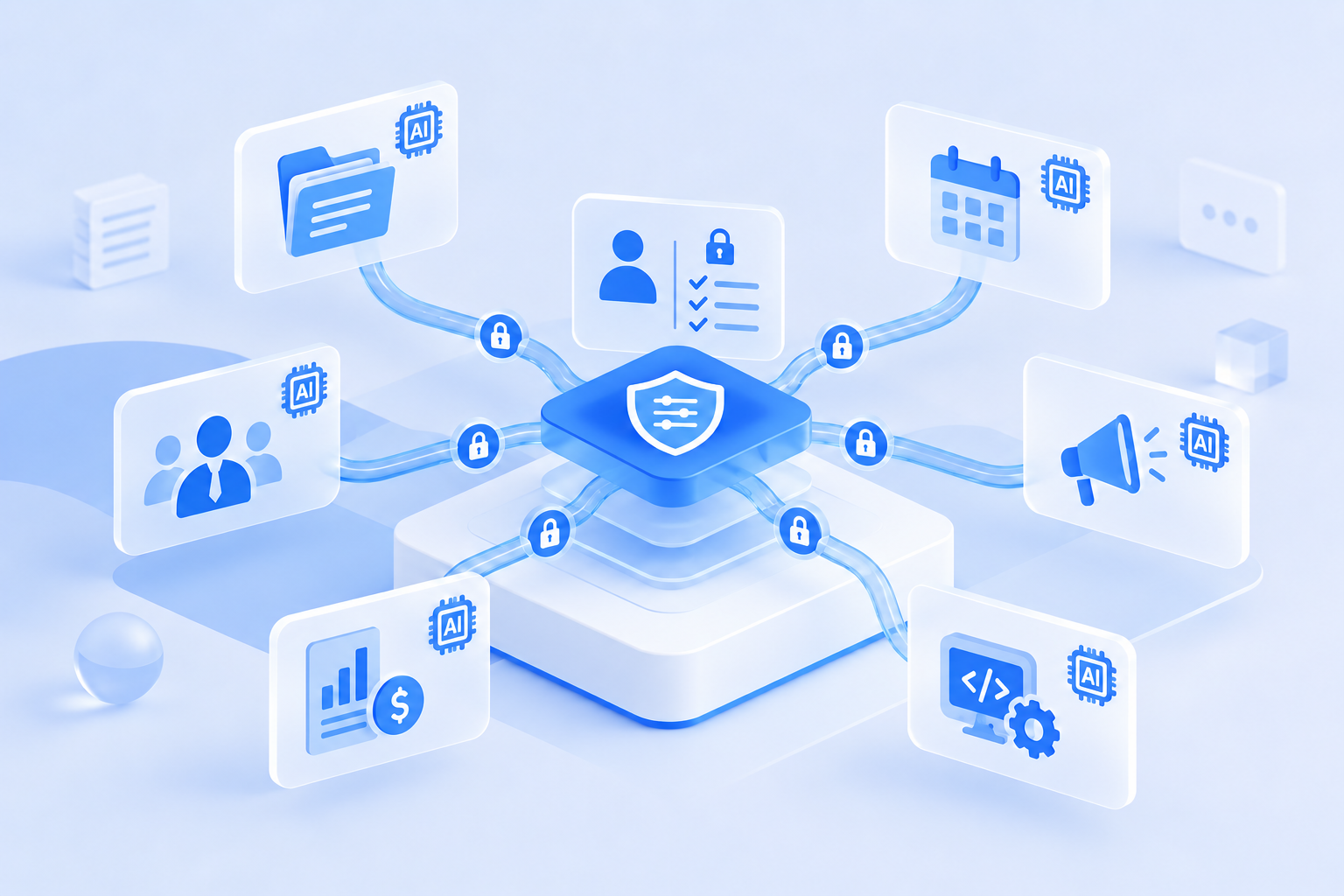
The practice of designing multiple agents to exchange tasks, and managing the entire workflow as one coordinated system, is called AI agent orchestration. Like an orchestra conductor, it assigns each agent a specific role and controls the sequence in which they perform their work.
When an organization uses only one agent, the person responsible can review the result and correct any problems. But the situation becomes more complex when Agent A prepares data, Agent B uses that data to make a decision, and Agent C acts on that decision.
When the final result is incorrect, simply identifying where the error began becomes a major task.
A small error from one agent can pass directly to every agent that follows. In a human organization, this would be like receiving an inaccurate handoff document and passing it to the next department without anyone checking the original information.
At this stage, the organization does not necessarily need a more advanced AI model. It needs clear operating rules:
- Define the scope of work assigned to each agent.
- Establish validation criteria at every handoff between agents.
- Determine who should be notified when an error or unusual situation occurs.
- Measure performance independently instead of relying only on vendor-provided reports. Practical indicators include whether the organization knows exactly how many agents it manages and how many errors have been reported.
What does this mean for the skills employees need?
The focus is shifting from writing effective prompts to safely integrating and managing AI within business systems.
If we reverse the causes of failure outlined above, the required capabilities become clear. Because the primary problems are not related to AI model performance, the solution cannot be limited to teaching employees how to use AI tools.
- Integration capability: Can employees connect AI to internal systems using open standards? This requires more than learning how to operate a particular tool.
- Governance capability: Can employees establish guidelines that prevent AI errors and security incidents? This extends beyond reviewing outputs to designing activity logs, approval points, and permission boundaries.
- Operational integration capability: Can employees embed AI into real business workflows without allowing errors to spread? The goal is not simply to detect and correct errors, but to establish boundaries that prevent those errors from affecting subsequent steps.
These responsibilities do not belong only to developers. Deciding which tasks should be delegated to AI, and where human review is required, depends on the judgment of the people who understand those business processes best.
This is often what separates organizations that remain stuck in the pilot stage from those that successfully move into production.

Frequently Asked Questions (FAQs)
What are the respective roles of MCP and A2A?
MCP is an open standard that defines how AI agents access external tools and data. A2A defines how agents communicate directly and exchange tasks with one another.
Both provide a foundation for connecting systems without becoming dependent on a single vendor’s products.
What should organizations prepare first for AI governance?
Start with activity logs and human approval points.
Organizations should maintain tamper-resistant records showing when an agent acted, which data it used, and what decisions it made. They should also define in advance when human review is mandatory, such as for high-value transactions or external communications.
A centralized structure for overseeing agents across multiple departments is also essential.
What does “human-in-the-loop” mean?
Human-in-the-loop is an approach that introduces human review or approval at critical stages of an AI-driven process.
It does not mean that people must review every task. Instead, it involves placing approval points before decisions that are difficult to reverse, such as contracts, payments, external communications, or the handling of personal information.
It is also one of the safeguards required by the EU AI Act in high-risk use cases.
What skills do employees need in the era of AI agents?
Employees need capabilities that go beyond prompt writing:
- The ability to connect AI to internal systems using open standards
- The ability to establish governance guidelines that prevent errors and security incidents
- The ability to integrate AI safely into real business workflows
Because the people closest to a business process are often best positioned to determine which tasks should be delegated and where human review is required, these capabilities are not limited to developers.
What is AI agent orchestration?
AI agent orchestration is the practice of designing multiple AI agents to exchange tasks and centrally managing the entire workflow.
It is different from building a single high-performing agent. Effective orchestration also requires clearly defined responsibilities, validation criteria at agent handoff points, and escalation paths for errors or unusual situations.