AI Training for Non-Developers: Beyond AI Tool Skills

On October 1, 2026, four organizations, SK AX, SpoAny, LG Chem, and Worksphere, announced AI training programs designed for non-developers and employees across multiple business functions.
They all shared one clear theme: helping employees automate real work with AI without requiring traditional coding skills.
At the same time, a new report from the Korea Information Society Development Institute (KISDI), published on September 30, raised an important concern. According to the report, Korea’s AI literacy policies have focused heavily on technical and functional AI usage skills, while paying less attention to capabilities such as setting the right objective, validating AI-generated results, and deciding what should or should not be delegated to AI.
For HR, L&D, and AI transformation leaders, this creates two important priorities.
First, enterprise AI training should teach employees not only how to use AI, but also what to delegate, what to verify, and where human judgment must remain involved.
Second, organizations need a consistent way to measure employee AI competency before and after training.
Codepresso addresses the second challenge through AI Fluent, an AI competency assessment designed to measure how employees actually work with AI.
|
One-Minute Summary 💡 |
On October 1, 2026, SK AX, SpoAny, LG Chem, and Worksphere announced or highlighted AI training programs for non-developers and employees across different business functions. A common theme across the programs was hands-on AI automation without traditional coding, including AI agents, vibe coding, workflow automation, content creation, and data analysis. However, a KISDI AI Outlook report published on September 30 argued that AI literacy should go beyond functional tool usage. It highlighted three broader capabilities:
Know-what-for
Understanding what AI should be used for
Know-how-to-know
Evaluating information and making better judgments with AI
Know-what-to-delegate
Deciding what to delegate to AI and what humans should retain
For companies, the next stage of AI workforce training is therefore not simply teaching more tools.
It is about combining
AI usage skills with judgment, delegation, validation, and
measurable competency development.
|
What Is Non-Developer AI Training?
Non-developer AI training is enterprise training designed to help employees outside traditional software development roles use generative AI, AI agents, and AI-assisted coding tools to automate or improve their own work.
By the second half of 2026, a clear training model is emerging in South Korea:
Instead of simply explaining AI concepts, companies are increasingly asking employees to build practical AI workflows and AI agents for their own jobs, often without writing traditional code.
This is a meaningful shift. AI education is moving from “understanding AI” toward “using AI to change how work gets done.”
But as enterprise AI adoption matures, another question is becoming just as important: Is knowing how to use an AI tool enough?
Four Non-Developer AI Training Programs Announced on October 1: What Do They Have in Common?
All four programs shared the same fundamental objective: Enable employees who are not professional developers to directly automate or improve their own work using AI.
The main differences were program duration, target participants, training format, and how or whether participant competency was assessed.
| Program | Target Audience | Duration & Format | Main Content | Assessment & Support |
|---|---|---|---|---|
| SK AX “AI Bootcamp Vibe” Launched Oct. 1 | Non-developer roles including HR, planning, marketing, and sales | Four weeks, online platform, dedicated AI mentor | Design and build business AI agents through vibe coding; participants choose problems from their own work | AI-based assignment submission and evaluation, with individual feedback reports |
| SpoAny × Convenzers Held Sept. 17–18 | Headquarters employees across planning, marketing, operations, HR, and other functions | Two days, 3.5 hours per day, morning and afternoon sessions | Department-specific exercises including branch operations inquiries, marketing copy, HR and labor documents, and purchasing records | One-on-one practical guidance from instructors |
| LG Chem × Republic of Korea Army Headquarters Held in September, announced Oct. 1 | Approximately 30 Army Headquarters officers | In-person training at LG Chem Leadership Center in Osan | Data collection, analysis and visualization automation, AI agents, and AI image generation | LG Chem provided instructors, training facilities, and accommodation |
| Worksphere “Workshift” Announced Oct. 1, starting Oct. 12 | SME employees, 45 participants per cohort, 360 total | 12 hours over two weeks, offline evening classes | Four tracks: AI recruitment branding, performance advertising, data-driven business development, and information security | Operated as a Korea Industrial Human Resources Development Corporation-supported training program |
Kim Min-hwan, who leads HRX at SK AX, explained the company’s approach by emphasizing that meaningful AI augmentation occurs when the employees who understand their work best are able to design and build the AI agents they personally need.
Convenzers, which operated the SpoAny program, expressed a similar view: enterprise AI training should move beyond introducing new technologies and instead help employees apply AI directly to their own jobs.
This transition from “AI introduction” to “AI-powered work automation” is clearly a positive development.
However, when the four programs are viewed side by side, one issue stands out. Among these examples, SK AX was the only organization that explicitly described an approach for evaluating participant performance after training. Even then, the assessment is conducted within its own training program.
For most enterprise AI training programs, the most visible success indicators remain: number of participants, completion rates, training hours, or participant satisfaction.
Those metrics tell us whether people attended the training. They do not necessarily tell us whether people became better at working with AI.
Why Does KISDI Say AI Education Has Focused Too Much on “Usage Skills”?
On September 30, 2026, the Korea Information Society Development Institute published KISDI AI Outlook 2026 Vol. 26.
The report, written by Professor Joo-Sung Hwang of the Graduate School of Public Policy and Information Technology at Seoul National University of Science and Technology, examined how AI literacy policy should differ from traditional digital literacy policy.
It argued that Korea’s AI policy has placed relatively strong emphasis on technical and functional AI usage capabilities.
As an alternative, the report proposed a more human-centered model of AI literacy built around three competencies.
| Competency | KISDI Term | Core Question | Country Highlighted |
|---|---|---|---|
| Purpose-oriented competency | know-what-for | What should AI be used for? | Singapore |
| Epistemic competency | know-how-to-know | How can we know, think, and make better judgments together with AI? | Finland, Netherlands, Germany |
| Agency-oriented competency | know-what-to-delegate | What should be delegated to AI, and what should remain under human control? | Canada |
The report also explains that generative AI creates a different type of digital divide. Smartphones and natural-language interfaces have significantly lowered the barrier to accessing AI.
But access does not guarantee capability. According to an analysis of Korea’s 2025 Digital Information Divide Survey cited in an October 2 report by EToday, 71.4% of people who had never used AI could not identify where AI was being applied, compared with 28.1% among AI users.
For enterprise training leaders, however, the most useful part of the KISDI report may be its description of the individual decision-making process when working with AI: Decide what to delegate → Review the AI output → Accept, modify, or reject it → Make the final human judgment → Take responsibility for the outcome
This shifts the goal of AI literacy away from simply asking: “How well can employees use AI?”
toward a more important set of questions: “Can employees use AI effectively, responsibly, independently, and with sound judgment?”
Although the report was written from a public-policy perspective, the same framework can be applied directly to enterprise AI training curriculum design.
How Can Companies Add “AI Judgment Skills” to Their Training Curriculum?
Companies do not need to remove practical tool training. Employees should still learn prompting, generative AI tools, vibe coding, workflow automation, and AI agent development.
The more practical approach is to add a decision-making layer to every exercise. Instead of stopping once employees generate an output, ask them to also:
- decide what should be delegated,
- define how the output will be validated,
- establish where human approval is required,
- and determine who remains responsible for the final result.
That is the difference between AI usage training and AI judgment training.
| Area | AI Usage Training | AI Judgment & Delegation Training |
|---|---|---|
| Goal | Create outputs using AI tools | Decide what AI should and should not do |
| Typical exercises | Prompt writing, AI agent creation, document and report automation | Breaking work into tasks, defining completion criteria, adding approval points before irreversible actions, defining validation criteria |
| What strong performers do | Produce the desired output quickly | Identify what should not be delegated and detect unreliable or incorrect outputs |
| How to evaluate it | Whether the final output was completed | AI interaction process, intermediate outputs, revisions, validation decisions |
| What remains after training | A number of automated tasks | Department-level AI delegation standards and approval rules |
At Codepresso, we describe this capability as AI delegation competency. It closely aligns with KISDI’s concept of know-what-to-delegate.
We observed the same issue while delivering the AX Grow program for the Seoul Center for Creative Economy and Innovation. Most participating employees were already familiar with generative AI.
However, knowing how to use a chatbot did not automatically mean they knew how to delegate work to AI effectively. Using AI and delegating work to AI are related but they are not the same competency.
A practical way to introduce this concept into an existing AI training program is to add three questions at the end of every exercise:
- Which parts of this task should not be delegated to AI?
- How will you verify that the AI-generated result is correct?
- Who is ultimately responsible for the final decision or outcome?
Simply requiring participants to answer these questions transforms a tool exercise into AI judgment and delegation training.
How Can Companies Measure AI Training Effectiveness?
The basic principle is straightforward: Measure competency before training, and measure it again afterward using the same evaluation framework. Completion rates and satisfaction surveys are useful, but they answer different questions.
A completion rate tells you: “Did the employee finish the program?”
A satisfaction survey tells you: “Did the employee like the program?”
Neither one proves: “Can the employee now work with AI more effectively?”
To measure actual capability improvement, companies need to assess participants using realistic work scenarios before and after training. A practical framework has four stages.
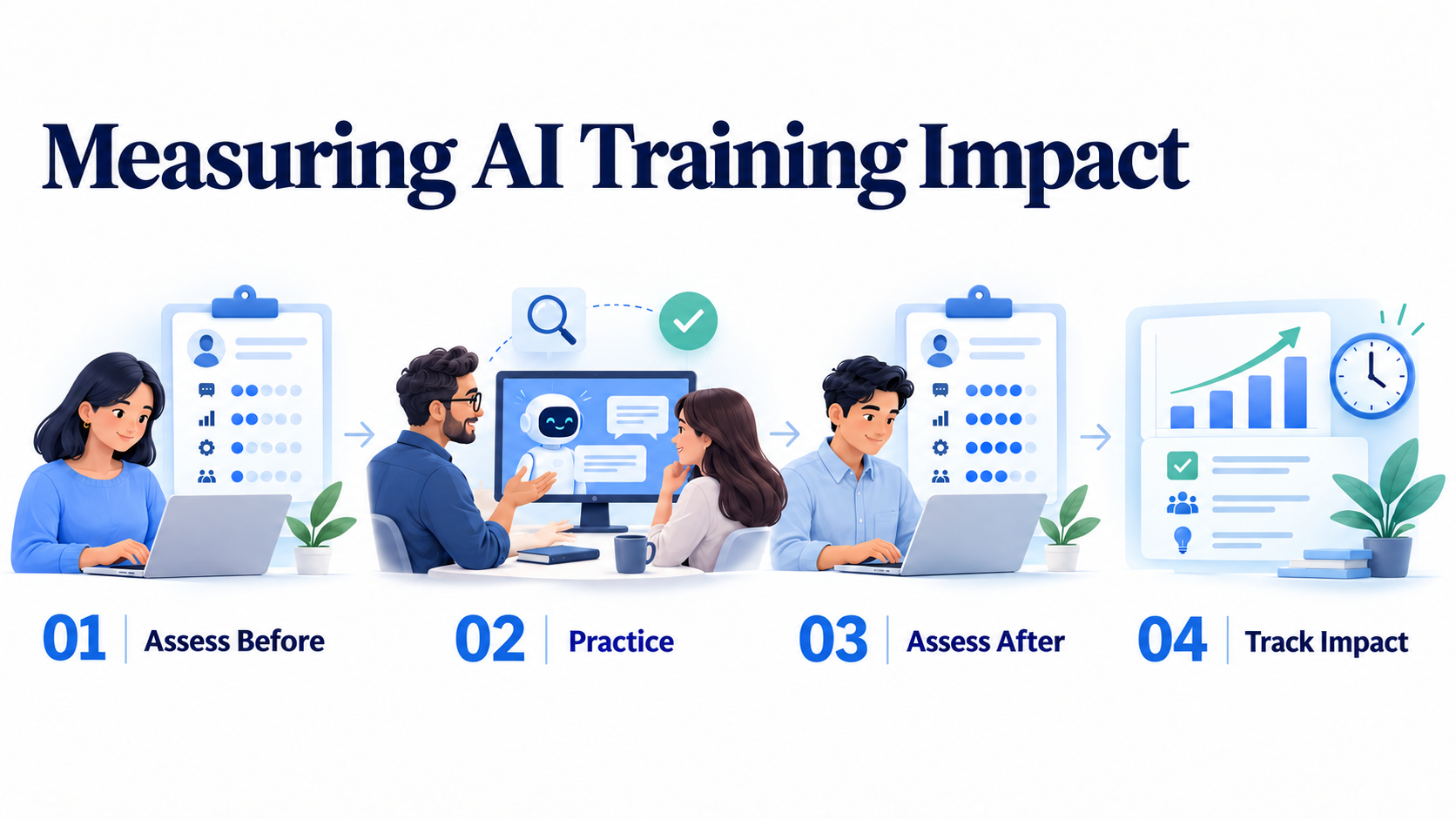
1. Conduct a Pre-Training AI Competency Assessment
Evaluate how employees currently work with AI in realistic business scenarios.
This creates a baseline. Without a pre-training baseline, it is difficult to prove how much competency improved after the program.
2. Deliver AI Training and Hands-On Practice
Continue teaching practical AI usage, but add judgment-related steps such as: delegation boundaries, validation criteria, approval points, and responsibility.
3. Conduct a Post-Training Assessment
Measure participants again using the same competency model.
Questions may differ by job function, but the scoring framework should remain consistent across the organization so that HR and L&D teams can compare competency levels between departments.
4. Track Business Impact
Thirty or ninety days later, measure operational changes such as: task completion time, number of tasks completed, rework rates, error rates, or productivity improvements.
| Measurement Area | Example Metric | How to Measure |
|---|---|---|
| Competency improvement | Change in pre- and post-training competency level | Score participants against the same competency model and track level movement |
| Training quality | Prompt, intermediate-output, and final-output scores | Evaluate both the final result and the process used to work with AI |
| AI judgment competency | Ability to define delegation and validation criteria | Check whether participants identify tasks that should remain human-controlled and define how AI outputs will be verified |
| Business impact | Processing time, output volume, rework rate | Compare the same workflows during the four weeks before and after training |
Measuring AI Skills Before and After Training with AI Fluent
Codepresso’s AI Fluent supports the first and third stages of this process: pre-training and post-training AI competency assessment.
Rather than evaluating only the final output, AI Fluent can assess multiple parts of the employee’s AI work process, including: prompt history, intermediate outputs, and final results.
Assessment scenarios vary by job function, including: marketing, HR, management and administration, customer service, R&D, and other business functions.
However, the underlying scoring framework remains consistent across the organization.
This allows companies to compare AI competency between teams and departments. AI Fluent results are organized into four competency levels: Entry → Beginner → Intermediate → Professional
Among the seven currently available assessment tracks, both AI Vibe Coding for Work Productivity and AI Agent-Based Work Productivity can be taken by employees from both developer and non-developer roles.
The Next Stage of Enterprise AI Training Is Not “More Tools”
The next stage of AI training for non-developers should not simply involve teaching employees more AI tools.
Companies increasingly need a continuous capability-development cycle: Assess → Train → Reassess → Improve
The four AI training programs announced on October 1 demonstrate how quickly enterprise AI education is moving toward practical workflow automation.
The next challenge is making those programs measurable. When training, assessment, and business outcomes are connected, HR and L&D teams can move beyond year-end reporting such as:
“500 employees completed AI training.”
Instead, they can report:
“AI competency in the marketing team increased from Beginner to Intermediate, while the operations team improved its delegation and validation scores by X%.”
That is a much stronger foundation for enterprise AI transformation.
Frequently Asked Questions
What Is AI Training for Non-Developers?
AI training for non-developers is corporate training designed to help employees outside traditional software development roles use generative AI, AI agents, and AI-assisted coding tools to automate and improve their work.
As of October 2026, programs from organizations such as SK AX, Convenzers, and Worksphere increasingly focus on vibe coding, department-specific AI projects, and no-code or low-code AI agent development.
Is Vibe Coding Training Enough to Build AI Competency?
Not by itself.
Vibe coding can improve employees’ ability to create outputs and automate work with AI, but companies should also develop capabilities such as defining the purpose of AI use, validating AI-generated results, deciding what should be delegated, and maintaining human accountability.
One practical approach is to add three questions to every AI exercise:
- What should not be delegated?
- How will the output be validated?
- Who owns the final decision?
How Should Companies Measure AI Skills Before and After Training?
Employees should complete realistic work scenarios in which both their AI interaction process and final output are evaluated.
Codepresso AI Fluent assesses prompt history, intermediate outputs, and final results, and reports competency across four levels: Entry, Beginner, Intermediate, and Professional.
Using the same competency framework before and after training makes it possible to measure improvement consistently.
How Can My Company Design AI Training and Competency Assessments?
If your organization is planning enterprise AI training and wants to measure employee capability before and after the program, contact Codepresso at sales@codepresso.kr.
References
- Hwang, Joo-Sung, “How Should AI Literacy Policy Differ from Digital Literacy Policy? Recommendations for a Human-Centered AI Literacy Policy,” KISDI AI Outlook 2026 Vol. 26, September 30, 2026
- EToday, “Teaching People How to Use AI Is Not Enough: Korea’s AI Education Focuses Too Heavily on Usage Skills,” October 2, 2026
- Bloter, “SK AX Launches ‘Bootcamp Vibe,’ Enabling Non-Developers to Build AI Agents,” October 1, 2026
- SK AX, AI Talent Lab
- Korea Youth Daily, “SpoAny Conducts Practical AI Training Across All Job Functions with Convenzers,” October 1, 2026
- Asia Economy, “LG Chem Provides Generative AI Training for Army Officers,” October 1, 2026
- Electronic Times, “Worksphere Launches AI Competency Training for SME Employees,” October 1, 2026