Do Employees Who Use AI Daily Still Need Training?

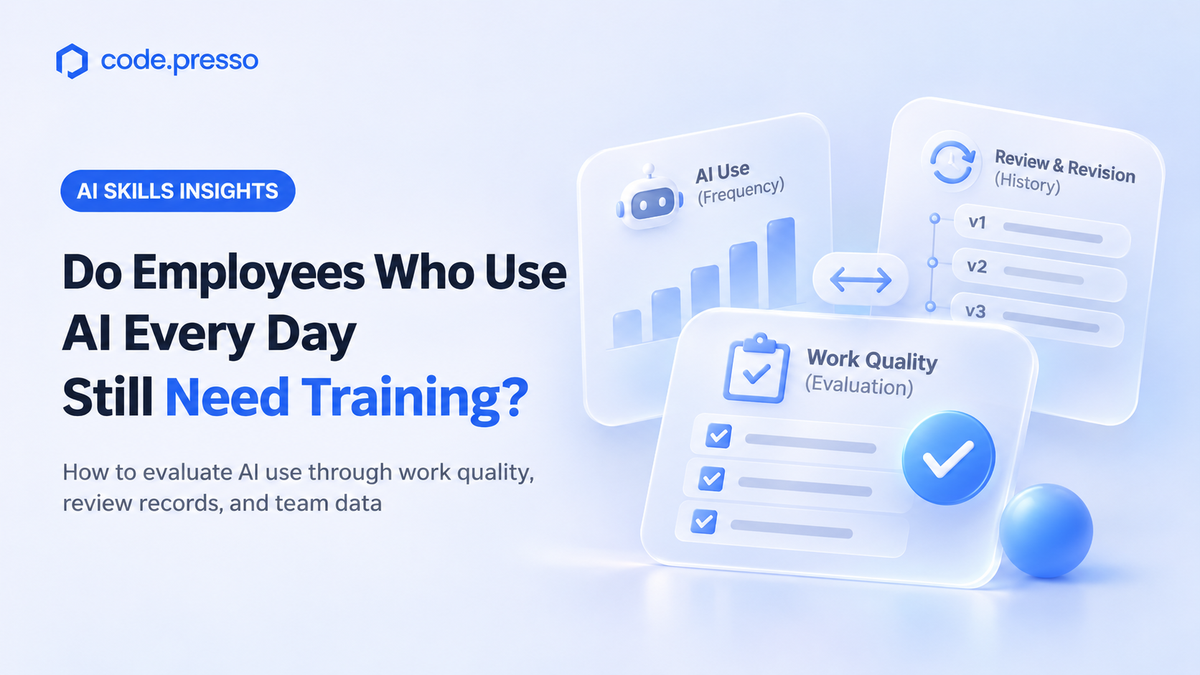
Using AI every day doesn't necessarily mean using it effectively at work. Learn how to evaluate employees' AI competency through real-world work outputs, review processes, and organizational data, and determine where additional AI training is needed.
💡 Key Takeaways: A 1-Minute Summary
Using AI frequently and using AI effectively are two different things. Frequency tells us how often employees use AI, while performance tells us whether they can produce reliable, work-ready results.
To determine actual training needs, organizations should look beyond self-assessments and examine employees' work outputs, review and revision records, and organizational data.
Together, these insights help identify which employees need additional support and which AI skills should be prioritized.
Before designing a training program, use Codepresso's AI Training Readiness Checklist to determine whether your organization has clearly defined how it will assess employees' current AI proficiency levels.
"Our employees already use AI every day. Do we really need to invest in more training?"
It's a question HR and Learning & Development (L&D) professionals frequently hear from business leaders during annual training planning. The answer is that daily AI usage alone is not enough to determine whether employees need additional training.
Usage frequency tells us how often employees interact with AI tools. It doesn't tell us whether they can use those tools to complete their work accurately, effectively, and reliably. To understand that, we need to look at the quality of their actual work.
In this article, we'll explore the difference between AI usage frequency and practical AI competency, examine the work outputs and organizational data L&D teams should review after self-assessments, and outline a structured approach to determining AI training needs.
1. Using AI Every Day Is Not the Same as Using It Effectively
As AI becomes increasingly common in the workplace, the gap between employees is shifting.
The question is no longer simply whether employees use AI, but how effectively they use it.
According to an August 2026 Yonhap News Agency report on a Public First survey of 1,057 South Korean adults, 74% of respondents expressed interest in training to improve their AI skills.
The report also highlighted findings suggesting that learning advanced prompting techniques, providing AI with clearer goals, context, and instructions, could reduce working time by approximately one-third compared with using basic prompts.
These findings suggest that even in markets where AI adoption is widespread, learning how to use AI effectively remains an important challenge.
AI Usage Frequency vs. Practical AI Competency
| Category | AI Usage Frequency | Practical AI Competency |
|---|---|---|
| Key question | How often do employees use AI, and which tools do they use? | Can employees produce AI-assisted outputs that are reliable and ready for actual business use? |
| Assessment methods | Surveys, self-assessments, usage logs | Actual work outputs, review and revision records, practical assessments |
| What it reveals | How widely AI tools have been adopted | Where employees struggle and which skills they need to develop |
| Common limitations | Frequent use may occur without proper validation | Requires predefined evaluation criteria and additional assessment time |
Codepresso's AI Training Readiness Checklist reinforces this distinction:
"AI usage frequency alone is not enough to determine employees' AI proficiency. Organizations should also evaluate their ability to review AI-generated outputs and adapt them to real business needs."
2. Two Employees Can Use AI Every Day, and Produce Very Different Results
Consider a hypothetical scenario involving two sales employees who use AI to prepare weekly performance reports every Monday. Both employees indicate in a survey that they use AI daily. However, their approaches to the same task are very different.
Employee A: Uses AI Frequently but Rarely Verifies the Results
Employee A uploads the previous week's sales data and enters a simple prompt: "Turn this into a report."
The employee then submits the AI-generated draft to the team manager without reviewing the figures. On one occasion, the submitted report includes outdated figures from the previous month.
Employee B: Uses AI with Clear Instructions and Validation
Employee B starts by defining the report's audience (the team manager), the comparison period (week-over-week), and the required information (changes among major customers). After generating the draft, the employee checks the totals and reporting dates against the original data. Any incorrect figures are corrected before the report is submitted.
Same Usage Frequency, Different Training Needs
A usage-frequency survey would classify these two employees at the same level. But their actual work outputs reveal different development needs. Employee A would benefit from training in structured prompting and output verification.
Employee B, on the other hand, may be ready to learn how to standardize the reporting process into a reusable workflow that the entire team can follow.
Providing both employees with identical training could result in a program that is too advanced for one and unnecessarily repetitive for the other.
Effective AI training should be based on what employees can actually do, not simply how often they use AI.
3. Three Things to Review After an AI Self-Assessment
Self-assessments are a useful starting point. They help employees reflect on their AI usage habits and provide organizations with an initial picture of adoption across the workforce. However, self-assessment results reflect employees' own perceptions of their capabilities.
To make informed decisions about training participants and curriculum design, L&D professionals should examine additional evidence.
Three Sources of Evidence for AI Training Needs
| What to Review | Where to Find It | What It Reveals |
|---|---|---|
| 1. Actual work outputs | AI-generated report drafts, customer communications, meeting notes, and other deliverables | Whether outputs are ready for business use and which errors occur repeatedly |
| 2. Review and revision records | Document revision histories, manager feedback, rejected submissions, and correction requests | Who validates the work, when reviews take place, and where corrections are needed |
| 3. Organizational data | AI usage by department and job role, approved AI tools, internal usage policies, and previous training records | Which roles and tasks should be prioritized and whether training aligns with existing workplace tools |
Organizations do not need to collect all three types of evidence before getting started.
Even reviewing a small sample of work outputs and manager feedback from a single department can reveal important training needs.
For example, it may become clear that employees do not need training on how to use AI more frequently.
Instead, they may need training on how to review AI-generated content, identify errors, and improve the quality of their work.
4. How to Determine Whether Employees Need AI Training
There are three common approaches to identifying corporate AI training needs.
No single approach is universally correct. The most appropriate method depends on your organization's goals and level of AI adoption.
Comparing Three AI Training Approaches
| Approach | Decision Criteria | Best Suited For | Limitations |
|---|---|---|---|
| Organization-wide training | All employees complete the same foundational curriculum | Organizations introducing AI or establishing shared usage guidelines and basic knowledge | Employees with advanced skills may find the content repetitive |
| Usage-based training | Employees who use AI less frequently receive training first | Organizations focused on increasing AI adoption | May overlook frequent users who fail to validate AI-generated outputs |
| Performance-based training | Training content is determined by actual work outputs and review processes | Organizations with widespread AI adoption seeking to improve quality and workplace application | Requires practical tasks and evaluation criteria to be defined in advance |
For organizations where employees already use AI every day, the third approach, performance-based training, is often the most relevant.
It shifts the focus from encouraging AI adoption to improving how employees apply AI in their work.
A Four-Step Framework for Identifying AI Training Needs
Step 1. Define Your Training Objectives
Start by clarifying what your organization wants to achieve.
Is the goal to increase AI adoption, improve the quality of AI-assisted work, or automate a specific business process?
Different objectives require different training strategies.
Step 2. Assess Current AI Competency Levels
Use self-assessments to understand the general distribution of AI usage and confidence across employees.
Then review representative work outputs and revision records to identify specific performance gaps.
Step 3. Match Training Content to Identified Skill Gaps
Design learning activities around the capabilities employees need to improve.
For example:
- Structured prompting for employees who struggle to communicate requirements clearly
- Output verification for employees who submit inaccurate or unsupported results
- Workflow standardization for employees who are ready to turn individual AI practices into repeatable team processes
Step 4. Reassess Using the Same Evaluation Criteria
After training, evaluate employees using the same criteria applied before the program.
Consistent evaluation standards make it possible to compare results and determine whether employees' practical AI capabilities have improved.
5. Why Codepresso Evaluates AI Workflows, Not Just Usage Frequency
At Codepresso, we believe organizations should evaluate more than how much employees know about AI.
What matters is how effectively they can apply AI to real business tasks.
That's why Codepresso AI Fluent, our generative AI competency assessment service, evaluates both the process and results of employees completing job-specific tasks with AI.
The assessment combines AI-powered automated scoring with expert validation to evaluate practical performance across four core competency areas:
- Problem Definition: Identifying and clearly defining the business problem to be solved
- Prompt Design: Creating effective instructions to guide AI toward the desired outcome
- Workflow and AI Agent Utilization: Applying AI tools, workflows, and agents to perform business tasks
- Output Validation: Reviewing and verifying AI-generated results for accuracy and business relevance
Employees are assessed using a consistent four-level proficiency framework, regardless of their job function: Entry → Beginner → Intermediate → Professional
Assessment features and proficiency framework are based on Codepresso's website as of October 2026.
From Self-Assessment to Practical AI Competency Assessment
Not every organization needs the same level of assessment.
For individuals, a brief three-minute self-assessment can provide a quick opportunity to reflect on everyday AI usage habits.
For organizations, a more comprehensive assessment based on job-specific practical tasks can provide deeper insight into employees' actual capabilities.
This distinction represents the next step beyond self-assessment.
By evaluating employees before training and reassessing them afterward using consistent criteria, organizations can make more meaningful comparisons of skill development.
For more information on selecting the right assessment approach, read our guide: How to Choose an AI Competency Assessment Service.
Not Ready for a Full Assessment? Start with Your AI Training Plan
If your organization is still in the early stages of planning its AI training strategy, you can begin by identifying which planning decisions have already been made and which still need attention.
Codepresso's AI Training Readiness Checklist provides a structured way to review your organization's preparation across six areas:
- Training objectives and scope
- Target participants and training format
- Current AI proficiency levels
- Training curriculum design
- Training evaluation and reporting
- Training budget and timeline
The online checklist includes 18 questions and provides a results summary outlining your current planning readiness.
Importantly, this tool is not designed to measure employees' AI competency or training effectiveness.
Its purpose is to help training managers identify gaps in their planning process, clarify outstanding decisions, and determine which internal stakeholders need to be involved before finalizing a program.

Related Articles
- South Koreans Use AI 1.7 Times More Than the Global Average. How Do Your AI Skills Compare?
- Planning AI Training for 2027? Where Should You Start?
Frequently Asked Questions (FAQ)
Q1. If most employees use AI every day, can we reduce our AI training budget?
Daily AI usage alone is not enough to determine whether training investments should be reduced.
Start by reviewing a sample of actual work outputs to determine whether they meet business requirements and identify where validation and revisions are taking place.
Depending on the findings, your organization may be able to reduce foundational training and focus its budget on more targeted capabilities, such as output verification or workflow standardization.
Q2. Can we segment employees for AI training based only on self-assessment results?
Self-assessments are helpful for understanding general trends in employees' AI usage and perceived proficiency.
However, because they rely on self-reported information, they should not be the sole basis for determining training groups or curriculum requirements.
For more reliable decisions, combine self-assessment results with practical evidence, such as actual work outputs, performance-based tasks, or records of how employees review and refine AI-generated content.
Q3. Can the AI Training Readiness Checklist evaluate employees' AI competency?
No.
The AI Training Readiness Checklist is designed to assess how prepared an organization is to plan and implement AI training.
It does not measure employees' actual AI skills or the effectiveness of training programs.
To evaluate practical AI competency, organizations need a separate performance-based assessment that examines how employees complete job-specific tasks, including their work processes and final outputs.
References
- The Korea Times / Yonhap News Agency, "Koreans' level of AI utilization 1.7 times the global average: report," August 27, 2026. Read the article
- Codepresso, AI Fluent official website, accessed October 19, 2026. Learn about AI Fluent
- Codepresso, AI Training Readiness Checklist, accessed October 19, 2026. View the checklist
Editorial note: The sales team scenario presented in this article is hypothetical and intended for illustrative purposes only. It does not represent an actual client case study or measured assessment results.